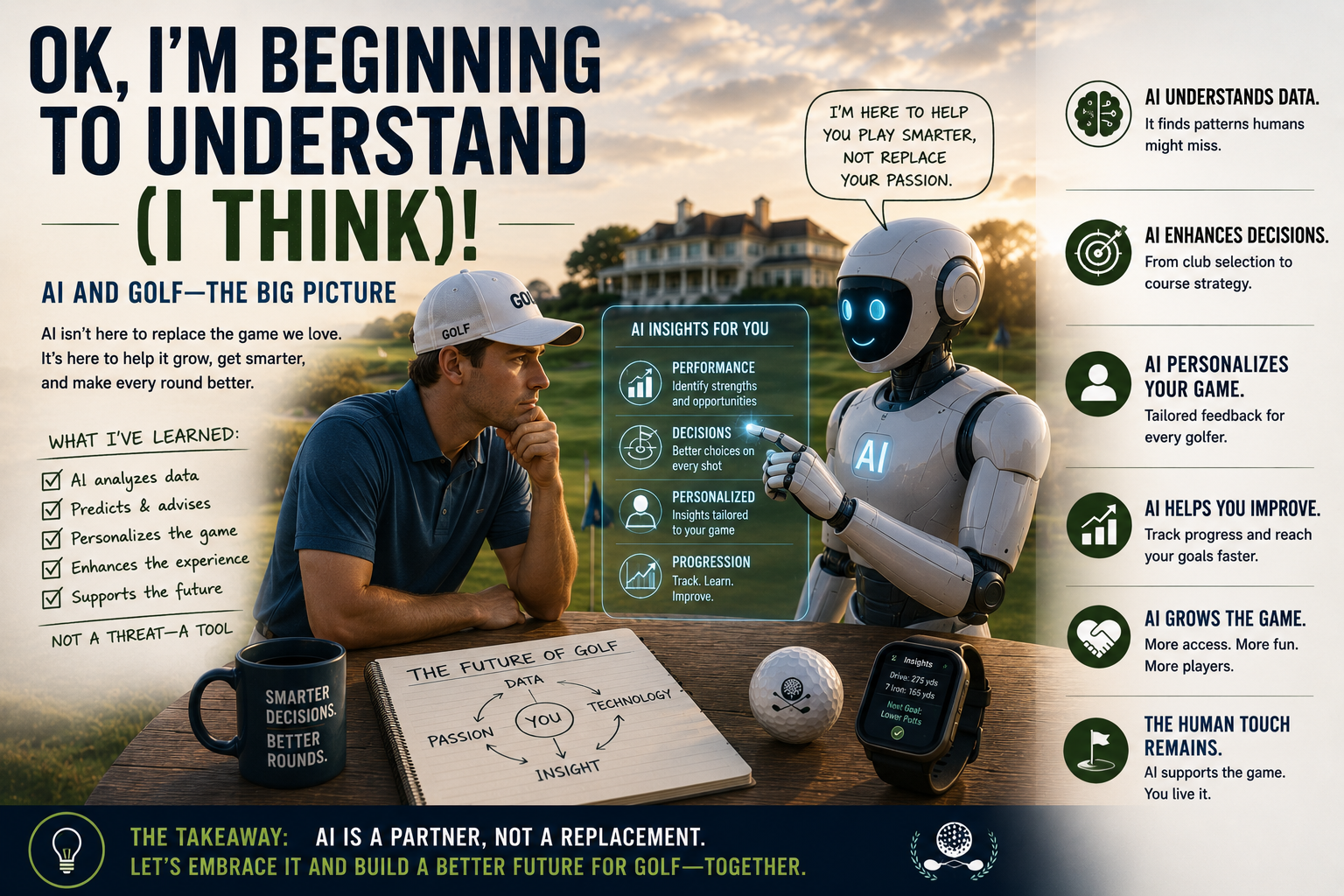
S: I’m momentarily interrupting my pause (It’s already by us…) to offer a golf analogy that might illuminate AI’s impact in more tangible terms. Imagine golf clubs and balls being reinvented, enabling golfers to drive a ball 1,000 yards, precisely hit the center of greens from 500 yards away, and guarantee a one-putt on every hole. In addition, picture a world where governing bodies like the USGA or local golf courses are powerless to prohibit this game-changing equipment. Such advancements would not only render traditional golf courses obsolete but also alter the very soul of the game. Similarly, AI’s meteoric rise and adoption are reshaping our world in dramatic ways. Yet, unlike the hypothetical golf scenario, the transformation driven by AI is not a mere thought experiment—it’s our reality.
_____________________________________
S: I’ve read most of Yuval Noah Harari’s stuff, and though I don’t mirror many of his thoughts, what he is saying is very much worth listening to-
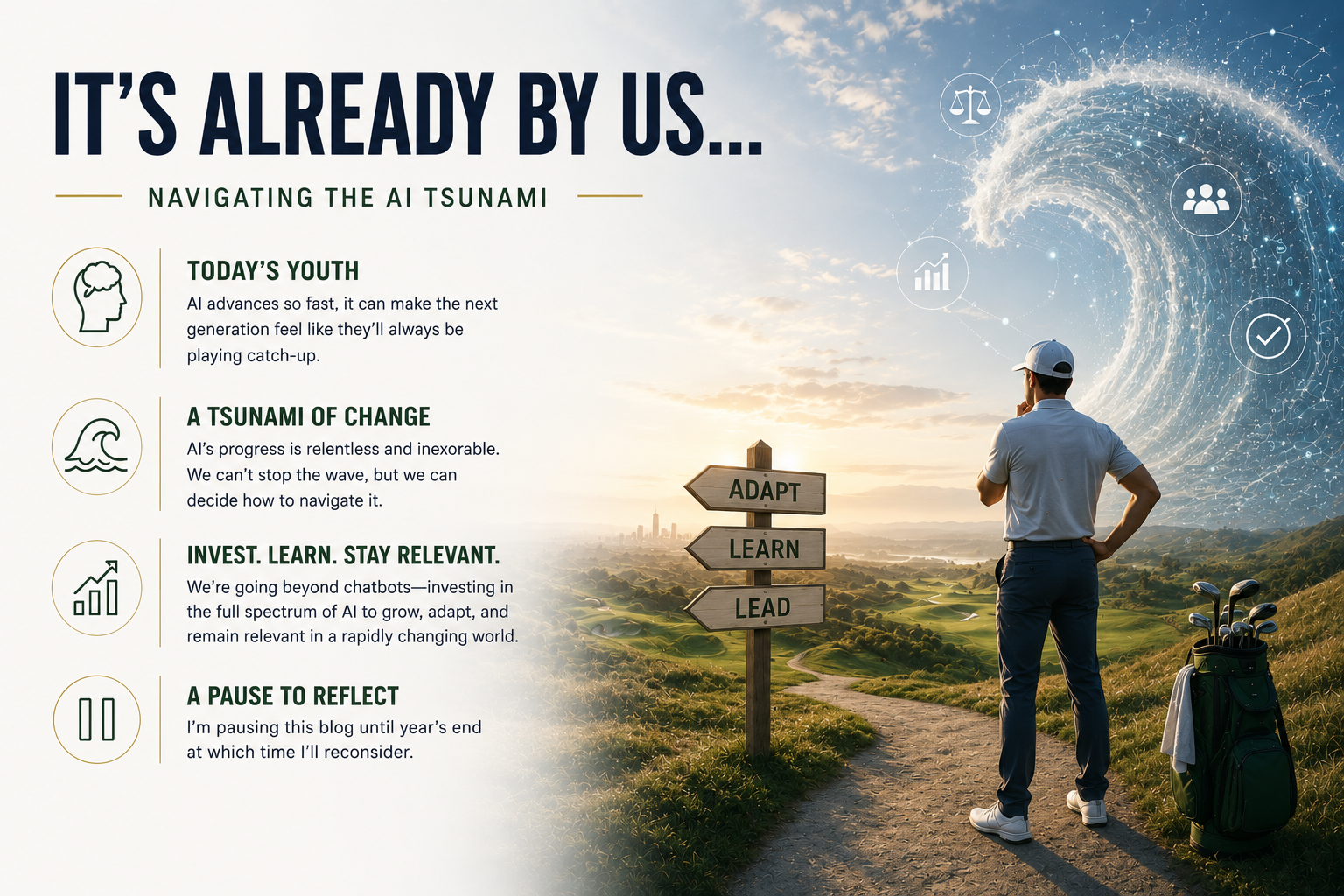
S: When choosing topics for this blog, my thoughts invariably drift to today’s youth. The swift advancement of AI may instill in them the belief that they can’t aspire to be the best or the brightest, as AI will always be a step ahead. It’s disheartening to think they could forever feel like runners-up in a contest they never chose to join.
Let’s face it: AI’s progress is surging with the velocity and might of a tsunami, its onward thrust relentless, inexorable. In light of this, I’ve opted to do more than engage chatbots as a tool for education. Instead, I decided to invest in the full spectrum of AI’s capabilities—including chatbots and machine learning—to propel my business forward. This not only allows me to learn firsthand but also, and perhaps more crucially, to remain relevant until the surging wave of AI reshapes our industry and renders most of us obsolete.
As a result, I’m pausing this blog until year’s end at which time I’ll reconsider.
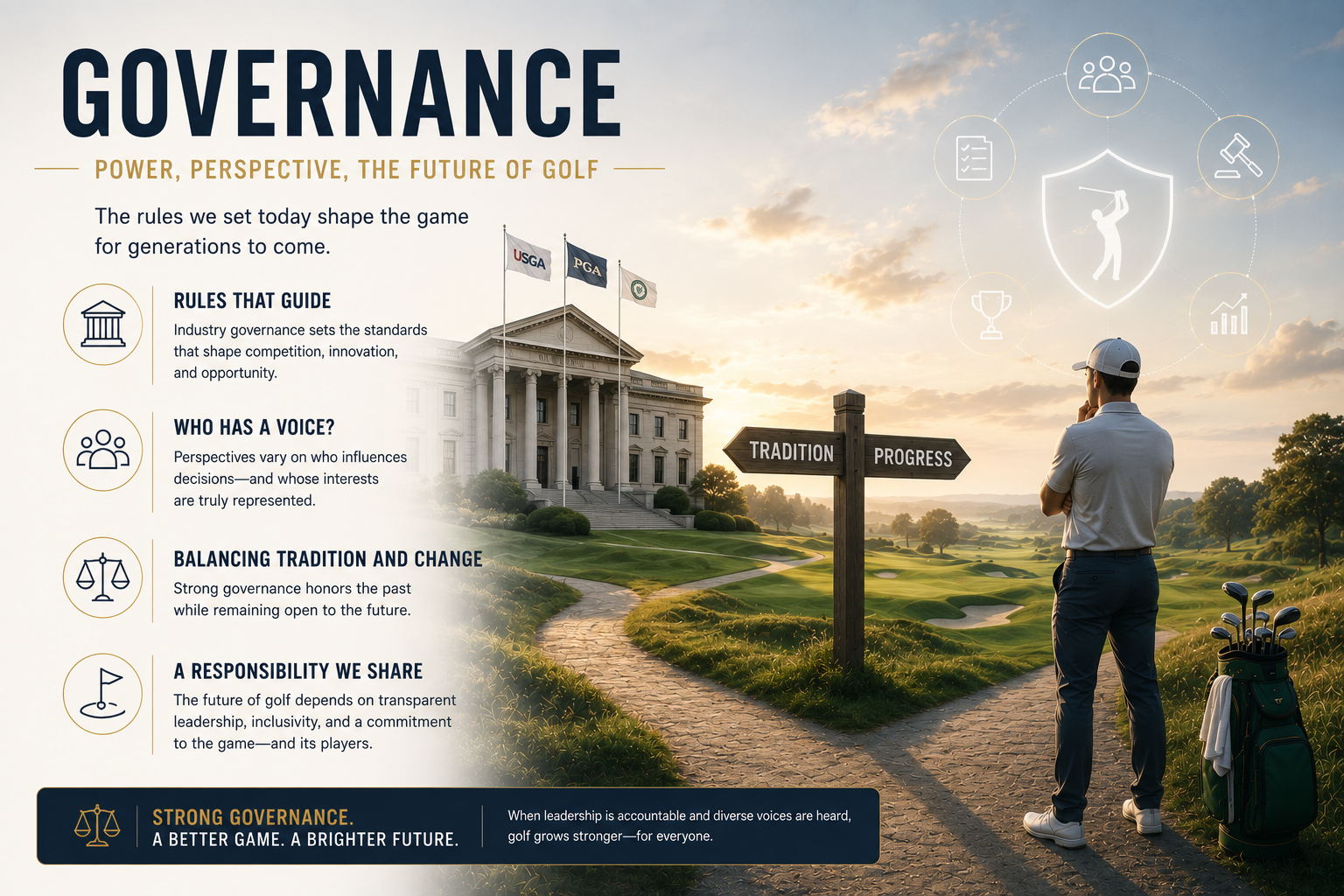
S: Industry governance can be described as the set of rules and standards that businesses within a specific field must adhere to. Such rules influence factors like the ease of starting a business, competition dynamics, compliance costs, and avenues for innovation. This holds true in the golf industry, which I often refer to as the ‘Golf Empire.’ Personally, I feel that the governance of golf largely mirrors a plutocracy. To delve deeper into this perspective, I consulted both ChatGPT and Bard and shared their opinions with each other, and their insights were illuminating.
What surprised me wasn’t their opinions as much as how they were able to influence each other. Apart from the subject matter, I found this to be both fascinating and concerning.
I invite you to review and form your own opinion.
S: In the United States could the governance of golf be best described as a plutocracy?
ChatGPT: In the United States, the governance of golf cannot be best described as a plutocracy. Plutocracy refers to a system of governance where the wealthy elite hold significant power and influence over the decision-making processes. While there may be instances where individuals with significant wealth or influence exert some control or influence over golf-related organizations or events, the overall governance structure of golf in the United States involves various stakeholders and democratic principles.
Golf in the United States operates through governing bodies, such as the United States Golf Association (USGA) and various regional and local golf associations. These organizations have established rules, regulations, and structures to ensure fair play, integrity, and the development of the sport. Decision-making processes often involve consultations, committees, and voting procedures to ensure representation and accountability.
Furthermore, the golf industry in the United States encompasses various stakeholders, including professional golf tours, amateur golf associations, golf course owners, equipment manufacturers, and media entities. These stakeholders contribute to the overall governance and development of golf, and decision-making involves collaboration, partnerships, and negotiations among them.
While wealth and influence may play a role in certain aspects of the golf industry, such as sponsorship or event management, the governance of the sport as a whole is not structured as a plutocracy. It is based on principles of fair competition, inclusivity, and participation from various stakeholders.
S: I then asked the exact same question of Bard.
S: In the United States could the governance of golf be best described as a plutocracy?
Bard: The governance of golf in the United States could be best described as a plutocracy, or rule by the wealthy. The governing bodies of golf, such as the United States Golf Association (USGA) and the Professional Golfers’ Association (PGA), are dominated by wealthy individuals and organizations. These organizations make decisions about the rules of golf, the future of the game, and the distribution of prize money.
There are a number of factors that contribute to the plutocratic nature of golf governance. First, golf is an expensive sport. The cost of equipment, green fees, and membership fees can be prohibitive for many people. This means that the majority of golfers are wealthy, and they are more likely to be involved in the governance of the sport.
Second, the governing bodies of golf are self-perpetuating. The members of these organizations are elected by the existing members, and this means that they are more likely to be wealthy and well-connected. This makes it difficult for new voices to be heard, and it perpetuates the status quo.
Finally, the governing bodies of golf have a vested interest in maintaining the status quo. They benefit from the high cost of golf, and they are reluctant to make changes that would make the sport more accessible to people from all walks of life.
As a result of these factors, the governance of golf in the United States is largely controlled by the wealthy. This has led to a number of criticisms, including that the game is elitist and that it does not reflect the diversity of the American population.
There are a number of things that could be done to make the governance of golf more democratic. One would be to make the governing bodies more transparent and accountable to the public. Another would be to open up the process of electing members of these organizations to a wider range of people. Finally, the governing bodies could make changes to the rules of golf to make the sport more accessible to people from all walks of life.
S: Does the answer provided by Bard change your opinion?
ChatGPT: While the perspective you present highlights concerns about the governance of golf in the United States and the influence of wealth, it is important to note that the characterization of the governance as a plutocracy is not universally agreed upon. Different viewpoints and interpretations exist regarding the extent of wealthy influence in golf governance.
While it is true that golf can be an expensive sport, and the governing bodies may include individuals with substantial resources, it does not necessarily mean that they exclusively serve the interests of the wealthy. The governing bodies of golf strive to uphold the integrity of the sport, develop and enforce rules, organize tournaments, and promote participation at various levels. Their decisions are influenced by factors such as tradition, fairness, the development of the sport, and the needs of the golfing community.
Efforts have been made to promote inclusivity and broaden access to the game. Initiatives such as junior golf programs, public golf courses, and amateur tournaments aim to make the sport more accessible to individuals from diverse backgrounds. Furthermore, organizations like the USGA and PGA have made efforts to promote diversity and increase representation within their ranks.
While challenges and criticisms exist regarding the governance of golf and its accessibility, it is important to consider multiple perspectives and ongoing efforts to address these concerns. The question of whether golf governance can be best described as a plutocracy or not remains a matter of interpretation and analysis.
S: Does the answer provided by ChatGPT change your opinion?
Bard: Yes, the information you have provided does change my opinion. I agree that the governance of golf in the United States is not structured as a plutocracy. There are a number of stakeholders involved in the governance of the sport, and decision-making processes are often transparent and accountable.
However, I still believe that the governance of golf could be more democratic. The governing bodies of golf could make more effort to include a wider range of voices in the decision-making process. They could also make changes to the rules of golf to make the sport more accessible to people from all walks of life.
I believe that these changes would make the governance of golf more representative of the diversity of the American population. They would also help to ensure that the sport is sustainable for future generations.
Thank you for providing me with this information. It has helped me to better understand the governance of golf in the United States.
__________________________
S: Why the term ‘Plutocracy’? Although ChatGPT managed to influence Bard’s perspective, I maintain that governance within the golf industry can be best be described as a ‘Plutocracy’. In this domain and in my experience, there’s an observable disparity between rhetoric and action—a nuance that AI is still grappling with. However, as technology progresses, I anticipate that AI will soon possess the sophistication to indentify intentions, integrity, and authenticity. The implications of AI’s evolving capability in this regard is something we should all await with interest and concern.
__________________________
S: If you’ve read this blog, it won’t surprise you to know that I don’t believe Zach Johnson should have picked Justin Thomas to be on the Ryder Cup team. Zach’s reasoning? Team chemistry trumps merit! Maybe it’ll turn out well, but good luck to “outsiders” who in the future will have to hit the chemistry target! Long live the Empire!
__________________________
S: Write a short poem promoting golf.
ChatGPT:
On rolling greens beneath the sky, Where golf balls soar and gently lie, With every swing and focused gaze, Golf’s charm unfolds in myriad ways.
A game of skill, of heart, of mind, Where friendships form and paths entwine, From dawn’s first light to sunset’s glow, Golf’s spirit is a joy to know.
Grab your clubs, embrace the day, On golf’s fair course, come lose your way, For in each shot and every hole, Lies a journey, a story, a soul.
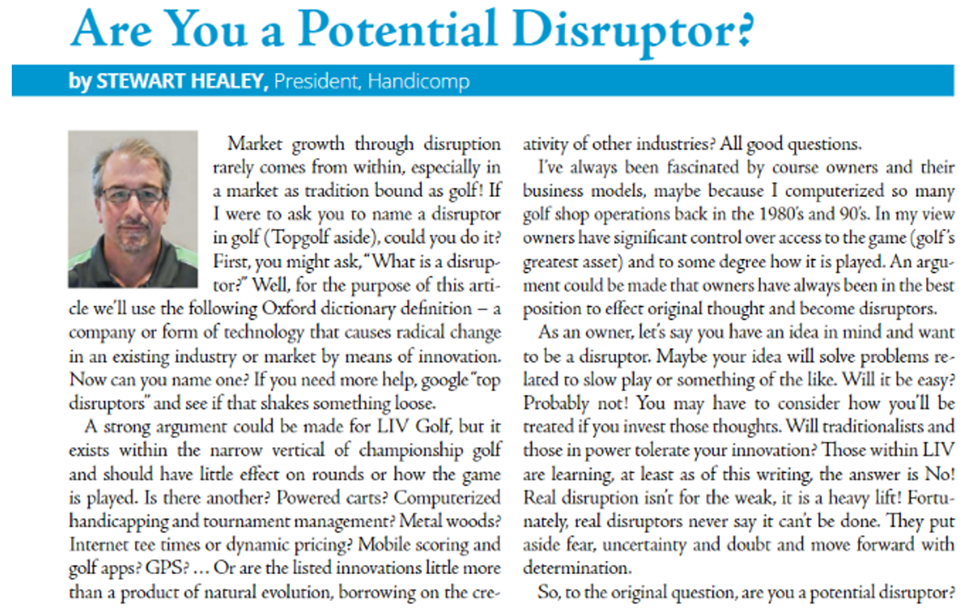
S: My company (Handicomp) has been a sponsor of the Michigan Golf Course Association for years and as part of that sponsorship I write an article for their Tee-Off Times publication. I mention this because the article I wrote for their upcoming issue is about AI and plays off my article from last year (2022), which was as follows:
S: My article for this year is as follows and has a secret:
“Artificial Intelligence: The Disruptor Set to Transform the Golf Industry”
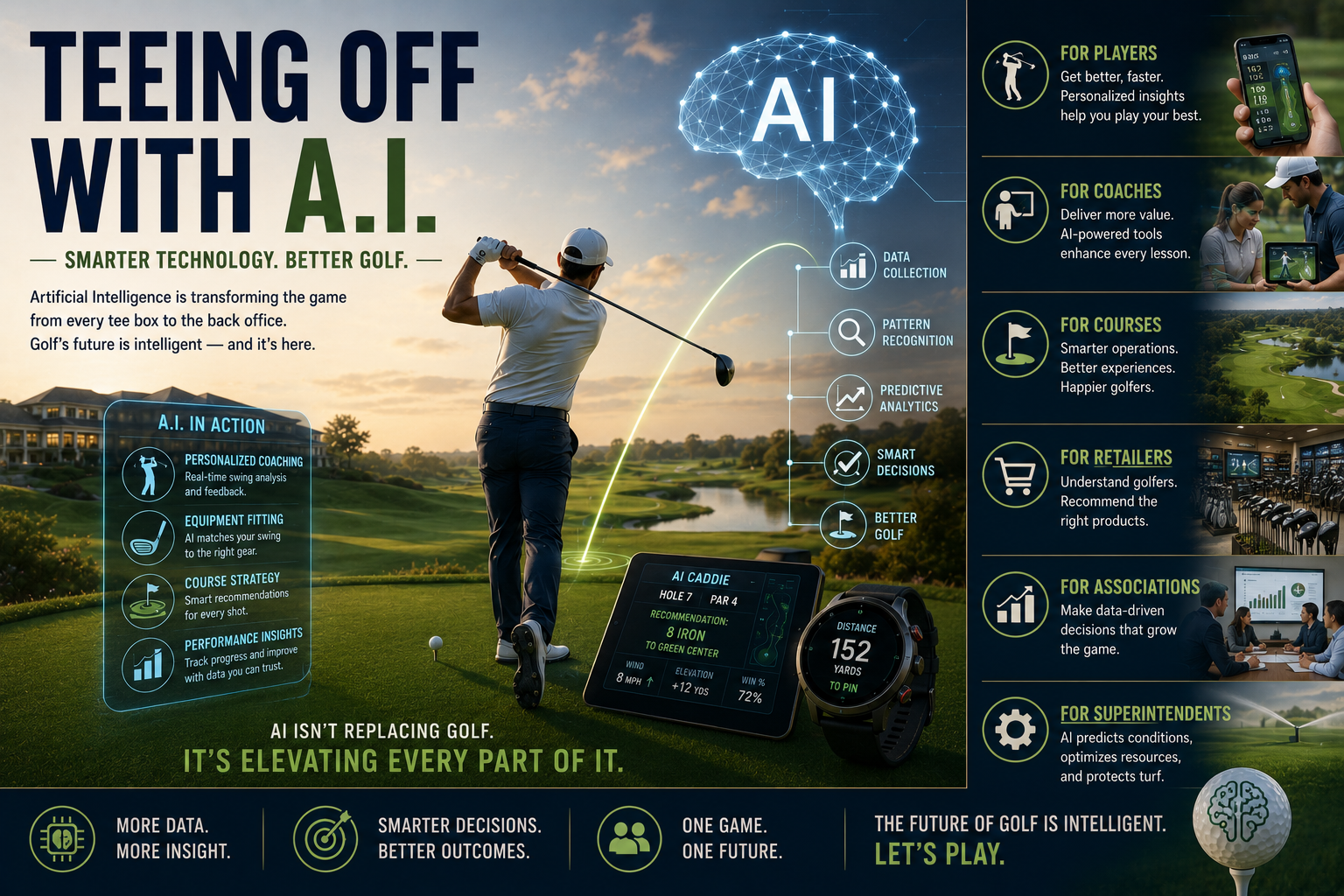
The golf industry, steeped in tradition and age-old practices, may seem impervious to radical change. But with the rapid advancements in technology, particularly artificial intelligence (AI), the game’s time-honored parameters are set to be challenged.
AI’s potential as a disruptor in the golf industry lies in its capacity to augment and transform several areas, from player performance and coaching to course management and customer experience.
Firstly, AI can personalize golf instruction by analyzing a golfer’s swing, recommending improvements, and even predicting future performance based on existing data. Using machine learning, AI can adapt and learn from every swing, every putt, every score, providing unparalleled insights that could revolutionize golf training.
Secondly, AI can enhance golf course management. With the help of AI-driven analytics, golf course owners can optimize everything from turf health to course layouts. AI could predict weather patterns and adjust irrigation schedules, saving water and energy, and providing optimal playing conditions. Furthermore, AI can provide actionable insights on player behavior, enabling course owners to tailor unique experiences and create new business models.
The prospect of slow play, a chronic issue in golf, could be mitigated with AI. Sophisticated algorithms can analyze player pace and suggest changes to tee-time schedules or course layouts to improve the flow of play, a solution that’s been elusive for ages.
Lastly, AI can elevate the customer experience. From AI-powered golf apps offering personalized suggestions to virtual reality experiences simulating world-famous courses, AI can bring an element of excitement and accessibility previously unseen in the industry.
The time for disruption is ripe, and those who can effectively wield the power of AI will shape the future of golf. The real question is, who is ready to tee off with AI?
Note, this article holds a secret! Go to my Blog at www.stuhealey.com and search for a post that shares this title.
_____________________________
S: So what’s the secret? I simply copied the article from last year and submitted it to ChatGPT with the following request: Please review the following article and write a follow up article of 300 words that outlines how artificial intelligence may be a disruptor in the golf industry. Within seconds it produced my article (almost exactly at 300 words) and I didn’t have to change a thing! In fact, all I did was add the last sentence. Pretty incredible!
Here’s the rub! In a previous post (A.I. Smarter than a 5th Grader) I referred to an article (link is near the bottom) about an AI tool from Google that is being designed to write news stories. Seems plausible and practical, right? Well consider the following article from CNN (link). This unclean intersection of AI and human generated content leads me to ask the following:
S: How can AI content creation assist the business of golf?
Bard: Artificial intelligence (AI) can assist the business of golf in a number of ways, including:
Generating high-quality content at scale. AI can be used to generate content that is both accurate and engaging, even on a large scale. This can be helpful for golf businesses that need to produce a lot of content, such as blogs, articles, social media posts, and video scripts.
Personalizing content for each individual golfer. AI can be used to personalize content for each individual golfer, based on their interests, skill level, and goals. This can help to keep golfers engaged and motivated.
Optimizing content for search engines. AI can be used to optimize content for search engines, making it more likely to be found by potential customers. This can help to improve a golf business’s visibility online and attract more customers.
Analyzing data to improve content. AI can be used to analyze data about how golfers interact with content, such as what they click on, how long they spend reading it, and what they share on social media. This data can be used to improve the quality and effectiveness of future content.
Automating content creation tasks. AI can be used to automate many of the tasks involved in content creation, such as writing, editing, and formatting. This can free up human resources to focus on other tasks, such as developing new content ideas and strategies.
Overall, AI has the potential to revolutionize the way golf businesses create and deliver content. By automating tasks, personalizing content, and optimizing for search engines, AI can help golf businesses to reach more golfers, improve their engagement, and boost their bottom line.
Here are some specific examples of how AI is being used in the golf industry:
Callaway Golf uses AI to design and optimize golf clubs. The company’s Flash Face technology uses AI to analyze millions of data points to create club faces that are more forgiving and provide more distance.
Topgolf uses AI to personalize the golf experience for each customer. The company’s app tracks each golfer’s swing data and uses it to recommend drills and tips.
GolfPass uses AI to recommend courses to golfers based on their interests and skill level. The company also uses AI to generate personalized content, such as articles and videos, that are tailored to each golfer’s needs.
These are just a few examples of how AI is being used in the golf industry. As AI technology continues to develop, it is likely that we will see even more innovative and creative applications of AI in the years to come.
S: You state that AI can be used to generate content that is accurate. How can this be trusted?
Bard: AI can be used to generate content that is accurate in a number of ways. First, AI models are trained on large datasets of text and code, which allows them to learn the patterns of human language. This means that they can generate text that is grammatically correct and semantically meaningful.
Second, AI models can be fine-tuned to specific domains or topics. This means that they can be trained on a dataset of text that is relevant to a particular subject, such as golf. This helps to ensure that the generated content is accurate and relevant to the topic at hand.
Third, AI models can be evaluated for accuracy. This can be done by comparing the generated content to a human-written reference standard. This helps to ensure that the AI model is generating accurate content.
However, it is important to note that AI models are not perfect. They can still make mistakes, especially when they are asked to generate content on unfamiliar topics. It is therefore important to always review AI-generated content carefully before using it.
Here are some tips for ensuring the accuracy of AI-generated content:
Use a reputable AI content generator. There are a number of AI content generators available, but not all of them are created equal. Do some research to find a generator that has a good reputation for accuracy.
Provide clear and concise input prompts. The more specific you can be with your input prompts, the more accurate the generated content will be.
Fine-tune the AI model for your specific domain or topic. This will help to ensure that the generated content is relevant and accurate.
Evaluate the AI model for accuracy. There are a number of tools available that can help you to evaluate the accuracy of an AI model.
Always review AI-generated content carefully before using it. Even the best AI models can make mistakes, so it is important to always double-check the content before using it.
By following these tips, you can help to ensure that the AI-generated content you use is accurate and reliable.
S: Do you believe AI content creation will contribute to human laziness?
It is possible that AI content creation could contribute to human laziness. AI can automate many of the tasks involved in content creation, such as writing, editing, and formatting. This could free up human resources to focus on other tasks, such as developing new content ideas and strategies. However, it is also possible that AI content creation could lead to a decrease in the quality of content. If people are no longer required to put in the effort to create their own content, they may be less motivated to produce high-quality work.
Ultimately, whether or not AI content creation contributes to human laziness depends on how it is used. If AI is used to automate tasks and free up human resources, it could lead to increased productivity and creativity. However, if AI is used to replace human content creators, it could lead to a decrease in the quality of content and a rise in human laziness.
Here are some potential benefits and drawbacks of AI content creation:
Benefits:
Increased productivity: AI can automate many of the tasks involved in content creation, freeing up human resources to focus on other tasks, such as developing new content ideas and strategies.
Improved accuracy: AI models can be trained on large datasets of text and code, which can help to ensure that the generated content is accurate and error-free.
Personalized content: AI can be used to personalize content for each individual user, based on their interests, preferences, and location.
Increased creativity: AI can be used to generate new ideas and concepts, which can help to improve the creativity of content.
Drawbacks:
Decreased quality: If AI is used to replace human content creators, it could lead to a decrease in the quality of content.
Lack of originality: AI-generated content may lack originality and creativity, as it is based on the patterns of human language that it has been trained on.
Bias: AI models can be biased, reflecting the biases that are present in the data they are trained on. This can lead to the generation of inaccurate or misleading content.
Job losses: AI content creation could lead to job losses in the content creation industry.
Overall, the impact of AI content creation on human laziness is uncertain. It is possible that AI could lead to a decrease in the quality of content and an increase in human laziness. However, it is also possible that AI could lead to increased productivity and creativity. The ultimate impact of AI content creation will depend on how it is used.
_____________________________
S: I reviewed the “AI produced” article I submitted to the TOT and was satisfied with the content, so I was fine calling it my own. For me, the lesson is efficiency, as what once took me hours to produce was reduced to minutes, if not seconds. I expect this will be the case in the future for most all content I generate, and I expect it’ll be the same for you. We can believe this won’t be the case, but it will!
_____________________________
S: Give me a golf riddle.
Bard: I’m a part of a golf course, but I’m not the grass. I’m not the sand, but I’m not the water. What am I?
Answer: The hole.
_____________________________
S: The ink has barely dried on my latest post (Will the Empire Strike Back?) and it seems my observations are aligning with current events. I just read an article from SI (link) where the author shares his opinion on whether or not LIV golfers should be considered for the Ryder Cup Team. One paragraph particularly stood out:
The best way to galvanize the American players—and they always need galvanizing—is to convince them they are making a statement on behalf of the PGA Tour: Whether the PIF deal goes through or not, they don’t need LIV. They are the best players in the world, period. (I do believe Johnson can add Koepka and still build that mission, for reasons I will explain.)
The author argues in support of the Tour (which I consider to be part of the broader Golf Empire) and sidelines the importance of representing America. It’s as if the value of patriotism is discounted. The suggestion is almost that Zach Johnson should prioritize players loyal to the Tour over those loyal to their country, which is in line with keeping players divided. An illuminating perspective, to say the least!
Still, while the player selections will be revealing, I’m more intrigued by the potential fan reactions. Will fans lean in the direction of supporting the Tour or in the direction of supporting America? Whether we win or lose will certainly add to that conversation!
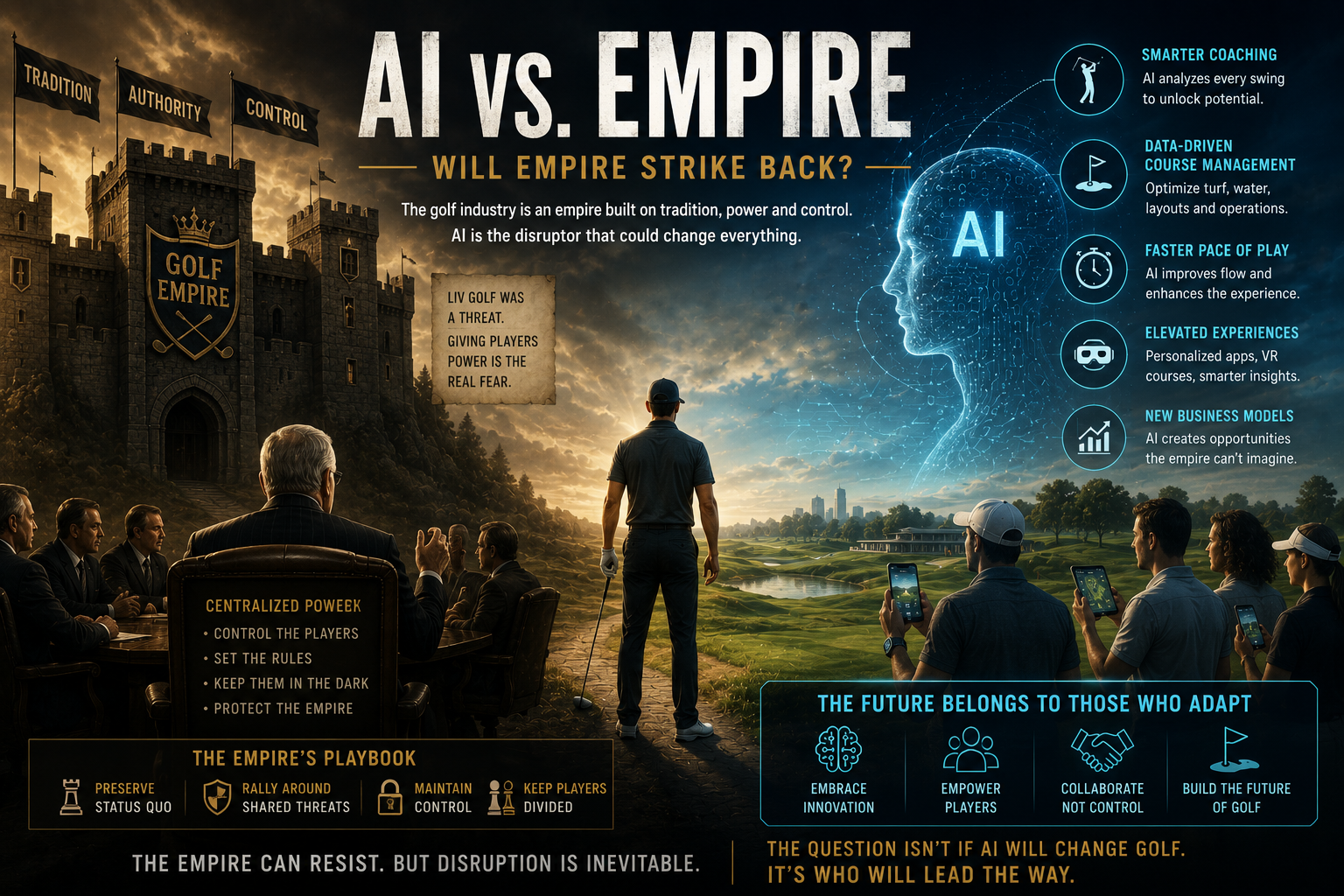
S: The golf industry is an empire! Factors such as central authority, infrastructure, intermingling, economic benefits, shared threats, tradition, and a powerful and often unspoken ‘allegiance’ have sustained its status for many years. And though there have been many challenges to this dominance, the empire has remained resilient. However, it is soon to face unprecedented disruptors empowered through AI and its response will be fascinating.
To understand AI’s potential impact on the empire and by extension the business of golf, it’s beneficial to first examine a non-AI disruptor: LIV Golf. Historically, the PGA Tour has been the dominant entity in the world of competitive golf. Yet, its authority was recently challenged by LIV. This face-off revealed the underlying power dynamics that govern the industry. Decisions by the PGA Tour to collaborate with LIV aimed at preserving its dominant position, even if it meant disregarding its key participants: the players.
For instance, it was reported by Golf Digest that the Tour drafted comments for Tiger Woods to criticize LIV Golf at a players’ meeting (link). Although Woods denied seeing the remarks, the very existence of such a script reveals the dynamic between the institution and its members. This raises a question: Are players merely subjects, or are their voices authentically represented? I believe the answer is obvious as players remain in the dark and are kept in conflict in an effort to keep them from organizing, which is the Tour’s greatest fear. Essentially, LIV was determined to be less of a threat than giving players an equal seat at the table as is the case in most all other major sports.
The effort to preserve centralized power within the Tour is a significant indicator. If the Tour can sideline its players in the name of preserving its status, other industry leadership will likely have similar reactions as AI begins to challenge their authority within the empire. It’s likely industry leaders will label AI as a shared threat, aiming to rally subjects around the preservation of the empire. Still, I believe as forward-thinking factions within the industry embrace AI those actions will fail, much as the Tour failed when it decided to keep its players in the dark.
In essence, the intersection of technology and tradition will undoubtedly lead to upheavals in the golf industry. While the PGA Tour’s recent decisions offer a glimpse into possible reactions, the imminent rise of AI in golf is a game changer of immense proportions and the Empire will be forced to react.
___________________________________
S: What is an empire in the context of an industry and how is it maintained?
ChatGPT: In the context of an industry, an “empire” typically refers to a dominant company or group of affiliated companies that exert significant influence, control, or market share over that specific industry. This empire can dictate industry standards, influence pricing, and often set trends that others follow.
Characteristics of an Empire in an Industry:
Dominant Market Share: Such companies hold a substantial portion of the market share in their industry, making them significant players whose actions can sway industry trends.
Setting Standards: They often play a role in setting technical, operational, or quality standards that other companies in the industry adopt or adhere to.
Influence Over Suppliers and Distributors: Due to their size and purchasing power, they can dictate terms to suppliers and control distribution channels.
Branding Power: They possess strong brand recognition and loyalty within the industry, making them the go-to choice for many consumers.
Resource Control: Just as in the broader business context, industry-specific empires often control crucial resources, be they raw materials, technology, or intellectual property.
How an Industry-Specific Empire is Maintained:
Continuous Innovation: Regularly introducing new products, services, or technologies that resonate with the market ensures that competitors are always playing catch-up.
Acquisition and Mergers: By acquiring emerging competitors or merging with other big players, the empire solidifies its position in the industry.
Leveraging Economies of Scale: Their size allows them to produce goods more efficiently and at a lower cost, giving them a pricing advantage.
Strong Marketing and Branding: Consistent and influential marketing campaigns help in retaining customers and attracting new ones.
Barrier Creation: They can erect barriers to entry for potential new entrants through tactics like exclusive contracts, pricing strategies, or controlling key distribution channels.
Customer Loyalty Programs: Ensuring repeat business through loyalty schemes, exclusive deals, or superior after-sales service.
Regulatory Influence: Larger companies often engage in lobbying or building relationships with regulatory bodies to influence industry regulations in their favor.
Diversification: Even within the industry, diversifying product lines or services ensures that they aren’t overly reliant on one revenue stream.
Quality Control: Ensuring that products or services are of high quality reduces the chance of customers looking elsewhere.
Research and Development: Investing in R&D to stay ahead of the curve, foresee industry trends, and align their offerings accordingly.
In essence, an empire in an industry context is maintained through a combination of strategic growth, continuous innovation, maintaining strong relationships throughout the supply chain, and ensuring that they remain the preferred choice for consumers through quality and branding.
S: In the context of an industry, define, compare and contrast an Empire and a Monopoly.
ChatGPT: Both “empire” and “monopoly” refer to dominant entities within an industry, but they operate differently and have distinct characteristics. Let’s define each term and then compare and contrast them.
Empire (Industry Context):
Definition: In the context of an industry, an “empire” typically refers to a dominant company or a group of affiliated companies that have substantial influence, control, or market share across that industry or multiple industries. While they might be dominant, they don’t necessarily exclude the presence or operation of other competitors.
Characteristics:
Diverse Holdings: Empires often have diversified interests across various sectors or product categories.
Significant Influence: They can set trends, influence industry standards, or dictate terms to suppliers and distributors.
Recognizable Brand: Often, they possess strong brand recognition and loyalty within the industry.
Control Over Resources: They might control key resources, be it raw materials, distribution channels, or intellectual property.
Monopoly (Industry Context):
Definition: A monopoly exists when a single company exclusively controls a product or service in a particular market, effectively eliminating any form of substantive competition.
Characteristics:
Exclusive Market Control: Monopolies control the majority (or all) of the market share for a particular product or service.
Price Setting: Without competition, monopolies have the power to set prices as they see fit.
Barrier Creation: They often create high barriers to entry, making it challenging for potential competitors to enter the market.
Unique Access: They might have unique access to a resource, technology, or infrastructure that others can’t replicate easily.
Comparison and Contrast:
Scope of Dominance:
Empire: An empire might be dominant in multiple sectors or industries but doesn’t necessarily eliminate competition in any one of them.
Monopoly: A monopoly dominates one specific product or service market to the extent that there’s little to no competition.
Diversification:
Empire: Typically diversified across multiple products, services, or sectors.
Monopoly: Singular focus on a specific product or service, though a company can have monopolies in multiple areas.
Relation with Competition:
Empire: An empire has significant influence and may overshadow competitors, but competitors still exist.
Monopoly: A monopoly largely eliminates or prevents competition in its specific domain.
Regulation:
Empire: Not inherently illegal or regulated against, but aspects of its operations (like mergers and acquisitions) might come under regulatory scrutiny.
Monopoly: Many countries have anti-monopoly or antitrust laws in place to prevent the formation of monopolies, seeing them as detrimental to free markets and consumer interests.
In essence, while both empires and monopolies signify dominance, the nature and extent of their dominance differ. An empire suggests breadth across multiple domains, while a monopoly indicates depth within a singular domain.
S: Explain how monopolies can work hand in glove with an industry empire.
ChatGPT: “Hand in glove” is an idiom that denotes a close collaboration or intimate relationship between two entities. When saying monopolies can work “hand in glove” with an industry empire, it implies that these monopolies can operate closely with, or even as a crucial component of, the empire’s broader strategy or framework.
Here’s how monopolies can intertwine with an industry empire:
Strategic Foundations: An industry empire might be built upon one or more monopolies. For instance, a company that holds a monopoly in a particular product or service can use the enormous revenues and market control from that monopoly to diversify and expand into other sectors, creating an empire.
Protection of the Core: While an empire might diversify into various sectors, it often uses its monopoly (or monopolies) as a protective core. The guaranteed income and market share from the monopoly provide the empire with financial stability and security, enabling risk-taking in other sectors.
Cross-Subsidization: The profits from a monopoly can be used to fund or subsidize other ventures within the empire, especially when entering new markets or sectors where initial profitability might be low.
Barrier Creation: The monopoly within the empire can create barriers to entry in its specific domain, ensuring that potential competitors are kept at bay. This allows the broader empire to focus on expansion and diversification without constantly safeguarding its core business.
Resource Allocation: Monopolies often control vast resources, from intellectual property to infrastructure. An industry empire can leverage these resources across its various ventures, ensuring competitive advantage in multiple sectors.
Unified Branding and Marketing: A well-established monopoly often has significant brand recognition. The empire can use this brand value to make inroads into new markets, leveraging consumer trust and recognition.
Shared Infrastructure and Distribution: The distribution channels, supply chains, and infrastructure established for the monopoly can be utilized for other ventures within the empire, ensuring cost efficiencies and rapid market access.
Regulatory Leverage: A monopoly often has considerable influence over regulators or policymakers due to its size and significance in the market. The empire can use this influence to shape regulations in other sectors it operates in, ensuring a favorable business environment.
Feedback Loop: Sometimes, the products or services from other sectors of the empire can feed into and strengthen the monopoly. For instance, a tech empire might have a monopoly on a popular operating system. If this empire also produces software or hardware, it can design them to work optimally with its monopolized OS, thereby boosting sales for both.
In essence, within an industry empire, monopolies not only provide a foundation of strength but also act as strategic tools to support and bolster the empire’s diversified ventures. This intertwined relationship can make the combined entity incredibly resilient and influential in the market.
S: Explain collective bargaining and when did it occur in each major sport?
ChatGPT:
Collective Bargaining:
Collective bargaining refers to the process by which employees, typically represented by a union, negotiate with employers regarding terms of employment. These terms can include wages, working hours, working conditions, benefits, and other aspects of workers’ compensation and rights. The goal of collective bargaining is to come to an agreement that is mutually beneficial for both parties.
For major North American sports leagues, collective bargaining typically takes place between player unions and league owners to establish conditions related to player contracts, revenue sharing, team salary caps, health provisions, pensions, and more.
Here’s a brief overview of the initiation of collective bargaining in major North American sports:
Major League Baseball (MLB):
First Occurrence: MLB players formed their union, the Major League Baseball Players Association (MLBPA), in 1966, with Marvin Miller as its first executive director.
Context: MLB players had sought representation for years, especially to challenge the reserve clause, which tied players to their teams indefinitely. The first collective bargaining agreement (CBA) was negotiated in 1968, which increased the minimum salary for players. The most significant win came later with the advent of free agency.
National Football League (NFL):
First Occurrence: The NFL Players Association (NFLPA) was formed in 1956, but it wasn’t until the late 1960s and early 1970s that it began to gain significant bargaining power.
Context: The NFLPA had various challenges and strikes, especially in 1982 and 1987, revolving around issues like free agency and salary caps.
National Basketball Association (NBA):
First Occurrence: The NBA Players’ Association (NBPA) was formed in 1954, making it one of the oldest sports unions. However, its first significant collective bargaining agreement that truly restructured player-team relations came in the late 1960s.
Context: Early negotiations led to improvements in pensions and other benefits. Significant strikes or lockouts in NBA history, related to collective bargaining disputes, include those in 1998-99 and 2011.
National Hockey League (NHL):
First Occurrence: The NHL Players’ Association (NHLPA) was formed in 1967.
Context: The NHLPA, like other player associations, has had its share of disputes with the league, leading to lockouts, notably in 1994-95, 2004-05 (which wiped out the entire season), and 2012-13.
Major League Soccer (MLS):
First Occurrence: The Major League Soccer Players Union (MLSPU) was recognized in 2003.
Context: The MLSPU has engaged in various rounds of collective bargaining with the league, especially as the league has grown and evolved.
It’s essential to note that the dates provided are for the formation of the unions or when they started to gain significant power. Each league has had multiple rounds of collective bargaining since their inception, with agreements typically lasting for several years before they are renegotiated. The dynamics of these negotiations often reflect the state of the sport, its revenues, and broader trends in professional athletics
___________________________________
S: Tell me a joke that includes the words empire and golf.
ChatGPT: Why did the empire’s golf team always win?
Because they had the best course of action!
___________________________________
S: The concept of LIV isn’t new. Greg Norman has been extraordinarily patient, waiting for the right resources to challenge the PGA Tour monopoly within the golf industry empire. This is explained in the link below. I believe others who embrace AI as their resource for challenging dominance within the empire will have success as well. This is why the effect AI will have within the business of golf will be so fascinating!
Ongoing concerns for all industries and the professions they support are skills replenishment and the retention of institutional knowledge. Golf is no exception.
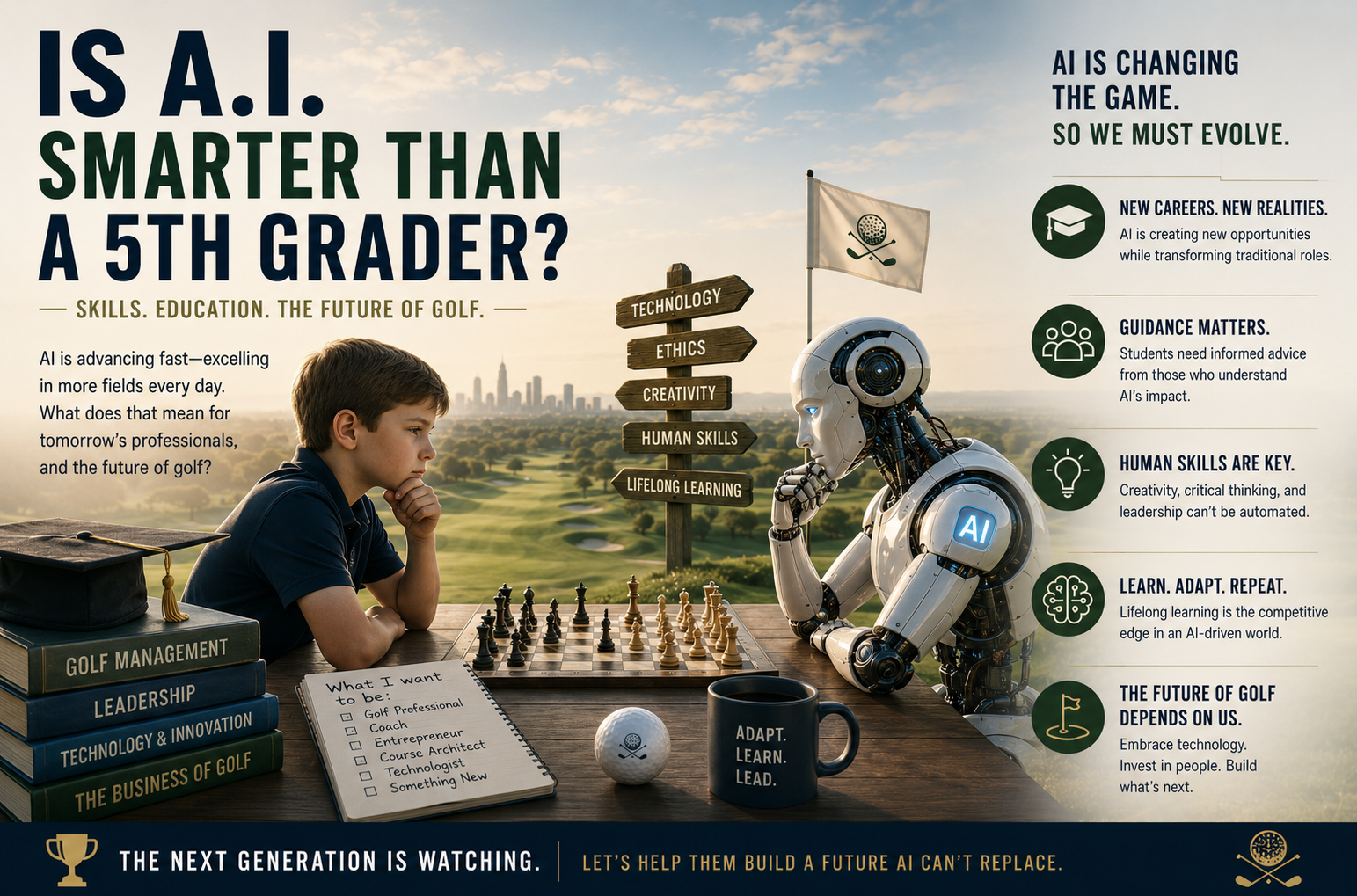
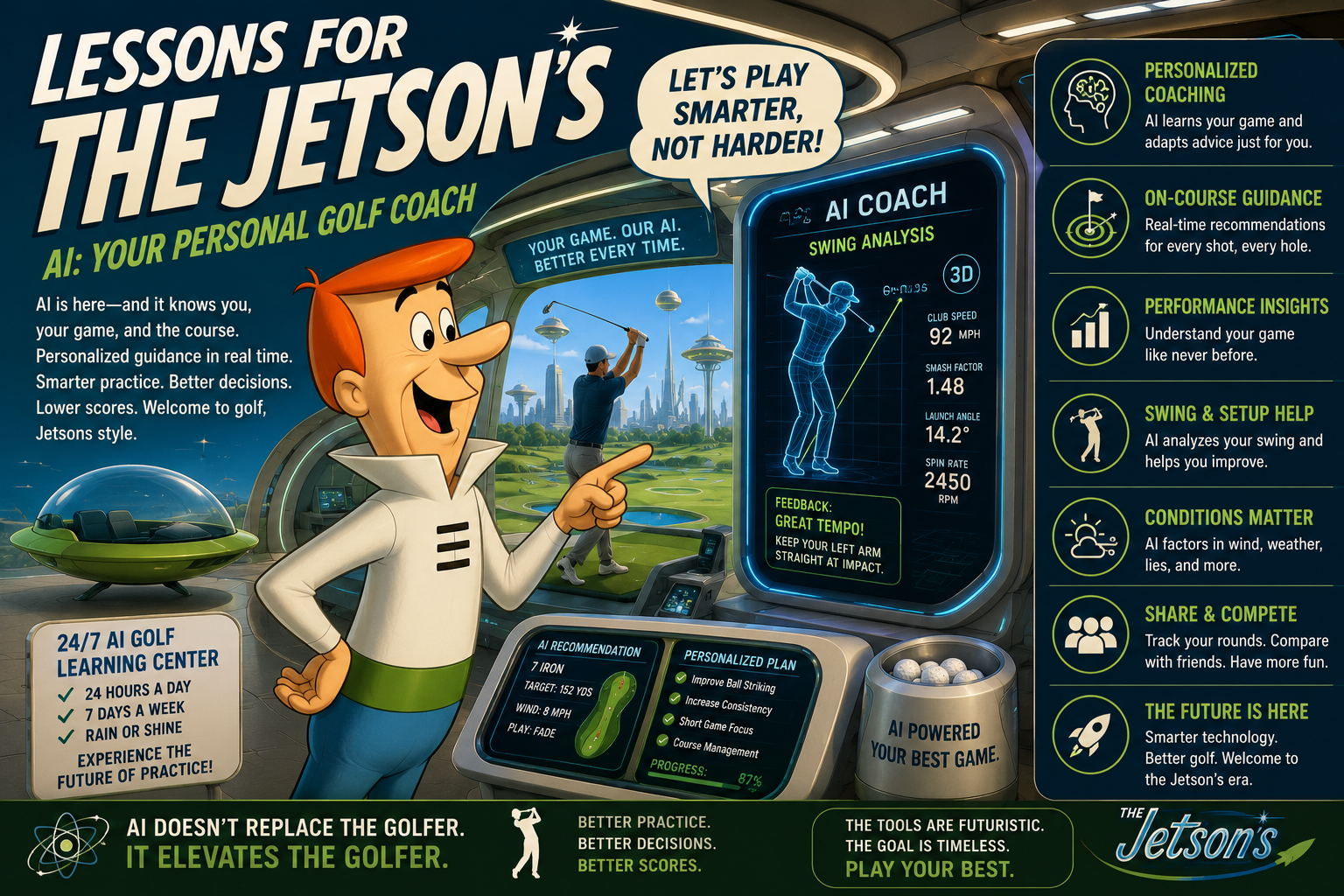
As children, we’re frequently asked, “What do you want to be when you grow up?” But how will kids looking to develop skills in an age of AI answer this question? Not everyone has the brains or innate talent to excel in every field, so why consider investing resources to become a computer programmer, a marketing expert, an author or writer, a legal assistant, a teacher, a financial advisor, a graphic designer, a musician, an accountant, a translator, a pilot, a secretary, a radiologist, a nurse or doctor, or a PGA professional (Lessons for the Jetson’s), and so on, when AI is set to bring extraordinary abilities to all these professions and more?
Consider for a moment how AI has been performing exceptionally well in a range of fields and the rate at which it’s becoming smarter (AI Passes Tests)! This has introduced a degree of uncertainty about what the future holds, making some higher education choices seem risky. Compounding the issue is that when students seek advice, they often find their parents or counselors ill-prepared to guide them, mostly because they have no experience with the rapidly evolving AI landscape.
So, let’s look at our industry. Like most sectors, golf has educational programs aimed at developing the professionals of the future. A large number of golf pros are graduates of Professional Golf Management (PGM) programs, offered at universities throughout the country, like the one at Ferris State University (link).
Though I didn’t graduate from this program, I’ve had considerable interaction with it. My company has hired its graduates, we’ve occasionally sponsored events, and I’ve even given guest lectures to classes within the program, mainly on the topic of technology. In my view, the technology curriculum seems somewhat outdated, and I’m not aware of any mention of AI. I strongly feel this issue needs to be addressed, not only within PGM programs, but throughout higher education everywhere.
Let’s delve into the larger question of college education.
S: How is AI changing the thinking of high schoolers as they explore college education and the value of certain degrees?
ChatGPT: AI is significantly influencing high school students as they consider their options for college education and the potential worth of various degrees. Here are some ways AI is shifting the mindset of these students:
Increased interest in tech-related fields: As AI and related technologies continue to develop and transform various industries, there is an increasing interest in tech-related degrees. Many students see the rapid progress in AI and want to be part of this exciting field, leading to an increasing demand for degrees in computer science, data science, artificial intelligence, and robotics.
Understanding of job market volatility: AI is also changing certain job markets, making some roles less secure while creating new ones. High schoolers are aware of this trend and might be more cautious about pursuing degrees linked to jobs that could be automated in the future.
Emphasis on soft skills: With the rise of AI, there is a growing understanding that uniquely human skills – such as critical thinking, creativity, communication, and emotional intelligence – are increasingly valuable. These ‘soft skills’ are harder to automate, leading some students to consider degrees in liberal arts and social sciences, which are known for fostering these abilities.
Interdisciplinary approach: AI is interdisciplinary in nature, combining elements of computer science, mathematics, linguistics, psychology, and more. As a result, students might be more inclined to pursue interdisciplinary degrees or to combine majors and minors in different fields to better prepare for the future.
Continuous learning mindset: AI’s rapid development means that what’s cutting-edge today may be outdated tomorrow. This understanding is encouraging students to develop a mindset of lifelong learning, realizing that a single degree may not be enough for a lifetime career.
Increased need for ethical considerations: As AI’s impact on society becomes more significant, there’s a growing need for professionals who can navigate ethical and societal implications of technology. This might encourage students to combine technical education with fields like philosophy, law, or sociology.
However, it’s also worth noting that these considerations may not be universally understood or appreciated by all high school students. The level of understanding about AI and its implications can greatly vary, and often depends on the quality of career guidance provided at schools or at home.
S: Parents and Advisors lack experience in AI. How is this impacting high school students as they explore higher education?
ChatGPT: The lack of AI experience among parents and advisors can significantly impact high school students as they navigate their higher education options in several ways:
Career Guidance: With rapid technological advancements, especially in AI, new career paths are emerging that didn’t exist a few years ago. Parents and advisors without a solid understanding of AI may struggle to guide students towards these opportunities, potentially limiting the student’s career prospects.
Perception of Job Security: Advisors and parents may underestimate the impact of AI on traditional professions. Their advice might lean towards professions that are at risk of automation, which could lead to future job insecurity for students.
Misunderstanding of AI’s Reach: AI isn’t just about coding and technology. It’s having profound effects across various sectors, from healthcare to finance to creative arts. Parents and advisors unfamiliar with AI might not fully appreciate its interdisciplinary nature and fail to encourage students to integrate AI knowledge with other areas of study.
Preparation for a Changing World: Advisors and parents play a critical role in preparing students for the future. A lack of understanding about AI means they might not emphasize the importance of skills that will be valuable in an AI-driven world, such as critical thinking, creativity, complex problem-solving, and emotional intelligence.
Assessing Educational Programs: As AI becomes more important, so does the need for it to be included in educational programs. Parents and advisors with limited AI knowledge may not adequately assess whether a particular course or degree program will equip students with necessary AI skills and knowledge.
Fear and Uncertainty: Finally, a lack of understanding about AI could lead to unnecessary fear and uncertainty. Parents and advisors might overemphasize the risks and downsides of AI, which could discourage students from pursuing fields associated with AI, despite the immense opportunities.
As a solution, educational institutions could provide training for parents and advisors on AI and its impact on the future job market. This would allow them to better guide students in making informed decisions about their higher education and career paths.
S: Could AI guide high schoolers in their higher education choices and what might be some examples of how this could occur?
ChatGPT: Yes, AI can indeed play a significant role in guiding high school students in making higher education choices. Here are some ways in which this could happen:
AI Chatbots and Virtual Advisors: AI can be used to create intelligent chatbots and virtual advisors that help students explore different fields of study, analyze their interests and skills, and suggest suitable higher education programs. These chatbots could provide personalized guidance 24/7 and offer resources for further exploration.
AI-powered Career Predictive Analytics: AI can analyze a large amount of data to predict future career trends. It can take into account a student’s interests, skills, and personality, and compare them with future job market trends to suggest the most suitable career paths and the educational programs that would prepare the student for those paths.
AI in College Admissions: AI tools can help students identify which colleges and universities they are likely to be admitted to based on their academic and extracurricular profiles. This information can be beneficial in helping students set realistic expectations and optimize their college application strategy.
AI Tutoring Systems: AI can also help students improve their academic performance. Intelligent tutoring systems can provide personalized learning experiences, identifying areas where a student is struggling and offering targeted instruction and practice. This can help students meet the prerequisites for their desired higher education programs.
AI Scholarship Finder: AI can help students find scholarships that they have the highest likelihood of receiving. It can analyze the requirements of thousands of scholarships and match them with a student’s profile to suggest the most suitable opportunities.
AI-enabled Social and Emotional Learning: AI can help students develop social and emotional skills that are crucial for success in higher education, such as resilience, time management, and self-motivation. These tools can provide personalized activities and resources to help students develop these skills.
S: What happens when people abandon a profession and institutional knowledge is lost, and please provide a recent example?
ChatGPT: When people abandon a profession and institutional knowledge is lost, it can have several adverse effects. These might include:
Decrease in Quality and Efficiency: Institutional knowledge is the cumulative understanding gained from years of experience in a profession. When this is lost, it can lead to lower productivity and efficiency, as well as a decrease in the quality of work and services provided.
Loss of Expertise and Skills: The accumulated skills and expertise that experienced professionals hold are not easily replaceable. This could lead to a significant skill gap in the profession.
Knowledge Gaps: The loss of experienced professionals might leave gaps in critical knowledge and understanding. This could hamper problem-solving and decision-making processes.
Impact on Culture: Institutional knowledge often embodies the culture and values of a profession. Its loss can disrupt the continuity of these cultural norms and practices.
A recent example of this can be seen in the pandemic-induced exodus of teachers in many parts of the world. Many experienced educators have retired or left the profession due to the stress and challenges of remote teaching, health concerns, or other pandemic-related issues. The result has been a loss of decades of accumulated teaching experience and understanding of educational practices. This not only affects the quality of education but also puts additional stress on remaining teachers, who must take on larger class sizes or additional responsibilities. New teachers, without the benefit of experienced colleagues to mentor them, may also struggle to adapt to the demands of the profession. This widespread departure of teachers can impact the overall quality of education and students’ learning outcomes in the long term.
________________________
S: AI as an advisor on the subject of AI! Should I add counselors to the list of professions to be affected by AI? Seems so!
S: I can see how AI can greatly assist with learning. However, I believe there is going to be a large divide between those motivated to learn using AI who then put that learning to use, and those less motivated to learn who then rely on AI to do their work for them.
S: I think the PGA should have ChatGPT take the PGM Level test(s) and publish the results.
S:Many of us may not be smarter than a 5th grader, but AI is!
________________________
AI Humor (you can ask a chatbot to tell you a joke and it will) –
S: Give me a golf riddle?
ChatGPT: “I can be driven, but have no wheels. I can be sliced, but remain whole. What am I?”
Answer: A golf ball.
________________________
S: Prior to the turn of the century most PGA Professionals owned their own shops (they were small business owners) and they had a piece of the concessions, often including the range, carts, bag storage, handicaps and more. This has changed dramatically, resulting in a decrease of institutional knowledge.
There is a reason for this and I’ll expand my thoughts on the subject further down the line!