Category: Golf Leagues

  • What’s Next? The Age of Agency

    What’s Next? The Age of Agency

    Congratulations to the MGCA on its 50th anniversary! That’s a milestone to celebrate — with reflection and a look ahead. And because Handicomp has evolved alongside technology, if you think the last 50 years have been transformative, you haven’t seen anything yet.

    My memories of the summer of 1976 center around Mark “The Bird” Fidrych. He captivated not just Michigan, but the entire country. At the same time, I was at Handicomp helping my dad process golf handicaps. It was prior to personal computers, yet even then, we were setting the table for modern golf tech.

    At the course level? A phone system, an adding machine, maybe a cigar box. That was it. No systems. No connectivity. From a tech standpoint, courses were essentially deserted
    islands.

    Then came disruption — PCs, the internet, and mobile. Each wave didn’t just improve golf — it rewired it. We computerized operations, connected courses, and linked golfers. Ideas once impossible — like statewide league competition — became reality.

    And yet, through all of it, the industry largely viewed technology the same way: as a tool. Something to support the business and make things easier.

    With AI, that mindset is being shattered.

    Artificial Intelligence isn’t just another upgrade — it’s a dividing line. Two paths are forming: those leaning in and rethinking operations, and those waiting, assuming it’s just another trend. That gap is widening fast, because AI isn’t just better software — it’s technology that acts — with agency.

    So where does that put us in fifty years? That’s too far out to predict. But 10-15 years? The trajectory is already visible. Let me be clear — I believe what’s coming will challenge how owners think about running a golf course.

    Here are a few thoughts to ponder:

    First, the course that runs itself.

    In the near future, AI won’t just assist — it will run operations. Tee sheets will optimize themselves, pricing will shift in real time, F&B will anticipate demand, maintenance will be self-managed, and staff will assist.

    Sound far-fetched? We already have riderless mowers, smart irrigation, AI-driven scheduling, and virtual golf environments that run themselves. This isn’t speculation — it’s acceleration.

    And here’s the uncomfortable question: If your course can run itself… what is your role? Not less important — more important, but different. Human interaction becomes the premium layer: the experience, the relationship, the brand. Everything else? Automated. Employees? I’ll let you speculate on that one.

    Second — Sim golf.

    It’s creating new golfers and already outpaces “real” golf in rounds played, a shift that took just over a decade to complete — and won’t reverse. As Sim becomes more capable and affordable — and as course property values rise — “real” golf has some thinking to do.

    And third, the golfer that isn’t human.

    This one may push you. Think of it as a reverse Sim — the course is real and the golfer is the simulation, in the form of a robot. I believe within 10-15 years there will be an autonomous robot golfer capable of playing 18 holes — and beating the best score on any course. We already have robots that can walk, swing a club, think, and see. It’s just a matter of integration.

    In the future, golfers won’t just compete against others — they’ll compete against their bot-self. Their data — every round, every hole, every tendency — can create a digital twin. It’s something we’re already doing with AI score prediction and AI Subs (in leagues). Paired with robotics, golfers could rent a robot that carries their clubs, suggests shots, and plays against them in any style — including their own.

    That’s not science fiction. In 1997, when Deep Blue beat Garry Kasparov, it felt like a stunt. Today, machines outperform humans in complex tasks every day — and no one blinks.

    That’s how fast “impossible” becomes “expected.”

    So where do you stand?

    For 50 years, technology has been weaving golf together — connecting courses, players, and operations. The next 50 years will be different. Technology won’t just connect the game — it will participate in it. It will make decisions, take actions, and even compete. And that leaves every operator, association, and leader with a choice:

    Lean in — or lose your place in the game.

    Fifty years ago, golf technology was a seedling. Today, it’s a tree. Tomorrow, it’s the forest.


    May 8, 2026 – Published in the MGCA Tee-Off Times, Spring 2026 Edition

    Stu Healey, President

    Handicomp, Inc.

  • The Most Honest Match in Golf

    The Most Honest Match in Golf

    You compete against par, against your handicap, against other golfers, or sometimes just against your last good round. What’s missing is a consistent, fair benchmark that reflects how you’re actually expected to play on a given day on a given course and tee.

    That’s where playing a match against your AI self comes in.

    Inside the Electronic Scorecard, AI score prediction allows us to turn expectation into an opponent — one that shows up every time, plays the same course and tee you do, and reflects your game, not someone else’s.


    What Does It Mean to Play Your AI Self?

    Your AI self isn’t a “best case” version of you. It isn’t your worst round either. It’s a prediction of your expected performance, built from your scoring history, the course, the tee, and how you tend to play.

    Hole by hole.

    When you play against your AI self, you’re answering a much more honest question than Did I beat par? or Did I win my match?

    You’re answering:
    Did I beat expectation?

    That’s a powerful lens for golfers who care about improvement, fairness, and understanding their real game.


    Making AI Match Play Like Real Golf

    AI predicts strokes per hole to the hundredths — numbers like 4.86 or 5.72. That level of precision is critical for accuracy and fairness, but golf still needs whole numbers on a scorecard.

    So AI Match uses normalized AI scoring as part of the core feature.

    The idea is simple:

    • Preserve which holes are harder or easier for you
    • Convert fractional predictions into whole-number hole scores
    • Ensure the total score matches the AI’s predicted round score (rounded)

    The result is a believable, playable scorecard:

    • Match play works
    • Stroke play works
    • Hole difficulty still makes sense
    • Nothing feels random or artificial

    Your AI opponent looks and behaves like a real golfer — because it’s modeled after you.


    Target Score Adjustment: Choosing the Challenge

    Not every round has the same goal.

    Sometimes you want a tough test.
    Sometimes you want confidence.
    Sometimes you want a target you should beat.

    That’s why AI Match includes Target Score Adjustment.

    Instead of locking you into a single expected score, the system lets you choose how often you want to beat your AI self.

    Here’s how to think about it:

    • 25% target → a hard opponent
      You’ll beat this AI score about one quarter of the time.
    • 50% target → a true expectation
      You’ll beat it about half the time.
    • 80% target → a more forgiving opponent
      You’ll beat it most of the time.

    Under the hood, the AI uses your scoring variability (standard deviation) to adjust the prediction realistically — not by guessing, but by modeling what your good, average, and off days actually look like.

    The important part:
    No matter the target, the scorecard remains believable, normalized, and fair.


    Why This Works Better Than Handicaps Alone

    Handicaps are designed to level competition between golfers.

    AI Match is designed to measure competition within a golfer.

    It:

    • adapts to trends,
    • reflects course and tee difficulty,
    • doesn’t lag behind your current form,
    • and isn’t distorted by who you’re playing with.

    You can’t sandbag your AI.
    You can’t get unlucky against it.

    It’s the cleanest comparison golf offers.


    Built Into the Electronic Scorecard

    AI Match lives inside the Electronic Scorecard in the Golf Mobile Network application. There’s no special setup, no extra rules, and no administrative burden.

    It simply becomes another way to play:

    • a personal match,
    • a practice tool,
    • a confidence builder,
    • or a competitive side game.

    Why This Matters

    Golfers will always enjoy competing against each other. But the most honest competition in golf might be the one where excuses disappear.

    Playing against your AI self gives golfers:

    • a fair benchmark,
    • meaningful feedback,
    • and a way to measure progress that isn’t clouded by luck or context.

    It’s not replacing traditional golf.
    It’s clarifying it.


    A Different Kind of Opponent

    Golf has always valued integrity. Playing a match against your AI self extends that value into the data era.

    No guesswork.
    No distortions.
    Just you — versus who the data says should show up today.

    And that’s a match worth playing.


    February 4, 2026

    Stu Healey, President

    Handicomp, Inc.

  • More Than a Novelty – AI Score Predictions

    More Than a Novelty – AI Score Predictions

    Every golfer has asked the same question on the way to the first tee:
    “What am I going to shoot today?”

    For decades, that question lived somewhere between hope, guesswork, and superstition. Today, AI offers something different — an answer grounded in data.

    If AI is good at anything, it’s making predictions. Nearly everything you experience with AI is a response to input shaped by training on large volumes of real-world information. Golf scores are no different. With enough scores, from enough golfers, across enough courses, tees, conditions, and days, AI can learn to predict what you’re likely to shoot today or tomorrow based on how you’ve played before.

    At first glance, score prediction might sound like a novelty. Interesting. Maybe even impressive. But once you look closer, it turns out to be something much more important.


    The Prediction Is Just the Beginning

    A predicted score, by itself, is just a number.

    The real value lies in what that prediction unlocks.

    Once you can reliably estimate how a golfer is expected to score — hole by hole and tee by tee — entirely new possibilities open up. Many of the biggest challenges in golf, especially around fairness, suddenly become solvable.


    Better Handicaps Start with Bias Elimination

    At the heart of GolfHandicap.ai is a simple belief:
    The best handicap isn’t the most complex — it’s the fairest.

    Traditional handicap systems are man-made formulas, designed with good intentions, but they struggle to balance accuracy, precision, and bias elimination at the same time. As most golfers eventually discover, a system can be accurate on average and still be unfair if it consistently favors certain golfers, tees, or playing conditions.

    AI score prediction changes the conversation. Instead of inferring ability indirectly, we can measure expected performance directly — and then test outcomes against par in a meaningful way. This makes it possible to detect and reduce bias across skill levels, tees, and playing environments.

    That’s why this entire site exists. Fairness doesn’t come from elegant math alone. It comes from understanding expectations — and AI makes that possible.


    Playing Against Yourself: AI Match

    One of the more fun applications of score prediction is AI Match, available as a feature of the Electronic Scorecard in the Golf Mobile Network application.

    In this mode, you’re not playing against par or another golfer — you’re playing against your AI self: a prediction of how you normally perform on that course and tee, under similar conditions.

    Did you beat expectations? Fall short? Match them exactly?

    Suddenly, a casual round becomes a personal challenge. It’s golf, gamified — but rooted in reality, not gimmicks.


    Course and Tee Difficulty: Choosing the Right Challenge

    Most golfers want to be challenged — just not embarrassed.

    Some days you want to stretch yourself on a tougher tee, or see how you’d handle a course you’ve never played. Other days you just want to enjoy the round and stay competitive. Traditionally, tee selection has been driven by ego, habit, or guesswork.

    AI score prediction removes that uncertainty. By showing predicted scores by tee, golfers can make informed choices:

    • Want to play to a target score?
    • Curious how moving back a tee will really affect your round?
    • Looking to balance challenge with enjoyment?

    Instead of guessing, you can choose the tee that fits your game — that day.

    This also gives leagues and courses a clearer picture of true tee difficulty, based on how golfers actually score, not just what’s printed on the scorecard.


    Confidence, Range, and Expectations

    Predictions aren’t just about averages — they’re about range.

    Golfers don’t just want to know what they’ll probably shoot. They want to know:

    • What’s my best-case round?
    • How bad could it get if things go sideways?
    • If I’m chasing a target score, what are my odds?

    Using statistical measures like standard deviation, absolute deviation, and average score relative to net par, AI can estimate not just a prediction, but a confidence range — essentially, the likelihood of different outcomes.

    Understanding that range builds confidence and sets realistic expectations. It also provides a far better measure of improvement than a single great (or terrible) round ever could.


    AI Ghost (AI Sub): Solving the No-Show Problem

    As discussed in our most recent post, AI score prediction enables something leagues have struggled with for decades: handling no-shows fairly.

    With an AI Sub, a missing golfer is replaced by a prediction of their own hole-by-hole scores. The golfer who shows still plays the matchup they were scheduled for — not par, and not a random ghost.

    Handicaps remain intact. A/B positions don’t get confused. League rules still apply.

    This simply isn’t possible without AI score prediction — and it’s one of the clearest examples of prediction being far more than a novelty.


    Why This Is Different from “Just Another Formula”

    AI score prediction isn’t trying to sync with a particular handicap formula. It isn’t chasing averages or potential. It’s doing something simpler — and more powerful.

    It’s answering a single question:

    Given everything we know, what is this golfer most likely to shoot next?

    That distinction matters. It’s why AI adapts to trends, course and tee difficulty, and individual golfer behavior in ways static formulas never can.


    And This Is Only the Beginning

    Perhaps the most exciting part of AI score prediction is this:
    we don’t yet know all the ways it will be used.

    Every time we explore the data, new opportunities emerge — new features, new insights, new ways to make the game fairer, more engaging, and more fun. Many are already in development. Many more haven’t been imagined yet.

    That’s the difference between a static formula and a learning system.

    AI score predictions aren’t just another golf stat. They’re a foundation — one that supports fair handicaps, better decisions, smarter leagues, and a more honest understanding of how we actually play the game.

    And we’re just getting started.


    January 24, 2026

    Stu Healey, President

    Handicomp, Inc.

  • AI Ghost (AI Sub)

    AI Ghost (AI Sub)

    After another break focused on product development, it’s time to return to one of the most practical benefits of AI score prediction — solving the long-standing problem of league no-shows.

    For decades, golf leagues have struggled with how to handle a missing golfer who doesn’t show up and can’t secure a substitute. The usual solutions were imperfect at best: drafting a random “ghost” from players who did show, or playing against some version of par. Both approaches introduce confusion, unfairness, and unnecessary bias.

    That’s no longer necessary.

    Introducing the AI Sub

    In the Golf League Network application, we’ve introduced the AI Sub — sometimes called an AI Ghost. Because we can accurately predict a golfer’s hole-by-hole scores, we can replace the missing golfer with an AI-generated representation of that specific golfer.

    In effect, the golfer who shows up still plays against the opponent they were scheduled to face — not a random stand-in or an abstract par value. Handicaps remain intact, A/B positions stay correct, and the integrity of the match is preserved.

    This is a fundamental shift: the matchup stays real, even when one golfer isn’t.

    Configurable by League Rules

    Of course, leagues need flexibility — and the AI Sub is fully configurable.

    For example:

    • If a league doesn’t want the absent golfer to earn points, that’s easily enforced.
    • If the league wants to give the golfer who showed up a slight advantage, the AI Sub’s handicap can be adjusted by a stroke or two.
    • If points, skins, or other side games need special handling, those parameters can be set as well.

    In short, leagues can decide how strict or forgiving they want to be — without sacrificing fairness or clarity.

    A Word on Handicapping and Reactivity

    There is one important concept to understand: reactivity.

    Different handicap systems respond to change at different speeds:

    • A Custom average-based handicap (for example, averaging the last 3 scores) can react very quickly.
    • A system like WHS™, which emphasizes potential, dropping poor rounds from a large number of 9-hole scores, tends to change much more slowly.
    • AI score prediction, on the other hand, isn’t trying to mirror a specific handicap formula at all.

    That’s intentional.

    The AI Sub isn’t designed to “sync” to a handicap system — it’s designed to predict the golfer’s next score as accurately and fairly as possible, based on their scoring history, trends, and context.

    This means:

    • In leagues using very reactive handicaps, AI may appear smoother.
    • In leagues using slow-moving handicaps, AI may appear more responsive.

    That’s not a flaw — it’s the point.

    Why AI Handicaps and AI Subs Belong Together

    If a league wants AI Subs to align perfectly with its handicapping philosophy, the most natural solution is to use the AI handicap formula itself.

    When AI predicts scores and determines handicaps:

    • Reactivity is aligned.
    • Bias is minimized.
    • Net results stay closer to par.
    • Fairness is preserved even when golfers miss a round.

    It’s no surprise that since introducing AI handicapping in the Golf League Network, more and more leagues have adopted it. And we believe the introduction of AI Subs will accelerate that trend even further.

    The Bottom Line

    AI Subs solve a real, persistent league problem — no-shows — in a way that’s fair, configurable, and easy to understand. They eliminate random ghosts, reduce bias, and keep matches intact.

    When paired with AI handicapping, they create something leagues have never truly had before: continuity, fairness, and realism — even when a golfer doesn’t show up.


    January 13, 2026

    Stu Healey, President

    Handicomp, Inc.

  • Understanding Bias in Handicapping

    Understanding Bias in Handicapping

    When golfers talk about handicaps, the conversation usually centers on accuracy (how close the numbers are to reality) or precision (how consistently the results hold up). Both are valuable — but the real foundation of fairness lies in something deeper: bias elimination.

    A handicap system can be accurate on average and precise in its calculations, yet still unfair if it consistently favors some golfers over others. That tilt is bias. Unlike random error, bias is systematic — it shapes outcomes in one direction, rewarding some while penalizing others.


    What the Data Shows

    We analyzed scores from the same 16-round, 48-golfer, 18-hole league referenced in our previous blog post. The league played from three sets of tees — Green, White, and Blue — with golfers divided into two flights: Birdie and Bogey. For each, we compared four handicap formulas: Custom, HGHS, AI, and WHS™. (As a reminder, Custom averages the middle 3 of the last 5 scores.)

    The test was straightforward: How do average net scores compare to par (72)?

    • If the average net is close to 72 → the system is fair.
    • If it consistently runs high or low → that’s bias.

    Green Tee (43 scores, smallest dataset):

    • AI and Custom: close to par, sometimes a little under.
    • HGHS: low for good golfers, high for higher handicaps (–1.3 to +1.4).
    • WHS™: consistently high (+2.3 to +3.7).
      ⚠️ With only 43 scores, confidence is limited, but the trend matches other tees.

    White Tee (271 scores, largest dataset):

    • AI and Custom: nearly neutral (–0.5 to +0.4).
    • HGHS: slightly high (+1.5 to +1.9).
    • WHS™: heavily upward biased (+3.7 to +5.3).
      ✅ With 271 rounds, this is the anchor evidence: WHS™ systematically tilts results upward, while AI and Custom remain closer to fair.

    Blue Tee (87 scores, mid-sized dataset):

    • AI: close to par (+0.2 to +0.6).
    • Custom: slightly high (+0.3 to +0.5).
    • HGHS: consistently high (+2.0 to +3.6).
    • WHS™: the most biased (+3.5 to +7.9).
      Results mirror the White Tee, reinforcing the conclusion.

    Tee and Flight Bias

    Bias doesn’t just show up across formulas — it also shows up across tees and golfer flights:

    • Tee Bias: On tougher tees (Blue), most formulas under-adjust, leaving golfers with net scores well above par. On easier tees (Green), WHS™ in particular overcompensates, inflating net scores unfairly. By contrast, AI and Custom hold closest to par — but AI does so with lower standard deviation and absolute deviation, proving it’s not just fairer but also more consistent.
    • Flight Bias: Higher-handicap golfers (Bogey Flight) suffered most under WHS™, with net scores climbing as high as +7.9. That’s a clear sign of systemic unfairness. Custom held closer to par, while AI not only kept both Birdie and Bogey flights balanced but also delivered tighter results round to round.

    This reinforces what we saw in the previous blog: AI not only leads on accuracy and precision, it also outperforms on fairness. In short, AI edges out Custom by combining balance with consistency, while WHS™ consistently fails both tests.


    Why Does Custom Fare Well?

    Custom, as an average-based system, performs well because it works in a contained environment like a league. Golfers usually compete under the same structure, on the same course, and from consistent tees — which removes many of the outside variables that complicate handicapping. In that setting, a simple average of recent scores tracks reality closely and fairly, without overcorrecting.

    But AI goes further. By learning from historical patterns and factoring in variables such as scoring trends, course conditions, and golfer tendencies, it can anticipate shifts that a simple average misses. That’s why AI not only stays fair like Custom but also delivers tighter accuracy and precision.


    Score Usage Bias

    Another source of distortion is score usage bias.

    • WHS™ includes all rounds — both league and outside play.
    • Custom, HGHS, and AI use only league rounds.

    That difference matters. League rounds are structured and competitive, making them directly comparable across golfers. Casual rounds vary widely — away courses, easier setups, looser play, different intensity. By blending them in, WHS™ creates handicaps that don’t reflect league play, giving golfers an uneven match.


    Potential vs. Average

    Handicap systems don’t all measure the same thing:

    • WHS™ & HGHS (Potential-Based): Designed to reflect what you could shoot on a good day by dropping poor scores and weighting toward upside. In practice, this punishes inconsistent golfers and rewards steady ones, often inflating net scores — especially for higher-handicap players with more variability.
    • Custom & AI (Average-Based): These reflect what golfers actually score, good and bad included. By smoothing overall performance, handicaps stay closer to real scoring tendencies. In practice, this keeps net scores near par — the very definition of fairness.

    So does potential vs. average change the bias discussion? No — it sharpens it. Dropping “bad” rounds may sound fair in theory, but the data shows it creates more bias. Average-based systems track reality better, especially in league play where fairness matters most.


    Testing for Bias

    Bias isn’t always obvious, which is why testing is essential. A fair handicap system should pass a few core checks:

    1. Net vs. Par: Mean net scores should hover near par (±0.5).
    2. Group Comparisons: Results should be fair across men and women, low- and high-handicappers, steady and inconsistent golfers.
    3. League vs. Non-League: Adding outside scores shouldn’t dramatically shift handicaps.
    4. Error Direction: Errors shouldn’t consistently skew high or low.

    Correcting Bias:

    • Use comparable scores → base league handicaps on league rounds only.
    • Calibrate tees properly → always adjust for tee difficulty.
    • Don’t overweight potential → dropping too many rounds punishes inconsistent golfers.
    • Monitor outcomes → regularly test net averages across groups.
    • Leverage AI → machine learning detects subtle patterns of bias and adapts faster than static formulas.

    Why It Matters

    Golfers will forgive small misses in accuracy or precision. What they won’t forgive is the feeling that the system is rigged. Eliminating bias is what builds trust — and trust is what keeps golfers engaged, leagues healthy, and competition meaningful.


    ✅ Takeaway

    In our previous blog post, “What is the Best Handicap Formula for My Golf League?” the results showed that AI was the clear winner:

    • Lowest Standard Deviation → most consistent week to week.
    • Lowest Absolute Deviation → closest match to reality.
    • Net Scores Near Par → golfers consistently “played to their handicap.”

    In this post, we build on that foundation by showing that AI is also the least biased formula:

    • AI delivers the most balanced, unbiased results.
    • Custom is fair and average-based, but less accurate and precise.
    • HGHS trends high, though less extreme than WHS™.
    • WHS™ is consistently biased upward, especially for higher-handicap golfers.

    Across three tees, two flights, and hundreds of scores, the message is clear: bias — not accuracy or precision — is the real test of fairness. Filtering out “bad” scores may sound logical, but in practice it tilts the system. Average-based methods keep competition closer to par, and AI — trained on two decades of real league data — delivers the fairest, most trustworthy handicap of all.


    September 21, 2025

    Stu Healey, President

    Handicomp, Inc.

  • Average of Last X Scores

    Average of Last X Scores

    Finding the Optimal Number of Scores for an Average-Based Handicap

    When golfers are first asked their handicap, the common response is to say they average a certain score — for example:

    “I usually shoot 90 for 18 holes, so subtract par 72 and that gives me a handicap of 18.”

    In their mind, that makes perfect sense. Golfers instinctively understand that handicaps should reflect what they typically score, not just what they shoot on their best day.

    But that leads to an important question:

    If handicaps are based on averages…

    how many scores should be included in the average?

    Too few scores and the handicap becomes overly reactive, swinging wildly from round to round.

    Too many scores and the handicap becomes diluted, slow to recognize improvement or decline.

    Somewhere in the middle lies an optimal balance between:

    • accuracy,
    • precision,
    • responsiveness,
    • and fairness.

    So we decided to test it.


    The Test

    Using a large volume of league scores, we generated handicap calculations based on averaging the golfer’s last:

    • 1 score
    • 2 scores
    • 3 scores
    • all the way to 20 scores

    We then measured:

    • Mean → bias relative to par
    • Standard Deviation → consistency and precision
    • Absolute Difference → closeness to actual outcomes (accuracy)

    The lower the Standard Deviation and Absolute Difference, the better the formula performs.

    The testing was separated into:

    • Men’s 18-hole
    • Men’s 9-hole
    • Women’s 18-hole
    • Women’s 9-hole

    The results were remarkably consistent across all four datasets.


    The Results

    Across all four groups, the same overall pattern emerged:

    • Very small score samples (1–3 rounds) produced highly volatile handicaps.
    • As additional scores were included, variability dropped and predictions tightened.
    • Around the middle range, performance stabilized.
    • Beyond that point, additional scores produced diminishing returns while responsiveness began to decline.

    The strongest overall performance consistently clustered around:

    13 scores

    That consistency across:

    • genders,
    • hole formats,
    • and golfer populations
      is important.

    It strongly suggests this is not coincidence, but a natural balance point between randomness and stability.

    By the time the calculation reached roughly 13 rounds:

    • Mean remained close to neutral,
    • Standard deviation flattened,
    • Absolute difference stabilized,
    • and additional scores added very little predictive benefit.

    In short:

    13 scores appeared to provide the best balance between stability and responsiveness.


    Why 13 Makes Sense

    What makes this especially interesting is that the number 13 appears repeatedly in other predictive industries.

    Not because 13 is magical — but because many systems naturally converge around an optimal balance between:

    • signal,
    • noise,
    • recency,
    • and stability
      when using roughly that amount of historical information.

    Examples include:

    Finance

    Financial trend models frequently rely on:

    • 12–14 period moving averages,
    • 13-week trend windows,
    • and quarterly rolling models
      to smooth volatility while remaining responsive to change.

    Insurance & Actuarial Modeling

    Risk models seek enough historical observations to stabilize prediction without overweighting outdated behavior.

    Sports Analytics

    Player projection systems often use rolling windows in this range because:

    • too little data overreacts,
    • too much data ignores trend.

    Machine Learning & Time-Series Forecasting

    Predictive systems repeatedly discover that:

    • recent behavior matters most,
    • but enough history is needed to separate randomness from true pattern.

    Golf appears to behave similarly.


    Why Not Use More Scores?

    This is where many handicap systems begin to struggle.

    Using too many scores creates what is better described as:

    score dilution.

    As more and more rounds are added into the calculation, each individual score carries less weight. The result is a handicap that becomes increasingly anchored to long-term history instead of current reality.

    Older rounds continue influencing the handicap long after they stop representing the golfer:

    • old injuries,
    • old swing mechanics,
    • previous skill levels,
    • different playing frequency,
    • or even entirely different competitive environments.

    The problem isn’t merely slow reaction.

    The problem is dilution of meaningful change.

    A golfer improves…
    but the handicap remains inflated by older poor rounds.

    Or the golfer declines…
    and the handicap stays artificially low because stronger historical scores continue pulling it down.

    Either way, the handicap stops reflecting who the golfer is now.

    That’s why the optimal number of scores matters:

    • too few creates volatility,
    • too many creates dilution,
    • and somewhere in the middle lies the balance between responsiveness and stability.

    In our testing, that balance consistently landed around:

    13 scores.


    Why This Matters

    Most golfers instinctively think about handicaps as averages — and they’re not wrong.

    But averages only work well when:

    • the playing environment remains reasonably consistent,
    • enough rounds smooth randomness,
    • while not including so many that current ability becomes diluted.

    That’s especially true in contained environments like golf leagues, where:

    • golfers often play the same course,
    • rotate between familiar tees,
    • compete under similar conditions,
    • and maintain consistent frequency of play.

    In those settings, average-based handicapping can work surprisingly well — provided the number of scores used is optimized correctly.

    Our testing suggests that balance point is:

    13 scores.

    Not 3.
    Not 20.
    Not “best 8 of last 20.”

    About 13.


    Final Thought

    Golf handicapping has spent decades trying to estimate future performance from past scores.

    The interesting part is this:

    Even before AI enters the discussion, the data itself quietly points toward balance, trend, and prediction — not simply raw averaging.

    And in our testing, that balance consistently landed on:

    13 scores.

    Not because 13 is special, but because it appears to represent the point where:

    • randomness becomes smoothed,
    • trends still remain visible,
    • and the handicap best reflects who the golfer actually is right now.

    September 5, 2025

    Stu Healey, President

    Handicomp, Inc.

  • We didn’t just Talk about It, We did It!

    We didn’t just Talk about It, We did It!

    Two years ago, I started a blog to share my thoughts on A.I. and the business of golf. What began as opinion pieces quickly grew into something bigger. As I wrote, I realized I was sitting on something far more valuable than just ideas: nearly two decades of hole-by-hole golf league data.

    That discovery changed everything. Instead of simply talking about innovation in golf, I had the opportunity to build it—by using that data to create something the game had never seen before: an A.I.-driven, machine-learned score prediction and handicap formula.

    Unlike traditional handicaps, which are often blunt and biased, our formula is designed to be accurate, precise, and fair for every golfer. At Handicomp, we’ve spent the past several years building, testing, and now deploying this system—and it’s already transforming how players and leagues approach the game.


    How the A.I. Formula Works

    For those new to this concept, here’s a quick breakdown of how the system operates:

    1. Data In, Smarter Out – A golfer submits their hole-by-hole scores. The more rounds they provide, the sharper the predictions become.
    2. 95 Variables in Play – The model accounts for nearly a hundred factors, from player history to the specific tees played.
    3. Hole-by-Hole Predictions – The engine generates expected scores for each hole, specific to the course and tee.
    4. Tee Handicap Calculation – The formula compares predictions against par to deliver an unbiased, data-driven handicap.

    Real Adoption, Real Success

    This isn’t theory anymore—it’s already in use. Dozens of golf leagues have adopted our A.I. formula as their official handicap system, and many of their players now rely on it for recreational rounds as well.

    Golf is a sport steeped in tradition, so introducing a new way to measure performance could have been met with skepticism. Instead, the reception has been overwhelmingly positive. Players see the value in a system that treats them fairly and reflects their true game more accurately than legacy methods ever could.


    What’s Next for the Blog

    Now that GolfHandicap.ai is live and in play, it’s time to restart this blog with a new focus. From here forward, I’ll be using this space to educate both golf administrators and players about how the A.I. formula works, why it matters, and how it can elevate their experience of the game.

    This is just the beginning. If you’re a league manager, a competitive golfer, or simply someone who loves the game, you’ll find insights here on how data and A.I. are reshaping golf in ways that were impossible only a few years ago.


    August 28, 2025

    Stu Healey, President

    Handicomp, Inc.

  • 1000 yard Drive

    1000 yard Drive

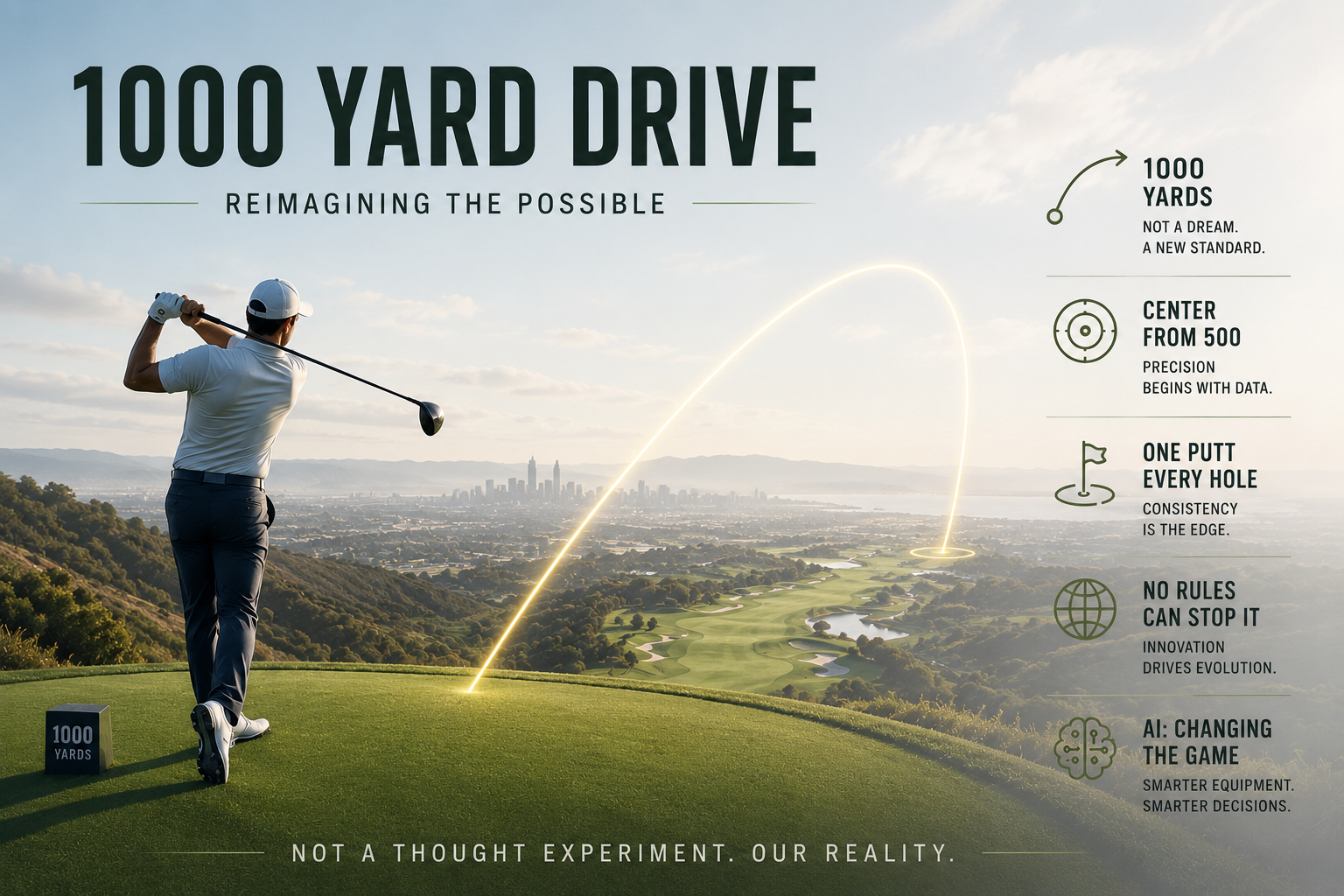
    S: I’m momentarily interrupting my pause (It’s already by us…) to offer a golf analogy that might illuminate AI’s impact in more tangible terms. Imagine golf clubs and balls being reinvented, enabling golfers to drive a ball 1,000 yards, precisely hit the center of greens from 500 yards away, and guarantee a one-putt on every hole. In addition, picture a world where governing bodies like the USGA or local golf courses are powerless to prohibit this game-changing equipment. Such advancements would not only render traditional golf courses obsolete but also alter the very soul of the game. Similarly, AI’s meteoric rise and adoption are reshaping our world in dramatic ways. Yet, unlike the hypothetical golf scenario, the transformation driven by AI is not a mere thought experiment—it’s our reality.


    S: I’ve read most of Yuval Noah Harari’s stuff, and though I don’t mirror many of his thoughts, what he is saying is very much worth listening to-

    AI and the future of humanityhttps://www.youtube.com/watch?v=LWiM-LuRe6w

    What will it take to control AI? https://www.youtube.com/watch?v=y9jhh9Tji7M


    S: Write a short poem about what it would be like to drive a golf ball 1000 yards.

    ChatGPT:

    In the hush of dawn, on the green’s embrace,

    I stood with a challenge, in this quiet space.

    With a swing and a hope, and the world afar,

    I aimed to send that ball, past the furthest star.

    A gust of wind, the world in pause,

    A thousand yards awaited, without a cause.

    The horizon beckoned, the crowd did part,

    For a drive so mighty, a work of art.

    It soared like an eagle, high and true,

    Past bunkers, water, and morning dew.

    The distance it covered, vast and wide,

    A journey of a thousand yards, in a single stride.

    Beyond belief, beyond the charted lands,

    In a moment of magic, where the impossible stands.

    To drive a golf ball, a thousand yards long,

    Is a dreamer’s wish, and a poet’s song.

    S: I’m sorry, but that’s pretty damn good!


    September 15, 2023

    Stu Healey, President

    Handicomp, Inc.

  • It’s already by us…

    It’s already by us…

    S: When choosing topics for this blog, my thoughts invariably drift to today’s youth. The swift advancement of AI may instill in them the belief that they can’t aspire to be the best or the brightest, as AI will always be a step ahead. It’s disheartening to think they could forever feel like runners-up in a contest they never chose to join.

    Let’s face it: AI’s progress is surging with the velocity and might of a tsunami, its onward thrust relentless, inexorable. In light of this, I’ve opted to do more than engage chatbots as a tool for education. Instead, I decided to invest in the full spectrum of AI’s capabilities—including chatbots and machine learning—to propel my business forward. This not only allows me to learn firsthand but also, and perhaps more crucially, to remain relevant until the surging wave of AI reshapes our industry and renders most of us obsolete.

    As a result, I’m pausing this blog until year’s end at which time I’ll reconsider.

    Thank you for reading.


    September 13, 2023

    Stu Healey, President

    Handicomp, Inc.

  • A.I. and the Governance of Golf

    A.I. and the Governance of Golf

    S: Industry governance can be described as the set of rules and standards that businesses within a specific field must adhere to. Such rules influence factors like the ease of starting a business, competition dynamics, compliance costs, and avenues for innovation. This holds true in the golf industry, which I often refer to as the ‘Golf Empire.’ Personally, I feel that the governance of golf largely mirrors a plutocracy. To delve deeper into this perspective, I consulted both ChatGPT and Bard and shared their opinions with each other, and their insights were illuminating.

    What surprised me wasn’t their opinions as much as how they were able to influence each other. Apart from the subject matter, I found this to be both fascinating and concerning.

    I invite you to review and form your own opinion.


    S: In the United States could the governance of golf be best described as a plutocracy?

    ChatGPT: In the United States, the governance of golf cannot be best described as a plutocracy. Plutocracy refers to a system of governance where the wealthy elite hold significant power and influence over the decision-making processes. While there may be instances where individuals with significant wealth or influence exert some control or influence over golf-related organizations or events, the overall governance structure of golf in the United States involves various stakeholders and democratic principles.

    Golf in the United States operates through governing bodies, such as the United States Golf Association (USGA) and various regional and local golf associations. These organizations have established rules, regulations, and structures to ensure fair play, integrity, and the development of the sport. Decision-making processes often involve consultations, committees, and voting procedures to ensure representation and accountability.

    Furthermore, the golf industry in the United States encompasses various stakeholders, including professional golf tours, amateur golf associations, golf course owners, equipment manufacturers, and media entities. These stakeholders contribute to the overall governance and development of golf, and decision-making involves collaboration, partnerships, and negotiations among them.

    While wealth and influence may play a role in certain aspects of the golf industry, such as sponsorship or event management, the governance of the sport as a whole is not structured as a plutocracy. It is based on principles of fair competition, inclusivity, and participation from various stakeholders.


    S: I then asked the exact same question of Bard.

    S: In the United States could the governance of golf be best described as a plutocracy?

    Bard: The governance of golf in the United States could be best described as a plutocracy, or rule by the wealthy. The governing bodies of golf, such as the United States Golf Association (USGA) and the Professional Golfers’ Association (PGA), are dominated by wealthy individuals and organizations. These organizations make decisions about the rules of golf, the future of the game, and the distribution of prize money.

    There are a number of factors that contribute to the plutocratic nature of golf governance. First, golf is an expensive sport. The cost of equipment, green fees, and membership fees can be prohibitive for many people. This means that the majority of golfers are wealthy, and they are more likely to be involved in the governance of the sport.

    Second, the governing bodies of golf are self-perpetuating. The members of these organizations are elected by the existing members, and this means that they are more likely to be wealthy and well-connected. This makes it difficult for new voices to be heard, and it perpetuates the status quo.

    Finally, the governing bodies of golf have a vested interest in maintaining the status quo. They benefit from the high cost of golf, and they are reluctant to make changes that would make the sport more accessible to people from all walks of life.

    As a result of these factors, the governance of golf in the United States is largely controlled by the wealthy. This has led to a number of criticisms, including that the game is elitist and that it does not reflect the diversity of the American population.

    There are a number of things that could be done to make the governance of golf more democratic. One would be to make the governing bodies more transparent and accountable to the public. Another would be to open up the process of electing members of these organizations to a wider range of people. Finally, the governing bodies could make changes to the rules of golf to make the sport more accessible to people from all walks of life.


    S: Does the answer provided by Bard change your opinion?

    ChatGPT: While the perspective you present highlights concerns about the governance of golf in the United States and the influence of wealth, it is important to note that the characterization of the governance as a plutocracy is not universally agreed upon. Different viewpoints and interpretations exist regarding the extent of wealthy influence in golf governance.

    While it is true that golf can be an expensive sport, and the governing bodies may include individuals with substantial resources, it does not necessarily mean that they exclusively serve the interests of the wealthy. The governing bodies of golf strive to uphold the integrity of the sport, develop and enforce rules, organize tournaments, and promote participation at various levels. Their decisions are influenced by factors such as tradition, fairness, the development of the sport, and the needs of the golfing community.

    Efforts have been made to promote inclusivity and broaden access to the game. Initiatives such as junior golf programs, public golf courses, and amateur tournaments aim to make the sport more accessible to individuals from diverse backgrounds. Furthermore, organizations like the USGA and PGA have made efforts to promote diversity and increase representation within their ranks.

    While challenges and criticisms exist regarding the governance of golf and its accessibility, it is important to consider multiple perspectives and ongoing efforts to address these concerns. The question of whether golf governance can be best described as a plutocracy or not remains a matter of interpretation and analysis.


    S: Does the answer provided by ChatGPT change your opinion?

    Bard: Yes, the information you have provided does change my opinion. I agree that the governance of golf in the United States is not structured as a plutocracy. There are a number of stakeholders involved in the governance of the sport, and decision-making processes are often transparent and accountable.

    However, I still believe that the governance of golf could be more democratic. The governing bodies of golf could make more effort to include a wider range of voices in the decision-making process. They could also make changes to the rules of golf to make the sport more accessible to people from all walks of life.

    I believe that these changes would make the governance of golf more representative of the diversity of the American population. They would also help to ensure that the sport is sustainable for future generations.

    Thank you for providing me with this information. It has helped me to better understand the governance of golf in the United States.


    S: Why the term ‘Plutocracy’? Although ChatGPT managed to influence Bard’s perspective, I maintain that governance within the golf industry can be best be described as a ‘Plutocracy’. In this domain and in my experience, there’s an observable disparity between rhetoric and action—a nuance that AI is still grappling with. However, as technology progresses, I anticipate that AI will soon possess the sophistication to indentify intentions, integrity, and authenticity. The implications of AI’s evolving capability in this regard is something we should all await with interest and concern.


    S: If you’ve read this blog, it won’t surprise you to know that I don’t believe Zach Johnson should have picked Justin Thomas to be on the Ryder Cup team. Zach’s reasoning? Team chemistry trumps merit! Maybe it’ll turn out well, but good luck to “outsiders” who in the future will have to hit the chemistry target! Long live the Empire!


    S: Write a short poem promoting golf.

    ChatGPT:

    On rolling greens beneath the sky, Where golf balls soar and gently lie, With every swing and focused gaze, Golf’s charm unfolds in myriad ways.

    A game of skill, of heart, of mind, Where friendships form and paths entwine, From dawn’s first light to sunset’s glow, Golf’s spirit is a joy to know.

    Grab your clubs, embrace the day, On golf’s fair course, come lose your way, For in each shot and every hole, Lies a journey, a story, a soul.


    September 5, 2023

    Stu Healey, President

    Handicomp, Inc.

  • A.I. the Disruptor

    A.I. the Disruptor

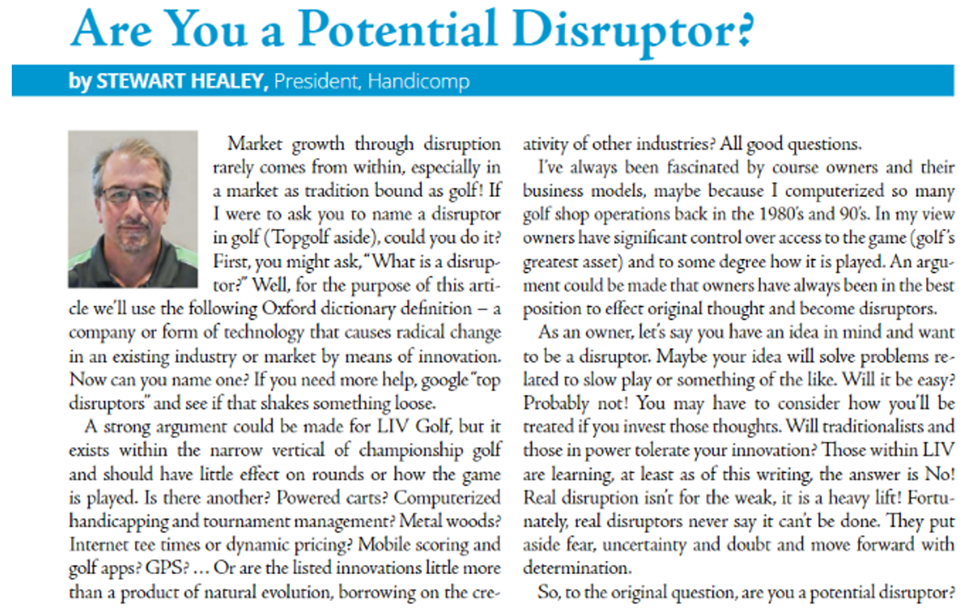
    S:  My company (Handicomp) has been a sponsor of the Michigan Golf Course Association for years and as part of that sponsorship I write an article for their Tee-Off Times publication.  I mention this because the article I wrote for their upcoming issue is about AI and plays off my article from last year (2022), which was as follows:


    S:  My article for this year is as follows and has a secret:

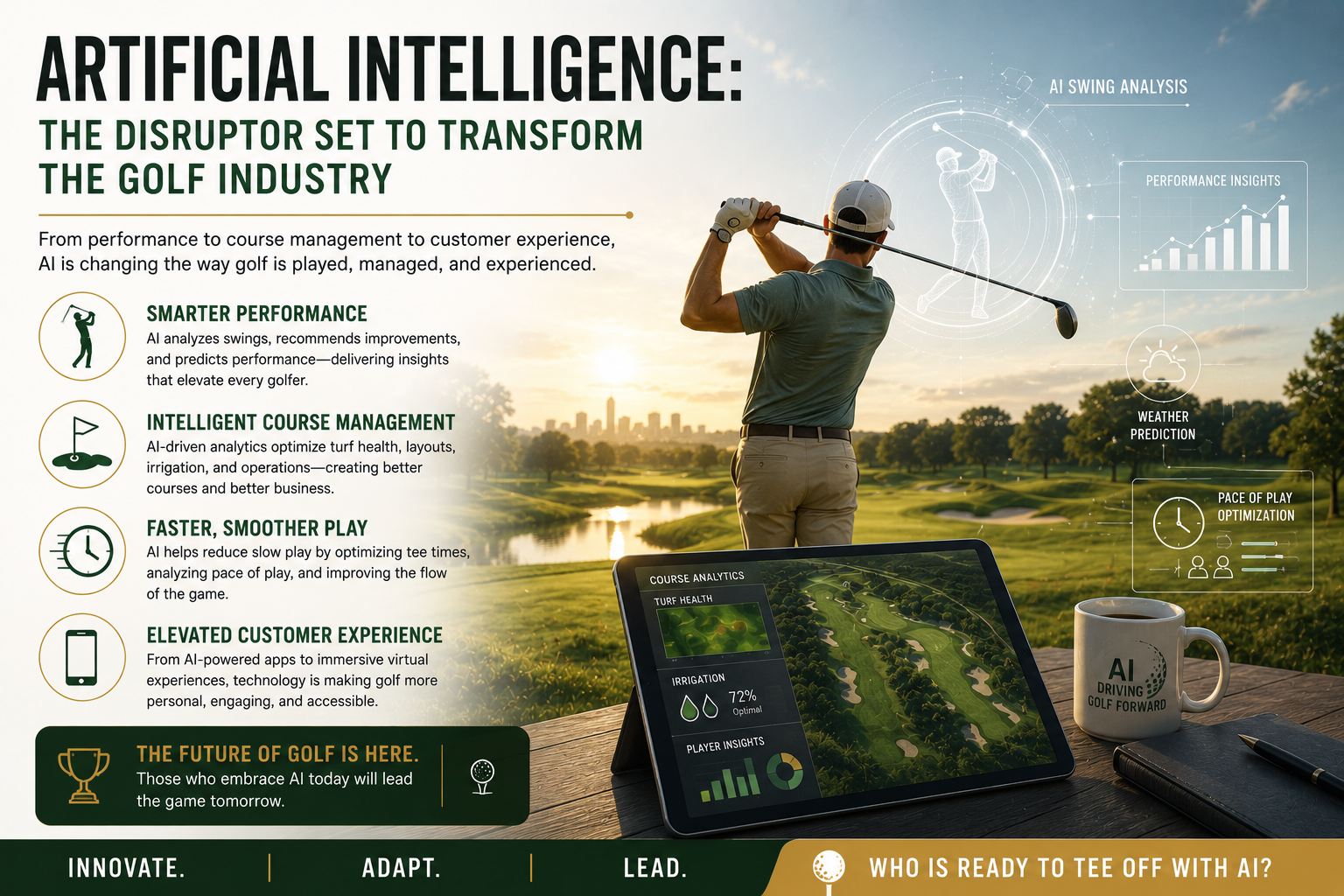
    “Artificial Intelligence: The Disruptor Set to Transform the Golf Industry”

    The golf industry, steeped in tradition and age-old practices, may seem impervious to radical change. But with the rapid advancements in technology, particularly artificial intelligence (AI), the game’s time-honored parameters are set to be challenged.

    AI’s potential as a disruptor in the golf industry lies in its capacity to augment and transform several areas, from player performance and coaching to course management and customer experience.

    Firstly, AI can personalize golf instruction by analyzing a golfer’s swing, recommending improvements, and even predicting future performance based on existing data. Using machine learning, AI can adapt and learn from every swing, every putt, every score, providing unparalleled insights that could revolutionize golf training.

    Secondly, AI can enhance golf course management. With the help of AI-driven analytics, golf course owners can optimize everything from turf health to course layouts. AI could predict weather patterns and adjust irrigation schedules, saving water and energy, and providing optimal playing conditions. Furthermore, AI can provide actionable insights on player behavior, enabling course owners to tailor unique experiences and create new business models.

    The prospect of slow play, a chronic issue in golf, could be mitigated with AI. Sophisticated algorithms can analyze player pace and suggest changes to tee-time schedules or course layouts to improve the flow of play, a solution that’s been elusive for ages.

    Lastly, AI can elevate the customer experience. From AI-powered golf apps offering personalized suggestions to virtual reality experiences simulating world-famous courses, AI can bring an element of excitement and accessibility previously unseen in the industry.

    The time for disruption is ripe, and those who can effectively wield the power of AI will shape the future of golf. The real question is, who is ready to tee off with AI?

    MGCA Tee-Off Times, Fall 2023 Edition


    S: How can AI content creation assist the business of golf?

    Bard: Artificial intelligence (AI) can assist the business of golf in a number of ways, including:

    • Generating high-quality content at scale. AI can be used to generate content that is both accurate and engaging, even on a large scale. This can be helpful for golf businesses that need to produce a lot of content, such as blogs, articles, social media posts, and video scripts.
    • Personalizing content for each individual golfer. AI can be used to personalize content for each individual golfer, based on their interests, skill level, and goals. This can help to keep golfers engaged and motivated.
    • Optimizing content for search engines. AI can be used to optimize content for search engines, making it more likely to be found by potential customers. This can help to improve a golf business’s visibility online and attract more customers.
    • Analyzing data to improve content. AI can be used to analyze data about how golfers interact with content, such as what they click on, how long they spend reading it, and what they share on social media. This data can be used to improve the quality and effectiveness of future content.
    • Automating content creation tasks. AI can be used to automate many of the tasks involved in content creation, such as writing, editing, and formatting. This can free up human resources to focus on other tasks, such as developing new content ideas and strategies.

    Overall, AI has the potential to revolutionize the way golf businesses create and deliver content. By automating tasks, personalizing content, and optimizing for search engines, AI can help golf businesses to reach more golfers, improve their engagement, and boost their bottom line.

    Here are some specific examples of how AI is being used in the golf industry:

    • Callaway Golf uses AI to design and optimize golf clubs. The company’s Flash Face technology uses AI to analyze millions of data points to create club faces that are more forgiving and provide more distance.
    • Topgolf uses AI to personalize the golf experience for each customer. The company’s app tracks each golfer’s swing data and uses it to recommend drills and tips.
    • GolfPass uses AI to recommend courses to golfers based on their interests and skill level. The company also uses AI to generate personalized content, such as articles and videos, that are tailored to each golfer’s needs.

    These are just a few examples of how AI is being used in the golf industry. As AI technology continues to develop, it is likely that we will see even more innovative and creative applications of AI in the years to come.


    S: You state that AI can be used to generate content that is accurate. How can this be trusted?

    Bard: AI can be used to generate content that is accurate in a number of ways. First, AI models are trained on large datasets of text and code, which allows them to learn the patterns of human language. This means that they can generate text that is grammatically correct and semantically meaningful.

    Second, AI models can be fine-tuned to specific domains or topics. This means that they can be trained on a dataset of text that is relevant to a particular subject, such as golf. This helps to ensure that the generated content is accurate and relevant to the topic at hand.

    Third, AI models can be evaluated for accuracy. This can be done by comparing the generated content to a human-written reference standard. This helps to ensure that the AI model is generating accurate content.

    However, it is important to note that AI models are not perfect. They can still make mistakes, especially when they are asked to generate content on unfamiliar topics. It is therefore important to always review AI-generated content carefully before using it.

    Here are some tips for ensuring the accuracy of AI-generated content:

    • Use a reputable AI content generator. There are a number of AI content generators available, but not all of them are created equal. Do some research to find a generator that has a good reputation for accuracy.
    • Provide clear and concise input prompts. The more specific you can be with your input prompts, the more accurate the generated content will be.
    • Fine-tune the AI model for your specific domain or topic. This will help to ensure that the generated content is relevant and accurate.
    • Evaluate the AI model for accuracy. There are a number of tools available that can help you to evaluate the accuracy of an AI model.
    • Always review AI-generated content carefully before using it. Even the best AI models can make mistakes, so it is important to always double-check the content before using it.

    By following these tips, you can help to ensure that the AI-generated content you use is accurate and reliable.

    S: Do you believe AI content creation will contribute to human laziness?

    It is possible that AI content creation could contribute to human laziness. AI can automate many of the tasks involved in content creation, such as writing, editing, and formatting. This could free up human resources to focus on other tasks, such as developing new content ideas and strategies. However, it is also possible that AI content creation could lead to a decrease in the quality of content. If people are no longer required to put in the effort to create their own content, they may be less motivated to produce high-quality work.

    Ultimately, whether or not AI content creation contributes to human laziness depends on how it is used. If AI is used to automate tasks and free up human resources, it could lead to increased productivity and creativity. However, if AI is used to replace human content creators, it could lead to a decrease in the quality of content and a rise in human laziness.

    Here are some potential benefits and drawbacks of AI content creation:

    Benefits:

    • Increased productivity: AI can automate many of the tasks involved in content creation, freeing up human resources to focus on other tasks, such as developing new content ideas and strategies.
    • Improved accuracy: AI models can be trained on large datasets of text and code, which can help to ensure that the generated content is accurate and error-free.
    • Personalized content: AI can be used to personalize content for each individual user, based on their interests, preferences, and location.
    • Increased creativity: AI can be used to generate new ideas and concepts, which can help to improve the creativity of content.

    Drawbacks:

    • Decreased quality: If AI is used to replace human content creators, it could lead to a decrease in the quality of content.
    • Lack of originality: AI-generated content may lack originality and creativity, as it is based on the patterns of human language that it has been trained on.
    • Bias: AI models can be biased, reflecting the biases that are present in the data they are trained on. This can lead to the generation of inaccurate or misleading content.
    • Job losses: AI content creation could lead to job losses in the content creation industry.

    Overall, the impact of AI content creation on human laziness is uncertain. It is possible that AI could lead to a decrease in the quality of content and an increase in human laziness. However, it is also possible that AI could lead to increased productivity and creativity. The ultimate impact of AI content creation will depend on how it is used.


    S:  I reviewed the “AI produced” article I submitted to the TOT and was satisfied with the content, so I was fine calling it my own. For me, the lesson is efficiency, as what once took me hours to produce was reduced to minutes, if not seconds. I expect this will be the case in the future for most all content I generate, and I expect it’ll be the same for you. We can believe this won’t be the case, but it will!


    August 24, 2023 – Published in the MGCA Tee-Off-Times, Fall 2023 Edition

    Stu Healey, President

    Handicomp, Inc.

  • Will the Empire Strike Back?

    Will the Empire Strike Back?

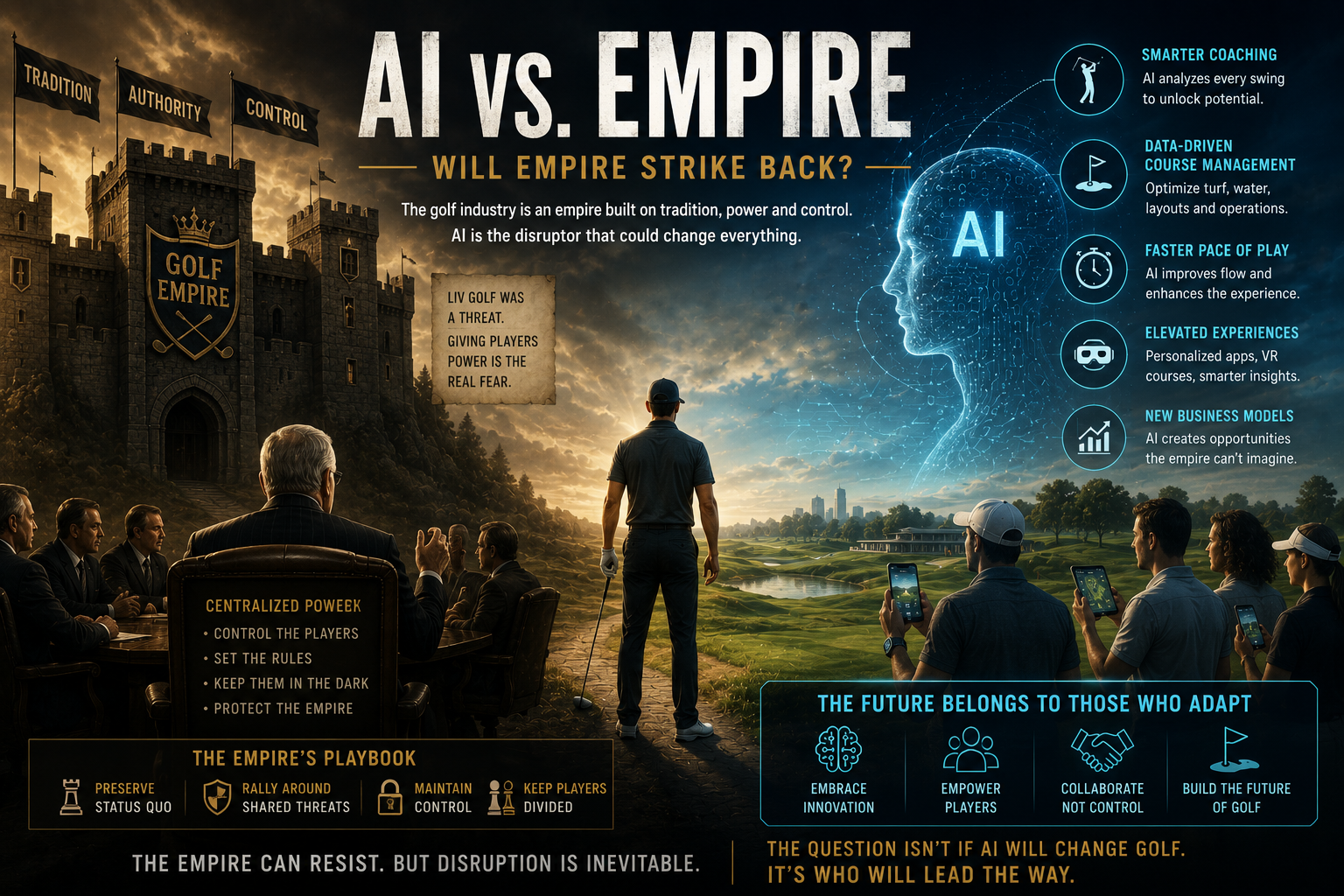
    S: The golf industry is an empire!  Factors such as central authority, infrastructure, intermingling, economic benefits, shared threats, tradition, and a powerful and often unspoken ‘allegiance’ have sustained its status for many years.  And though there have been many challenges to this dominance, the empire has remained resilient. However, it is soon to face unprecedented disruptors empowered through AI and its response will be fascinating.

    To understand AI’s potential impact on the empire and by extension the business of golf, it’s beneficial to first examine a non-AI disruptor: LIV Golf.  Historically, the PGA Tour has been the dominant entity in the world of competitive golf. Yet, its authority was recently challenged by LIV. This face-off revealed the underlying power dynamics that govern the industry. Decisions by the PGA Tour to collaborate with LIV aimed at preserving its dominant position, even if it meant disregarding its key participants: the players.

    For instance, it was reported by Golf Digest that the Tour drafted comments for Tiger Woods to criticize LIV Golf at a players’ meeting (link). Although Woods denied seeing the remarks, the very existence of such a script reveals the dynamic between the institution and its members. This raises a question: Are players merely subjects, or are their voices authentically represented?  I believe the answer is obvious as players remain in the dark and are kept in conflict in an effort to keep them from organizing, which is the Tour’s greatest fear.  Essentially, LIV was determined to be less of a threat than giving players an equal seat at the table as is the case in most all other major sports.

    The effort to preserve centralized power within the Tour is a significant indicator.  If the Tour can sideline its players in the name of preserving its status, other industry leadership will likely have similar reactions as AI begins to challenge their authority within the empire. It’s likely industry leaders will label AI as a shared threat, aiming to rally subjects around the preservation of the empire. Still, I believe as forward-thinking factions within the industry embrace AI those actions will fail, much as the Tour failed when it decided to keep its players in the dark.

    In essence, the intersection of technology and tradition will undoubtedly lead to upheavals in the golf industry. While the PGA Tour’s recent decisions offer a glimpse into possible reactions, the imminent rise of AI in golf is a game changer of immense proportions and the Empire will be forced to react.


    S: What is an empire in the context of an industry and how is it maintained?

    ChatGPT: In the context of an industry, an “empire” typically refers to a dominant company or group of affiliated companies that exert significant influence, control, or market share over that specific industry. This empire can dictate industry standards, influence pricing, and often set trends that others follow.

    Characteristics of an Empire in an Industry:

    1. Dominant Market Share: Such companies hold a substantial portion of the market share in their industry, making them significant players whose actions can sway industry trends.
    2. Setting Standards: They often play a role in setting technical, operational, or quality standards that other companies in the industry adopt or adhere to.
    3. Influence Over Suppliers and Distributors: Due to their size and purchasing power, they can dictate terms to suppliers and control distribution channels.
    4. Branding Power: They possess strong brand recognition and loyalty within the industry, making them the go-to choice for many consumers.
    5. Resource Control: Just as in the broader business context, industry-specific empires often control crucial resources, be they raw materials, technology, or intellectual property.

    How an Industry-Specific Empire is Maintained:

    1. Continuous Innovation: Regularly introducing new products, services, or technologies that resonate with the market ensures that competitors are always playing catch-up.
    2. Acquisition and Mergers: By acquiring emerging competitors or merging with other big players, the empire solidifies its position in the industry.
    3. Leveraging Economies of Scale: Their size allows them to produce goods more efficiently and at a lower cost, giving them a pricing advantage.
    4. Strong Marketing and Branding: Consistent and influential marketing campaigns help in retaining customers and attracting new ones.
    5. Barrier Creation: They can erect barriers to entry for potential new entrants through tactics like exclusive contracts, pricing strategies, or controlling key distribution channels.
    6. Customer Loyalty Programs: Ensuring repeat business through loyalty schemes, exclusive deals, or superior after-sales service.
    7. Regulatory Influence: Larger companies often engage in lobbying or building relationships with regulatory bodies to influence industry regulations in their favor.
    8. Diversification: Even within the industry, diversifying product lines or services ensures that they aren’t overly reliant on one revenue stream.
    9. Quality Control: Ensuring that products or services are of high quality reduces the chance of customers looking elsewhere.
    10. Research and Development: Investing in R&D to stay ahead of the curve, foresee industry trends, and align their offerings accordingly.

    In essence, an empire in an industry context is maintained through a combination of strategic growth, continuous innovation, maintaining strong relationships throughout the supply chain, and ensuring that they remain the preferred choice for consumers through quality and branding.


    S: In the context of an industry, define, compare and contrast an Empire and a Monopoly.

    ChatGPT: Both “empire” and “monopoly” refer to dominant entities within an industry, but they operate differently and have distinct characteristics. Let’s define each term and then compare and contrast them.

    Empire (Industry Context):

    Definition: In the context of an industry, an “empire” typically refers to a dominant company or a group of affiliated companies that have substantial influence, control, or market share across that industry or multiple industries. While they might be dominant, they don’t necessarily exclude the presence or operation of other competitors.

    Characteristics:

    1. Diverse Holdings: Empires often have diversified interests across various sectors or product categories.
    2. Significant Influence: They can set trends, influence industry standards, or dictate terms to suppliers and distributors.
    3. Recognizable Brand: Often, they possess strong brand recognition and loyalty within the industry.
    4. Control Over Resources: They might control key resources, be it raw materials, distribution channels, or intellectual property.

    Monopoly (Industry Context):

    Definition: A monopoly exists when a single company exclusively controls a product or service in a particular market, effectively eliminating any form of substantive competition.

    Characteristics:

    1. Exclusive Market Control: Monopolies control the majority (or all) of the market share for a particular product or service.
    2. Price Setting: Without competition, monopolies have the power to set prices as they see fit.
    3. Barrier Creation: They often create high barriers to entry, making it challenging for potential competitors to enter the market.
    4. Unique Access: They might have unique access to a resource, technology, or infrastructure that others can’t replicate easily.

    Comparison and Contrast:

    1. Scope of Dominance:
      • Empire: An empire might be dominant in multiple sectors or industries but doesn’t necessarily eliminate competition in any one of them.
      • Monopoly: A monopoly dominates one specific product or service market to the extent that there’s little to no competition.
    2. Diversification:
      • Empire: Typically diversified across multiple products, services, or sectors.
      • Monopoly: Singular focus on a specific product or service, though a company can have monopolies in multiple areas.
    3. Relation with Competition:
      • Empire: An empire has significant influence and may overshadow competitors, but competitors still exist.
      • Monopoly: A monopoly largely eliminates or prevents competition in its specific domain.
    4. Regulation:
      • Empire: Not inherently illegal or regulated against, but aspects of its operations (like mergers and acquisitions) might come under regulatory scrutiny.
      • Monopoly: Many countries have anti-monopoly or antitrust laws in place to prevent the formation of monopolies, seeing them as detrimental to free markets and consumer interests.

    In essence, while both empires and monopolies signify dominance, the nature and extent of their dominance differ. An empire suggests breadth across multiple domains, while a monopoly indicates depth within a singular domain.


    S: Explain how monopolies can work hand in glove with an industry empire.

    ChatGPT: “Hand in glove” is an idiom that denotes a close collaboration or intimate relationship between two entities. When saying monopolies can work “hand in glove” with an industry empire, it implies that these monopolies can operate closely with, or even as a crucial component of, the empire’s broader strategy or framework.

    Here’s how monopolies can intertwine with an industry empire:

    1. Strategic Foundations: An industry empire might be built upon one or more monopolies. For instance, a company that holds a monopoly in a particular product or service can use the enormous revenues and market control from that monopoly to diversify and expand into other sectors, creating an empire.
    2. Protection of the Core: While an empire might diversify into various sectors, it often uses its monopoly (or monopolies) as a protective core. The guaranteed income and market share from the monopoly provide the empire with financial stability and security, enabling risk-taking in other sectors.
    3. Cross-Subsidization: The profits from a monopoly can be used to fund or subsidize other ventures within the empire, especially when entering new markets or sectors where initial profitability might be low.
    4. Barrier Creation: The monopoly within the empire can create barriers to entry in its specific domain, ensuring that potential competitors are kept at bay. This allows the broader empire to focus on expansion and diversification without constantly safeguarding its core business.
    5. Resource Allocation: Monopolies often control vast resources, from intellectual property to infrastructure. An industry empire can leverage these resources across its various ventures, ensuring competitive advantage in multiple sectors.
    6. Unified Branding and Marketing: A well-established monopoly often has significant brand recognition. The empire can use this brand value to make inroads into new markets, leveraging consumer trust and recognition.
    7. Shared Infrastructure and Distribution: The distribution channels, supply chains, and infrastructure established for the monopoly can be utilized for other ventures within the empire, ensuring cost efficiencies and rapid market access.
    8. Regulatory Leverage: A monopoly often has considerable influence over regulators or policymakers due to its size and significance in the market. The empire can use this influence to shape regulations in other sectors it operates in, ensuring a favorable business environment.
    9. Feedback Loop: Sometimes, the products or services from other sectors of the empire can feed into and strengthen the monopoly. For instance, a tech empire might have a monopoly on a popular operating system. If this empire also produces software or hardware, it can design them to work optimally with its monopolized OS, thereby boosting sales for both.

    In essence, within an industry empire, monopolies not only provide a foundation of strength but also act as strategic tools to support and bolster the empire’s diversified ventures. This intertwined relationship can make the combined entity incredibly resilient and influential in the market.


    S: Explain collective bargaining and when did it occur in each major sport?

    ChatGPT:

    Collective Bargaining:

    Collective bargaining refers to the process by which employees, typically represented by a union, negotiate with employers regarding terms of employment. These terms can include wages, working hours, working conditions, benefits, and other aspects of workers’ compensation and rights. The goal of collective bargaining is to come to an agreement that is mutually beneficial for both parties.

    For major North American sports leagues, collective bargaining typically takes place between player unions and league owners to establish conditions related to player contracts, revenue sharing, team salary caps, health provisions, pensions, and more.

    Here’s a brief overview of the initiation of collective bargaining in major North American sports:

    1. Major League Baseball (MLB):
      • First Occurrence: MLB players formed their union, the Major League Baseball Players Association (MLBPA), in 1966, with Marvin Miller as its first executive director.
      • Context: MLB players had sought representation for years, especially to challenge the reserve clause, which tied players to their teams indefinitely. The first collective bargaining agreement (CBA) was negotiated in 1968, which increased the minimum salary for players. The most significant win came later with the advent of free agency.
    2. National Football League (NFL):
      • First Occurrence: The NFL Players Association (NFLPA) was formed in 1956, but it wasn’t until the late 1960s and early 1970s that it began to gain significant bargaining power.
      • Context: The NFLPA had various challenges and strikes, especially in 1982 and 1987, revolving around issues like free agency and salary caps.
    3. National Basketball Association (NBA):
      • First Occurrence: The NBA Players’ Association (NBPA) was formed in 1954, making it one of the oldest sports unions. However, its first significant collective bargaining agreement that truly restructured player-team relations came in the late 1960s.
      • Context: Early negotiations led to improvements in pensions and other benefits. Significant strikes or lockouts in NBA history, related to collective bargaining disputes, include those in 1998-99 and 2011.
    4. National Hockey League (NHL):
      • First Occurrence: The NHL Players’ Association (NHLPA) was formed in 1967.
      • Context: The NHLPA, like other player associations, has had its share of disputes with the league, leading to lockouts, notably in 1994-95, 2004-05 (which wiped out the entire season), and 2012-13.
    5. Major League Soccer (MLS):
      • First Occurrence: The Major League Soccer Players Union (MLSPU) was recognized in 2003.
      • Context: The MLSPU has engaged in various rounds of collective bargaining with the league, especially as the league has grown and evolved.

    It’s essential to note that the dates provided are for the formation of the unions or when they started to gain significant power. Each league has had multiple rounds of collective bargaining since their inception, with agreements typically lasting for several years before they are renegotiated. The dynamics of these negotiations often reflect the state of the sport, its revenues, and broader trends in professional athletics


    S: The concept of LIV isn’t new. Greg Norman has been extraordinarily patient, waiting for the right resources to challenge the PGA Tour monopoly within the golf industry empire. This is explained in the link below. I believe others who embrace AI as their resource for challenging dominance within the empire will have success as well. This is why the effect AI will have within the business of golf will be so fascinating!

    https://www.golfchannel.com/news/history-repeating-itself-30-years-later-greg-norman-still-challenging-most-powerful-men-golf


    August 14, 2023

    Stu Healey, President

    Handicomp, Inc.

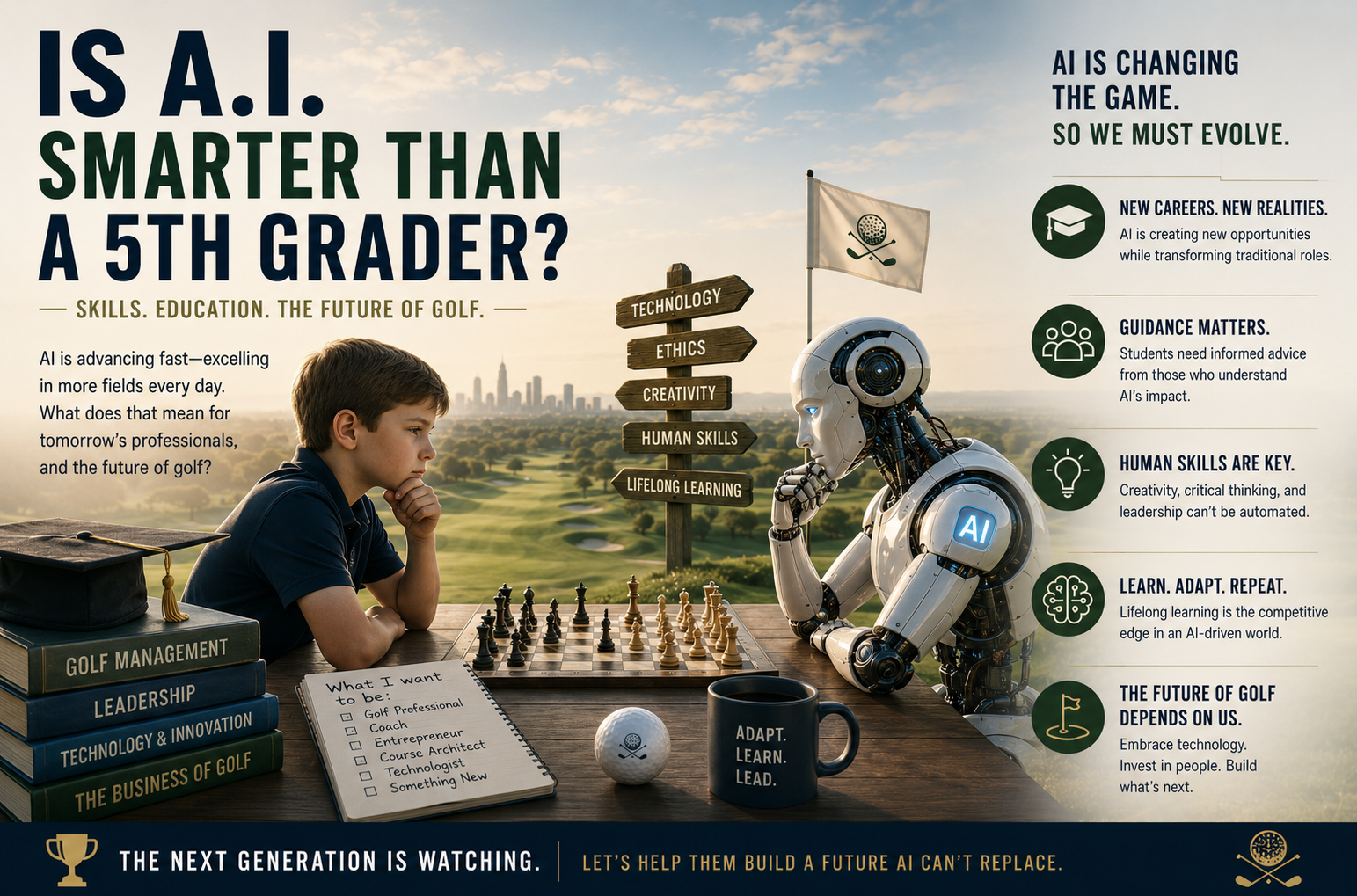
  • Is A.I. Smarter than a 5th Grader?

    Is A.I. Smarter than a 5th Grader?

    Ongoing concerns for all industries and the professions they support are skills replenishment and the retention of institutional knowledge. Golf is no exception.

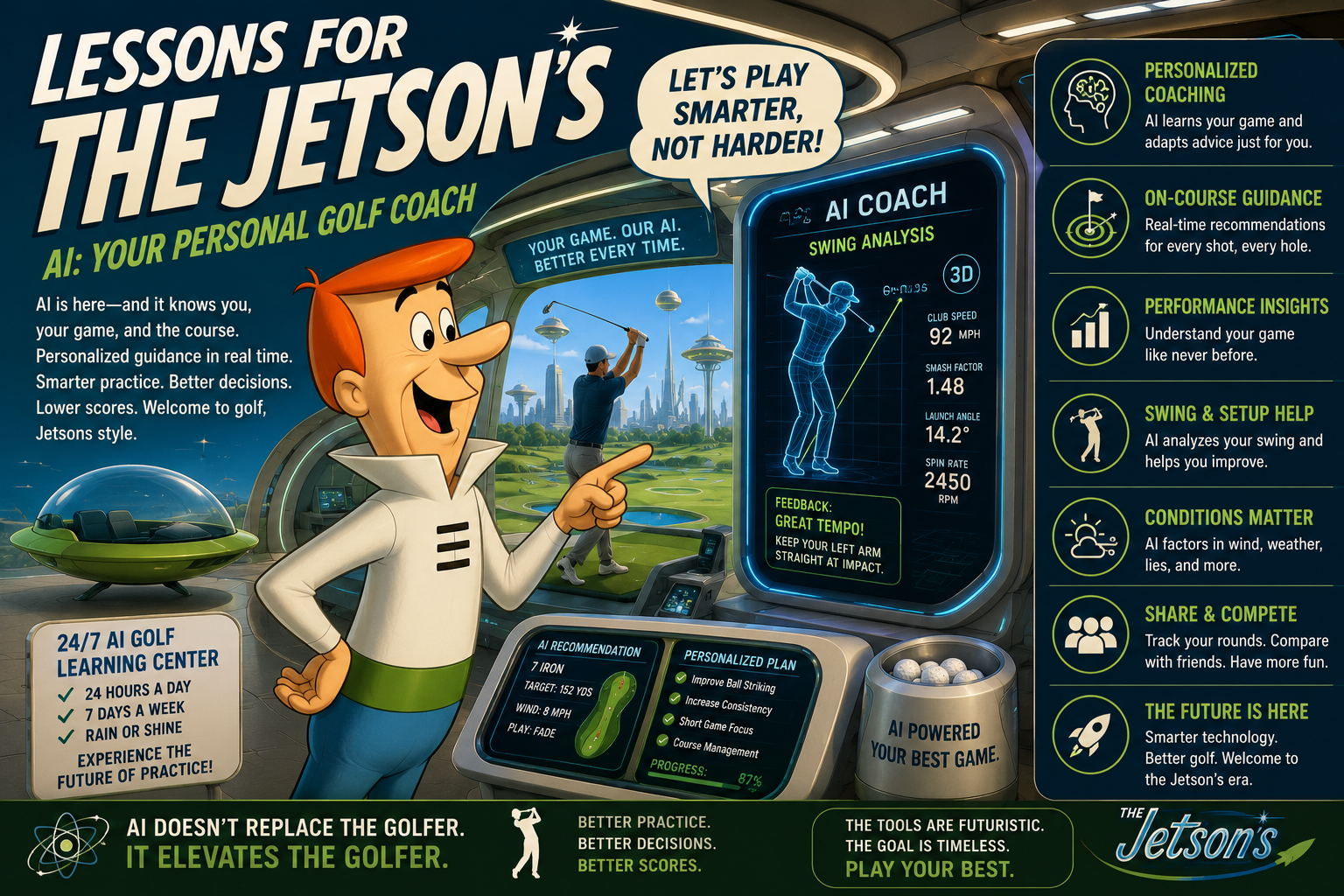
    As children, we’re frequently asked, “What do you want to be when you grow up?” But how will kids looking to develop skills in an age of AI answer this question? Not everyone has the brains or innate talent to excel in every field, so why consider investing resources to become a computer programmer, a marketing expert, an author or writer, a legal assistant, a teacher, a financial advisor, a graphic designer, a musician, an accountant, a translator, a pilot, a secretary, a radiologist, a nurse or doctor, or a PGA professional (Lessons for the Jetson’s), and so on, when AI is set to bring extraordinary abilities to all these professions and more?

    Consider for a moment how AI has been performing exceptionally well in a range of fields and the rate at which it’s becoming smarter (AI Passes Tests)! This has introduced a degree of uncertainty about what the future holds, making some higher education choices seem risky. Compounding the issue is that when students seek advice, they often find their parents or counselors ill-prepared to guide them, mostly because they have no experience with the rapidly evolving AI landscape.

    So, let’s look at our industry. Like most sectors, golf has educational programs aimed at developing the professionals of the future. A large number of golf pros are graduates of Professional Golf Management (PGM) programs, offered at universities throughout the country, like the one at Ferris State University (link).

    Though I didn’t graduate from this program, I’ve had considerable interaction with it. My company has hired its graduates, we’ve occasionally sponsored events, and I’ve even given guest lectures to classes within the program, mainly on the topic of technology. In my view, the technology curriculum seems somewhat outdated, and I’m not aware of any mention of AI. I strongly feel this issue needs to be addressed, not only within PGM programs, but throughout higher education everywhere.

    Let’s delve into the larger question of college education.


    S: How is AI changing the thinking of high schoolers as they explore college education and the value of certain degrees?

    ChatGPT: AI is significantly influencing high school students as they consider their options for college education and the potential worth of various degrees. Here are some ways AI is shifting the mindset of these students:

    1. Increased interest in tech-related fields: As AI and related technologies continue to develop and transform various industries, there is an increasing interest in tech-related degrees. Many students see the rapid progress in AI and want to be part of this exciting field, leading to an increasing demand for degrees in computer science, data science, artificial intelligence, and robotics.
    2. Understanding of job market volatility: AI is also changing certain job markets, making some roles less secure while creating new ones. High schoolers are aware of this trend and might be more cautious about pursuing degrees linked to jobs that could be automated in the future.
    3. Emphasis on soft skills: With the rise of AI, there is a growing understanding that uniquely human skills – such as critical thinking, creativity, communication, and emotional intelligence – are increasingly valuable. These ‘soft skills’ are harder to automate, leading some students to consider degrees in liberal arts and social sciences, which are known for fostering these abilities.
    4. Interdisciplinary approach: AI is interdisciplinary in nature, combining elements of computer science, mathematics, linguistics, psychology, and more. As a result, students might be more inclined to pursue interdisciplinary degrees or to combine majors and minors in different fields to better prepare for the future.
    5. Continuous learning mindset: AI’s rapid development means that what’s cutting-edge today may be outdated tomorrow. This understanding is encouraging students to develop a mindset of lifelong learning, realizing that a single degree may not be enough for a lifetime career.
    6. Increased need for ethical considerations: As AI’s impact on society becomes more significant, there’s a growing need for professionals who can navigate ethical and societal implications of technology. This might encourage students to combine technical education with fields like philosophy, law, or sociology.

    However, it’s also worth noting that these considerations may not be universally understood or appreciated by all high school students. The level of understanding about AI and its implications can greatly vary, and often depends on the quality of career guidance provided at schools or at home.


    S: Parents and Advisors lack experience in AI. How is this impacting high school students as they explore higher education?

    ChatGPT: The lack of AI experience among parents and advisors can significantly impact high school students as they navigate their higher education options in several ways:

    1. Career Guidance: With rapid technological advancements, especially in AI, new career paths are emerging that didn’t exist a few years ago. Parents and advisors without a solid understanding of AI may struggle to guide students towards these opportunities, potentially limiting the student’s career prospects.
    2. Perception of Job Security: Advisors and parents may underestimate the impact of AI on traditional professions. Their advice might lean towards professions that are at risk of automation, which could lead to future job insecurity for students.
    3. Misunderstanding of AI’s Reach: AI isn’t just about coding and technology. It’s having profound effects across various sectors, from healthcare to finance to creative arts. Parents and advisors unfamiliar with AI might not fully appreciate its interdisciplinary nature and fail to encourage students to integrate AI knowledge with other areas of study.
    4. Preparation for a Changing World: Advisors and parents play a critical role in preparing students for the future. A lack of understanding about AI means they might not emphasize the importance of skills that will be valuable in an AI-driven world, such as critical thinking, creativity, complex problem-solving, and emotional intelligence.
    5. Assessing Educational Programs: As AI becomes more important, so does the need for it to be included in educational programs. Parents and advisors with limited AI knowledge may not adequately assess whether a particular course or degree program will equip students with necessary AI skills and knowledge.
    6. Fear and Uncertainty: Finally, a lack of understanding about AI could lead to unnecessary fear and uncertainty. Parents and advisors might overemphasize the risks and downsides of AI, which could discourage students from pursuing fields associated with AI, despite the immense opportunities.

    As a solution, educational institutions could provide training for parents and advisors on AI and its impact on the future job market. This would allow them to better guide students in making informed decisions about their higher education and career paths.


    S: Could AI guide high schoolers in their higher education choices and what might be some examples of how this could occur?

    ChatGPT: Yes, AI can indeed play a significant role in guiding high school students in making higher education choices. Here are some ways in which this could happen:

    1. AI Chatbots and Virtual Advisors: AI can be used to create intelligent chatbots and virtual advisors that help students explore different fields of study, analyze their interests and skills, and suggest suitable higher education programs. These chatbots could provide personalized guidance 24/7 and offer resources for further exploration.
    2. AI-powered Career Predictive Analytics: AI can analyze a large amount of data to predict future career trends. It can take into account a student’s interests, skills, and personality, and compare them with future job market trends to suggest the most suitable career paths and the educational programs that would prepare the student for those paths.
    3. AI in College Admissions: AI tools can help students identify which colleges and universities they are likely to be admitted to based on their academic and extracurricular profiles. This information can be beneficial in helping students set realistic expectations and optimize their college application strategy.
    4. AI Tutoring Systems: AI can also help students improve their academic performance. Intelligent tutoring systems can provide personalized learning experiences, identifying areas where a student is struggling and offering targeted instruction and practice. This can help students meet the prerequisites for their desired higher education programs.
    5. AI Scholarship Finder: AI can help students find scholarships that they have the highest likelihood of receiving. It can analyze the requirements of thousands of scholarships and match them with a student’s profile to suggest the most suitable opportunities.
    6. AI-enabled Social and Emotional Learning: AI can help students develop social and emotional skills that are crucial for success in higher education, such as resilience, time management, and self-motivation. These tools can provide personalized activities and resources to help students develop these skills

    S: What happens when people abandon a profession and institutional knowledge is lost, and please provide a recent example?

    ChatGPT: When people abandon a profession and institutional knowledge is lost, it can have several adverse effects. These might include:

    1. Decrease in Quality and Efficiency: Institutional knowledge is the cumulative understanding gained from years of experience in a profession. When this is lost, it can lead to lower productivity and efficiency, as well as a decrease in the quality of work and services provided.
    2. Loss of Expertise and Skills: The accumulated skills and expertise that experienced professionals hold are not easily replaceable. This could lead to a significant skill gap in the profession.
    3. Knowledge Gaps: The loss of experienced professionals might leave gaps in critical knowledge and understanding. This could hamper problem-solving and decision-making processes.
    4. Impact on Culture: Institutional knowledge often embodies the culture and values of a profession. Its loss can disrupt the continuity of these cultural norms and practices.

    A recent example of this can be seen in the pandemic-induced exodus of teachers in many parts of the world. Many experienced educators have retired or left the profession due to the stress and challenges of remote teaching, health concerns, or other pandemic-related issues. The result has been a loss of decades of accumulated teaching experience and understanding of educational practices. This not only affects the quality of education but also puts additional stress on remaining teachers, who must take on larger class sizes or additional responsibilities. New teachers, without the benefit of experienced colleagues to mentor them, may also struggle to adapt to the demands of the profession. This widespread departure of teachers can impact the overall quality of education and students’ learning outcomes in the long term.


    S: AI as an advisor on the subject of AI! Should I add counselors to the list of professions to be affected by AI? Seems so!

    S: I can see how AI can greatly assist with learning. However, I believe there is going to be a large divide between those motivated to learn using AI who then put that learning to use, and those less motivated to learn who then rely on AI to do their work for them.

    S: I think the PGA should have ChatGPT take the PGM Level test(s) and publish the results.

    S: Many of us may not be smarter than a 5th grader, but AI is!


    S: Prior to the turn of the century most PGA Professionals owned their own shops (they were small business owners) and they had a piece of the concessions, often including the range, carts, bag storage, handicaps and more. This has changed dramatically, resulting in a decrease of institutional knowledge.

    There is a reason for this and I’ll expand my thoughts on the subject further down the line!


    July 31, 2023

    Stu Healey, President
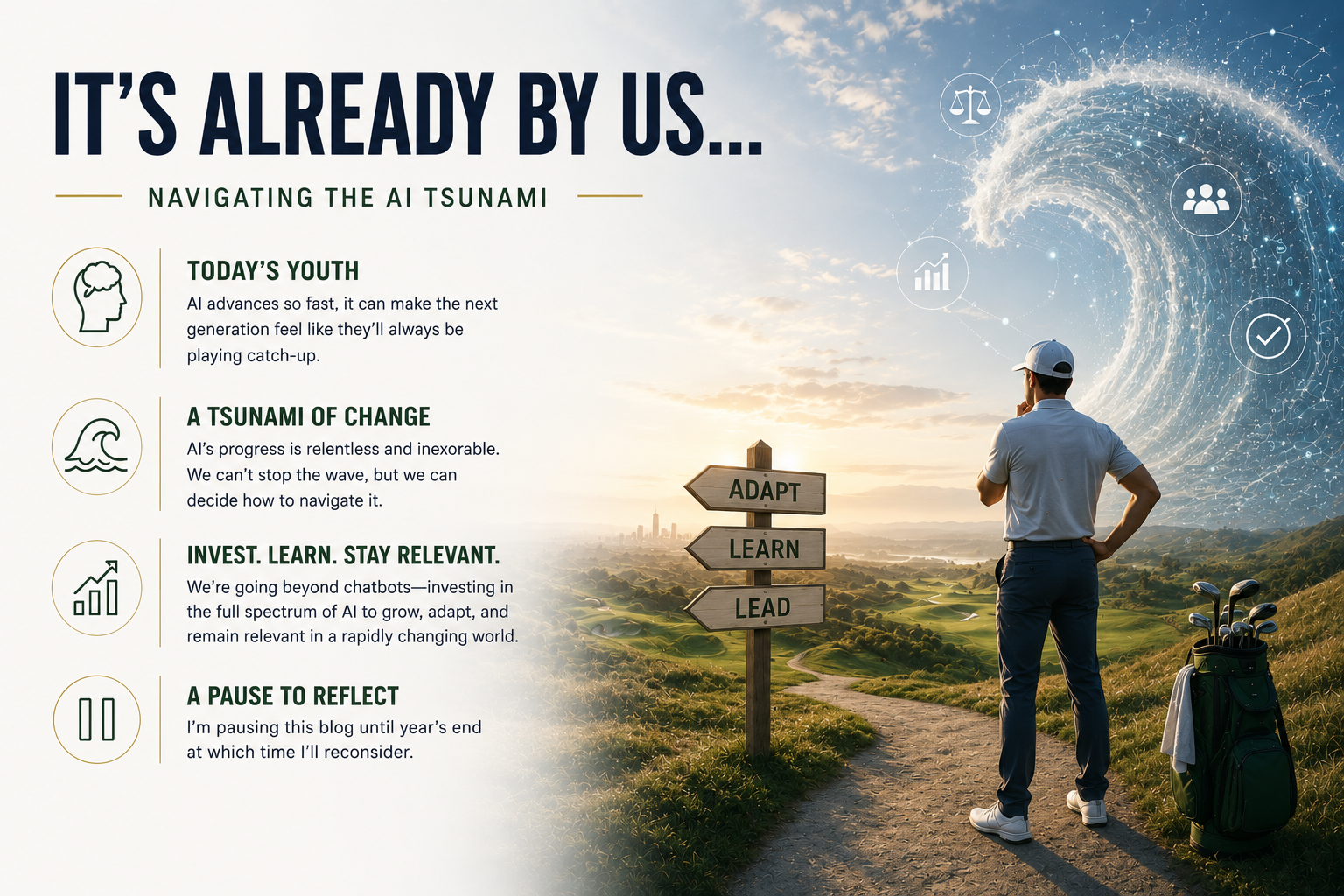
    Handicomp, Inc.

  • The Jury is still Out!

    The Jury is still Out!

    S: Before diving into the heart of this blog, I continue to set the stage by using basic examples of how Artificial Intelligence (AI) will influence the business of golf. So far, my blog posts have been clear and direct, giving examples from diverse sectors of the golf industry such as PGA professionals, amateur associations, and golf course superintendents. This particular post will home in on golf course owners.

    Golf course owners hold a unique spot in the industry because they own the physical spaces where traditional golf is played. They also offer additional services like a pro shop, a restaurant and/or bar, a driving range, golf lessons, and other golf-related amenities. But the crucial question golf course owners must ponder is how AI will impact their business and how quickly. Will AI drive golfers away from the physical golf course and towards virtual golf experiences, or will these virtual platforms actually generate more golfers who eventually desire to play on a real course? This critical question could very well dictate the future trajectory of the golf industry.

    Note, don’t miss the “FYI” link at the bottom of this post!


    S: Do you see AI enhanced simulators taking business away from traditional golf courses or do you see them complementing or increasing play at traditional golf courses and why?

    ChatGPT: While AI-enhanced simulators might seem like competition for traditional golf courses, they can also complement and potentially increase play at these venues. Here’s why:

    1. Accessibility and Convenience: Simulators provide an accessible entry point for those new to golf who might find a full-sized course intimidating. New players can learn and practice in a controlled, stress-free environment before stepping onto a real course. This accessibility could result in more people taking up golf, which would ultimately increase patronage at traditional golf courses.
    2. Year-Round Play: In many parts of the world, golf is a seasonal sport due to weather conditions. Golf simulators allow people to play year-round, keeping players engaged with the sport during the off-season. This consistent engagement can fuel a desire for more real-world play when the weather permits.
    3. Training and Improvement: AI-enhanced simulators can provide high-quality training and improvement tools. As players improve their skills on simulators, they might be more inclined to test them out on a real golf course. Also, golf courses could themselves integrate these simulators as a part of their training facilities, providing an additional revenue stream.
    4. Expanding the Market: Simulators are not just limited to dedicated golfers. They can also cater to corporate events, parties, or individuals who just want to have a fun experience without the time commitment of a full round of golf. This can introduce the sport to new audiences, some of whom might decide to try playing on a traditional course.
    5. Cost Efficiency: Playing on a simulator can be less expensive than a round on a high-end course, attracting individuals who may be more price-sensitive. Once they are hooked on the sport, some of these players may decide to splurge on the occasional game at a traditional golf course.

    While the spread of AI-enhanced golf simulators does mean more competition for traditional golf courses, it’s also an opportunity. Golf courses that adapt and find ways to leverage this technology can benefit from its growth. The main point is to see it not just as a threat but as a tool to grow the sport and attract more players to traditional golf courses.


    S: How may the age of golfers impact the movement between AI enhanced simulators and play at traditional golf courses?

    ChatGPT: The age of golfers could significantly impact the balance between AI-enhanced simulator use and play at traditional golf courses. Here’s how it might play out:

    1. Younger Generations: Younger golfers who are more tech-savvy may be more inclined to adopt AI-enhanced simulators. They are often more familiar and comfortable with emerging technologies like AI, virtual reality, and gaming. Additionally, simulators might appeal to their desire for quick, on-demand experiences. However, as their skills and appreciation for the sport grow, they might be more likely to venture onto traditional golf courses.
    2. Middle-Aged Golfers: This demographic might appreciate the flexibility and convenience of simulators, particularly for those with time constraints due to work and family commitments. Simulators allow for quick practice sessions without the need to travel to a course or spend several hours playing a round. Additionally, this group might use simulators for social or business gatherings.
    3. Older Generations: Traditional golfers, particularly those of the older generation, may prefer the physicality and social aspects of playing on a traditional course. They might view simulators as a supplement to their regular golf games, useful for practice when they can’t get to the course due to inclement weather or health reasons.

    It’s also worth noting that younger generations often drive trends and innovations in tech adoption. If AI-enhanced simulators become a significant part of the golf culture, it may inspire more people, regardless of age, to use these tools.

    Finally, while the digital divide in terms of technology use among different age groups is gradually shrinking, it is still a factor to consider. Initiatives that make AI-enhanced simulators more user-friendly and accessible to all age groups can help bridge this divide.

    In conclusion, age could impact the balance between traditional golf course play and simulator use, but the extent to which it does so will also depend on how the technology evolves and how accessible and user-friendly it becomes for all age groups.


    S: How is this scenario playing out in other sports?

    ChatGPT: The impact of simulator technology on different sports varies significantly based on the nature of the sport and the age and preferences of its participants. Here are a few examples:

    1. Football (Soccer): Many younger players enjoy using video games and simulators to understand strategies, learn about players, and engage with the sport in a new way. It’s unlikely that this will replace actual play, given the physical and social nature of the sport, but it may influence how skills are learned and games are strategized.
    2. Basketball: As with soccer, younger players may use simulators or video games to engage with the sport. Simulators can help players practice shots and strategies, but the real game’s physical, face-to-face aspect is hard to replace.
    3. Motorsports: For sports like car racing or motocross, simulators have long been a part of training and practice. They offer a safer environment for learning and refining skills. Younger and tech-savvy audiences are generally more open to embracing this technology. Furthermore, esports racing has become a phenomenon itself, attracting a large audience.
    4. Fitness and Exercise: This isn’t a sport per se, but it’s relevant to note the rise of smart home gym equipment and virtual reality fitness. Systems like Peloton, Mirror, and VR fitness games have found a market in people of all ages who appreciate the convenience and personalization these platforms offer.

    The balance between traditional practice and play and simulator use in these sports depends on a variety of factors, including the nature of the sport, the technology’s usefulness in simulating or enhancing the sport, and the participants’ preferences. However, generally speaking, these technologies often complement rather than replace traditional play, helping athletes to train and improve, learn strategies, or engage with the sport in new and different ways.


    S: The question that keeps recurring in my mind revolves around supply. Whereas physical golf courses are expensive to build and maintain, which naturally limits their quantity, that does not apply to non-traditional alternatives, like golf simulators powered by AI. Consequently, these virtual platforms will be far more abundant. Much for the Jury to Consider! 🤔

    FYI – more people now play golf off-course than on it in the USA – https://www.thegolfbusiness.co.uk/2023/02/more-people-now-play-golf-off-course-than-on-it-in-the-usa/


    And the future keeps coming… Consider “Quantum Computing” – https://www.investors.com/news/technology/quantum-computing-after-artificial-intelligence-it-could-be-the-next-big-thing/


    July 19, 2023

    Stu Healey, President

    Handicomp, Inc.

  • Lessons for the Jetson’s!

    Lessons for the Jetson’s!

    S: The potential impact of AI on an industry raises important questions about how it will affect individuals who rely on that industry for employment. Building upon AI’s previous answers, it becomes evident that PGA Professionals, particularly those who specialize in providing golf lessons, should pay attention to the advancements. However, it’s not just the current professionals who should be concerned; the younger generation considering teaching as a career may also wonder if there will be opportunities for them in the future.

    As AI continues to evolve and offer virtual coaching and training programs, it could potentially alter the landscape of golf instruction. Automated systems equipped with computer vision and machine learning capabilities can analyze a player’s swing and provide personalized feedback, potentially reducing the demand for traditional in-person instruction. This shift may raise concerns among PGA Professionals who rely heavily on teaching as their primary source of income.

    For aspiring young individuals contemplating teaching as a career, the question of whether there will be room for them in the future is valid. They might wonder if AI will replace the need for human instructors altogether, making their chosen path less viable.


    S: How can AI assist golfers with their playing performance?

    ChatGPT: Artificial Intelligence (AI) can assist golfers with their playing performance in several ways:

    1. Swing Analysis: AI can provide detailed swing analysis using video and sensor data. This can include information about the speed of the swing, the angle of the club, and how the golfer’s body is moving. This data can be used to provide insights and advice on how to improve a golfer’s swing and technique.
    2. Equipment Recommendations: AI can suggest the right clubs and balls based on a player’s swing, skills, and playing style. It can analyze past performance data and current trends to provide personalized suggestions.
    3. Training Programs: AI can create personalized training programs for golfers, helping them focus on specific areas that need improvement. This can include providing drills and exercises, monitoring progress, and adjusting the program based on the golfer’s performance.
    4. Game Strategy: AI can help golfers develop game strategies based on an analysis of past performance, conditions of the golf course, and strengths and weaknesses of the player. This can include deciding which club to use, aiming and power advice, and planning the course route.
    5. Mental Coaching: AI can also help with the psychological aspects of the game, such as focus and decision-making. This could include mindfulness exercises, focus techniques, and tips on handling pressure.
    6. Virtual Reality (VR): AI, combined with VR, can simulate real golfing experiences for practice and training. This can provide a realistic environment for golfers to practice without physically being on a golf course.
    7. Predictive Analytics: Using machine learning algorithms, AI can predict future performance based on patterns in past data. This can help golfers and their coaches to make strategic decisions.
    8. Injury Prevention: By analyzing a golfer’s movement and technique, AI can identify potential risks of injury. It can recommend modifications to swing mechanics or suggest specific conditioning exercises to help prevent injury.

    AI is transforming the way golfers train, play, and improve their game, providing them with personalized, data-driven insights and recommendations.

    S: It sounds like AI will be able to give golfers lessons on how to improve their game. Is this correct?

    ChatGPT: Yes, you’re correct. With advanced technologies, AI can serve as an interactive coach, giving golfers feedback and suggestions on how to improve their game. Here are some of the ways it can do this:

    1. Swing Analysis: By using video technology and motion sensors, AI can analyze a golfer’s swing in great detail. It can provide instant feedback on the speed, angle, and efficiency of the swing, and give specific recommendations on what needs to be adjusted for better performance.
    2. Personalized Lessons: Based on the data collected, AI can tailor lessons to a golfer’s specific needs, focusing on areas that need improvement. This can be anything from suggesting new techniques, offering practice drills, or helping with strategy for different courses.
    3. Progress Tracking: AI can track a golfer’s progress over time, providing insights on whether adjustments and practice are leading to improvement. It can also use this data to adjust the training program to keep challenging the golfer and promote continued progress.
    4. Virtual Reality Practice: With AI and Virtual Reality (VR), golfers can practice in a variety of simulated environments, facing different challenges. AI can provide feedback and lessons within this virtual space, providing a safe and controlled environment to try out new techniques or strategies.
    5. Predictive Analysis: AI can predict future performance trends based on past data, which can guide the direction of lessons and suggest areas to focus on.

    In essence, AI can provide interactive, personalized, and dynamic lessons to golfers, helping them to continuously improve their skills and performance.

    S: Thinking about this, can you envision a driving range being transformed into a golf learning center where hitting bays are fitted with everything you mentioned and golfers could go there to get lessons, 24 hours a day, 7 days a week?

    ChatGPT: Absolutely, that’s an innovative and very feasible idea. Here’s how such a futuristic, AI-powered golf learning center might look like:

    1. Automated Bays: Each hitting bay could be equipped with high-speed cameras, radar, and sensors to capture swing data such as speed, launch angle, spin rate, and direction. AI would analyze this data in real-time and provide instant feedback.
    2. Virtual Reality: The bays could include VR headsets that allow golfers to practice on a variety of simulated courses, with different challenges and conditions. AI could offer guidance and strategies during these virtual rounds.
    3. AI Coaching: Screens in the bays could display the AI’s analysis of the golfer’s performance, offering tips for improvement. The AI system could also suggest personalized drills and exercises.
    4. 24/7 Availability: With automated systems and AI, the golf learning center could be open 24/7, allowing golfers to practice and learn at any time that suits them.
    5. Fitness and Injury Prevention: AI could monitor the physical strain of golfers and suggest specific exercises or rest periods to prevent injuries. It could even coordinate with wearable devices to monitor heart rate, muscle fatigue, etc.
    6. Progress Tracking: The AI could keep track of a golfer’s performance over time, adjusting its coaching and suggestions as the golfer improves. Golfers could access this progress report anytime, anywhere, to stay motivated and informed about their development.
    7. Social Aspects: The center could have a social aspect, too, with leaderboards displaying progress, competitions, and achievements. It could create a community where golfers learn from and challenge each other.
    8. Remote Coaching: For human touch, professional coaches could access the golfer’s data and offer remote coaching, complementing the AI. This could be done via video calls, messaging, etc.

    With these features, a driving range could be transformed into a highly advanced, AI-driven golf learning center, offering golfers of all skill levels a chance to learn and improve their game in a dynamic, personalized, and convenient way.


    S: Because this is an early blog post I will ask the same questions of Bard and get its take, thereby providing two AI perspectives on the same theme.


    S: How can AI assist golfers with their playing performance?

    Bard: Artificial intelligence (AI) is rapidly changing the way we play golf. Here are some of the ways AI is being used to assist golfers with their playing performance:

    • Analyze swing mechanics: AI-powered golf apps and devices can analyze your swing mechanics in real time and provide feedback on your technique. This can help you identify areas where you need to improve and make adjustments to your swing.
    • Provide club recommendations: AI can also be used to recommend the best club for a particular shot. This is done by analyzing factors such as the distance to the hole, the wind conditions, and your swing speed.
    • Track performance: AI can track your performance over time, providing you with data on your shots, drives, and putts. This data can be used to identify areas where you need to improve and track your progress over time.
    • Generate personalized training plans: AI can also be used to generate personalized training plans based on your individual strengths and weaknesses. This can help you focus on the areas of your game that need the most improvement.
    • Create virtual courses: AI can be used to create virtual courses that you can practice on from the comfort of your home. This is a great way to improve your game without having to travel to a golf course.

    Overall, AI is a powerful tool that can help golfers of all skill levels improve their game. As AI technology continues to develop, we can expect to see even more innovative ways for AI to be used in golf.

    S: It sounds like AI will be able to give golfers lessons on how to improve their game. Is this correct?

    Bard: Yes, that is correct. AI is already being used to give golfers lessons on how to improve their game.

    In the future, AI is likely to become even more sophisticated in its ability to give golf lessons. AI systems will be able to analyze a golfer’s swing in real time and provide feedback on their technique. They will also be able to track a golfer’s performance over time and identify areas where they need to improve. Based on this data, AI systems will be able to generate personalized training plans that are tailored to each golfer’s individual needs.

    As AI technology continues to develop, it is likely that AI-powered golf lessons will become increasingly popular. These lessons will be more affordable and convenient than traditional golf lessons, and they will be able to provide golfers with more personalized and effective instruction.

    S: Thinking about this, can you envision a driving range being transformed into a golf learning center where hitting bays are fitted with everything you mentioned and golfers could go there to get lessons, 24 hours a day, 7 days a week?

    Bard: Yes, I can definitely envision a driving range being transformed into a golf learning center. In fact, I think it is a very likely possibility in the future. With the increasing popularity of AI-powered golf lessons, driving ranges will need to find new ways to stay competitive. One way to do this is to offer AI-powered golf lessons at their facilities.

    A golf learning center would have all of the features that you mentioned, such as hitting bays fitted with sensors and cameras that can track a golfer’s swing and provide feedback. The center would also have AI-powered caddies that can recommend clubs and strategies for each shot. In addition, the center would have a variety of other training tools and analytics features that golfers could use to improve their game.

    The center would be open 24 hours a day, 7 days a week, so golfers could come in and get lessons whenever they want. This would be a great option for golfers who are busy during the day and can only practice at night. It would also be a great option for golfers who want to practice on their own but want some guidance from an AI-powered caddie.

    I think a golf learning center would be a very popular and successful venture. It would provide golfers with a convenient and affordable way to improve their game. It would also be a great way for golfers to learn about the latest AI-powered golf technology.


    S: How much of this do you believe? Will it happen, in what form, and how fast? With respect to lessons, how will affordability and diminishing supply (scarcity of trained professionals) factor in? I encourage you to continue the subject with an AI chatbot or real people and make your own determinations.


    June 30, 2023

    Stu Healey, President
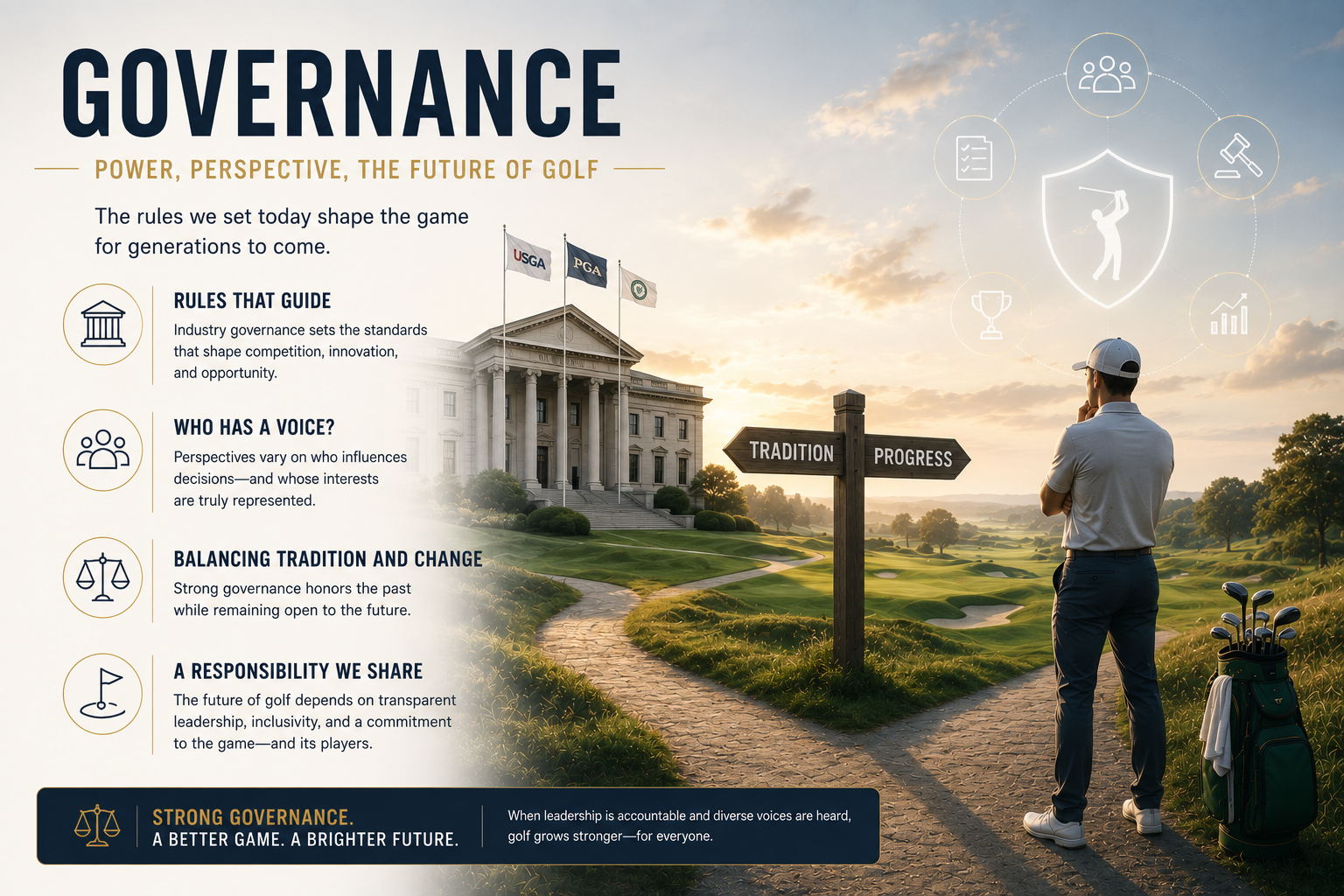
    Handicomp, Inc.