S: In discussing this blog with others, one common point of confusion often arises: understanding the difference between automation and AI. Getting a handle on this distinction is key to fully grasping how AI will impact the landscape of the golf industry. Therefore, I’ll start by having a chatbot detail what sets the two apart, followed by a real-world example to demonstrate their differences.
S: What is the difference between automation and AI?
ChatGPT: Automation and Artificial Intelligence (AI) are both important concepts in the field of technology, but they are fundamentally different and serve different purposes. Here’s a simple breakdown:
- Automation: Automation is the use of technology to perform tasks without human intervention. This involves following pre-defined and repeatable rules, and making things more efficient. For example, a car assembly line uses automation to install parts, a smart thermostat might adjust your home temperature based on the time of day, or a software script might be written to sort and organize files on your computer.
- Artificial Intelligence (AI): AI, on the other hand, refers to the simulation of human intelligence processes by machines, especially computer systems. It involves learning (the acquisition of information and rules for using the information), reasoning (using rules to reach approximate or definite conclusions), and self-correction. AI is designed to make decisions based on data inputs, often making decisions or identifying patterns that aren’t pre-programmed by developers. AI technologies include machine learning, neural networks, and natural language processing.
So, while both automation and AI can accomplish tasks without human intervention, the primary difference lies in the complexity and adaptability of the tasks they can accomplish. Automation can perform predefined tasks more efficiently than humans, but it doesn’t learn from experience or adapt to new situations. AI, in contrast, can learn from data and improve its performance over time without being explicitly programmed to do so, enabling it to carry out much more complex tasks.
It’s important to note that AI can drive automation. This is seen in fields like machine learning where systems can automatically learn and improve from experience without being explicitly programmed. This type of AI-driven automation is referred to as intelligent automation.
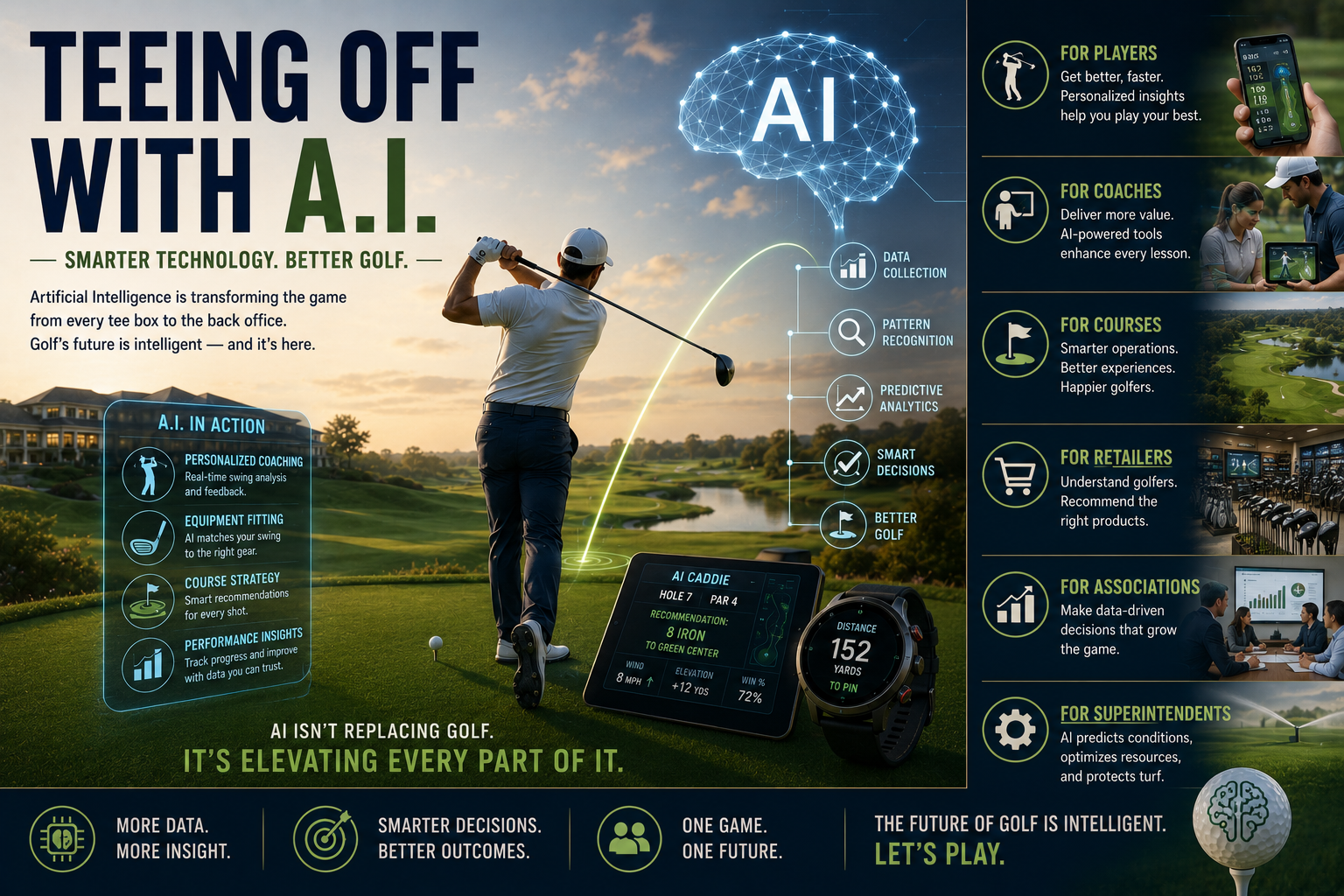
S: In my first blog post “Teeing off with A.I.” ChatGPT suggested AI will have an impact on Course Management and Maintenance. Without going into depth (as we’re still in the early stages of this blog), I’m going to ask a chatbot about the future of golf course lawn and weed maintenance.
S: Is is possible to kill a weed with a laser?
Bard: Yes, it is possible to laser a weed to kill it. Laser weeding is a new technology that uses high-powered lasers to target and kill weeds. The laser beam is focused on the weed’s leaves, and the heat from the laser causes the leaves to vaporize, killing the weed.
Laser weeding is a more precise and environmentally friendly way to control weeds than traditional methods, such as herbicides. It is also more efficient, as it can kill weeds much faster than herbicides.
There are a number of companies that are developing laser weeding technologies. One company, Carbon Robotics, has developed a self-driving robot that uses lasers to kill weeds. The robot can be used to control weeds in a variety of settings, including farms, golf courses, and roadsides.
Laser weeding is still a relatively new technology, but it is gaining popularity as a more effective and environmentally friendly way to control weeds. It is likely that laser weeding will become more widely used in the future.
Here are some of the advantages of using lasers to kill weeds:
- Precise: Lasers can be used to target weeds very precisely, leaving surrounding plants unharmed. This is important in areas where crops or other plants are growing.
- Effective: Lasers can kill weeds very effectively. The heat from the laser vaporizes the water in the weed’s leaves, killing the plant instantly. This is much more effective than herbicides, which can take several days or even weeks to kill the weed.
- Environmentally friendly: Lasers do not release any harmful chemicals into the environment. This makes them a more sustainable option for weed control than herbicides.
However, there are also some disadvantages to using lasers to kill weeds:
- Cost: Laser weeding systems can be expensive. This may make them out of reach for some homeowners or small businesses.
- Training: Operating a laser weeding system requires some training. This may not be an option for people who do not have experience with this type of technology.
- Weather conditions: Laser weeding systems may not be able to operate in certain weather conditions, such as heavy rain or fog.
Overall, laser weeding is a promising new technology for weed control. It is more precise, effective, and environmentally friendly than traditional methods. However, it is still a relatively new technology, and there are some limitations to its use.
S: Do you believe the cost of laser weeding will come down?
Bard: Yes, I believe the cost of laser weeding will come down in the future. As the technology matures and more companies start to develop laser weeding systems, the cost of these systems is likely to decrease. In addition, as more farmers and other businesses start to use laser weeding systems, the demand for these systems is likely to increase, which could also lead to lower prices.
According to a recent article in Farm Equipment magazine: https://www.farm-equipment.com/blogs/6-opinions-columns/post/20156-laser-weeding-reduces-weed-management-costs, the cost of laser weeding systems is currently around $100,000. However, the article predicts that the cost of these systems could come down to as low as $50,000 within the next few years.
The article also cites a study by the University of California, Davis, which found that laser weeding can save farmers up to 80% on weed control costs. This means that even if the cost of laser weeding systems does not come down significantly, farmers could still save money by using this technology.
Overall, I believe that laser weeding is a promising new technology for weed control. The cost of laser weeding systems is likely to come down in the future, and the technology is becoming more widely adopted by farmers and other businesses. This suggests that laser weeding is a viable option for weed control that could save businesses money and reduce their environmental impact.
S: Is laser weeding a product of AI?
Bard: Yes, laser weeding is a product of AI. The AI technology used in laser weeding is called computer vision. Computer vision is a field of artificial intelligence that deals with the extraction of meaningful information from digital images or videos. In the case of laser weeding, computer vision is used to identify weeds from crops. This is done by analyzing the images of the plants using algorithms that have been trained on a large dataset of images of weeds and crops.
Once the weeds have been identified, the laser weeding system can then target and kill them using a high-powered laser. The laser beam is focused on the weed’s leaves, and the heat from the laser causes the leaves to vaporize, killing the weed.
The use of AI in laser weeding makes it a more precise and efficient way to control weeds than traditional methods. It is also more environmentally friendly, as it does not require the use of herbicides.
Here are some of the benefits of using AI in laser weeding:
- Precision: AI-powered laser weeding systems can target weeds very precisely, leaving surrounding plants unharmed. This is important in areas where crops or other plants are growing.
- Efficiency: AI-powered laser weeding systems can kill weeds much faster than traditional methods. This can save farmers time and money.
- Environmentally friendly: AI-powered laser weeding systems do not use herbicides. This makes them a more sustainable option for weed control.
Overall, AI is a key technology that makes laser weeding a viable option for weed control. It is more precise, efficient, and environmentally friendly than traditional methods. As AI technology continues to develop, laser weeding is likely to become even more widely used in the future.
S: How can AI driven laser weeding benefit a golf course?
Bard: There are many benefits to using a laser weeding system at a golf course. Here are a few of the most important ones:
- Precision: Laser weeding systems can target weeds very precisely, leaving surrounding plants unharmed. This is important in areas where the grass is closely cropped, such as on a golf course.
- Effectiveness: Laser weeding systems are very effective at killing weeds. The heat from the laser vaporizes the water in the weed’s leaves, killing the plant instantly. This is much more effective than herbicides, which can take several days or even weeks to kill the weed.
- Environmentally friendly: Laser weeding systems do not release any harmful chemicals into the environment. This makes them a more sustainable option for weed control than herbicides.
- Safety: Laser weeding systems are safe to use around people and animals. The laser beam is focused on the weed’s leaves, and the heat from the laser does not travel far enough to harm anything else.
- Cost-effectiveness: The cost of laser weeding systems has been decreasing in recent years. As the technology becomes more widespread, the cost is likely to continue to decrease. This makes laser weeding a more affordable option for golf courses.
Overall, laser weeding systems offer a number of advantages over traditional methods of weed control. They are more precise, effective, environmentally friendly, safe, and cost-effective. As the technology continues to develop, laser weeding is likely to become even more widely used in golf courses and other settings.
Here are some additional benefits of using a laser weeding system at a golf course:
- Improved turf quality: Laser weeding can help to improve the quality of the turf on a golf course by removing weeds that can compete with the grass for water, nutrients, and sunlight. This can lead to a more lush and verdant playing surface.
- Reduced maintenance costs: Laser weeding can help to reduce the need for manual weed removal, which can save golf courses time and money.
- Increased customer satisfaction: Golfers appreciate playing on courses that are free of weeds, and laser weeding can help to create a more aesthetically pleasing and enjoyable playing experience.
S: It sounds like an AI powered laser weeding system married with an automated lawnmowing system will dramatically change the job of a greenskeeper at a golf course.
Bard: Yes, AI driven laser weeding and automated lawn mowers are likely to dramatically change the job of greenskeepers at a golf course. In the past, greenskeepers were responsible for manually weeding and mowing the golf course. This was a labor-intensive and time-consuming task.
However, AI driven laser weeding and self-driving lawn mowers can automate these tasks. This means that greenskeepers will no longer need to spend as much time weeding and mowing the golf course. They will be able to focus on other tasks, such as repairing greens and bunkers, or managing irrigation systems.
In addition, AI driven laser weeding and self-driving lawn mowers can be more precise and efficient than manual methods. This means that they can produce a better quality playing surface, and they can do so with less environmental impact.
Overall, AI driven laser weeding and self-driving lawn mowers are likely to make the job of greenskeepers more efficient, less labor-intensive, and more environmentally friendly. This could lead to job losses in the short term, but it could also create new opportunities for greenskeepers in the long term.
Here are some of the ways in which the job of greenskeepers may change in the future:
- Greenkeepers will need to be more skilled in operating and maintaining AI-powered equipment. This will require them to have a strong understanding of computer science and engineering principles.
- Greenkeepers will need to be more familiar with data analysis and interpretation. This will allow them to use data from AI-powered equipment to make better decisions about how to manage the golf course.
- Greenkeepers will need to be more creative in their problem-solving skills. This will be necessary as they adapt to the changing landscape of golf course management.
Overall, the job of greenskeepers is likely to become more technologically advanced in the future. This will require them to have a different set of skills and knowledge than they do today. However, it will also create new opportunities for them to use their skills and knowledge to make a positive impact on the environment and the game of golf.
S: What is your best guess as to how far out we are from having a majority of golf courses adopt AI driven laser weeding systems?
Bard: It is difficult to say exactly how far away in time we are from having most golf courses implement AI driven laser weeding. However, I believe that it is likely to happen within the next 10-15 years.
There are a number of factors that will influence the pace of adoption of this technology. One factor is the cost of the technology. As the cost of AI-powered equipment decreases, it will become more affordable for golf courses to implement.
Another factor is the availability of the technology. As more companies develop and market AI-powered equipment for golf courses, it will become more widely available.
Finally, the demand for this technology will also influence the pace of adoption. As golfers become more aware of the benefits of AI-powered equipment, they will be more likely to demand that their favorite golf courses adopt it.
Overall, I believe that AI driven laser weeding is likely to become widespread in the golf industry within the next 10-15 years. The technology has the potential to make golf courses more efficient, less labor-intensive, and more environmentally friendly. As the cost of AI laser weeding technology decreases and the demand increases, I believe that we will see more and more golf courses adopt it.
S: For all the Marvel fans out there, think of it like this: Imagine the movie Captain America and the Winter Soldier. The mower/laser-weeder would be like a Helicarrier. Instead of targeting certain people and sparing others, as in the movie, the AI in our case would be targeting and eliminating weeds while sparing crops. 🤔
June 7, 2023
Stu Healey, President
Handicomp, Inc.