Tag: PGA

  • 1000 yard Drive

    1000 yard Drive

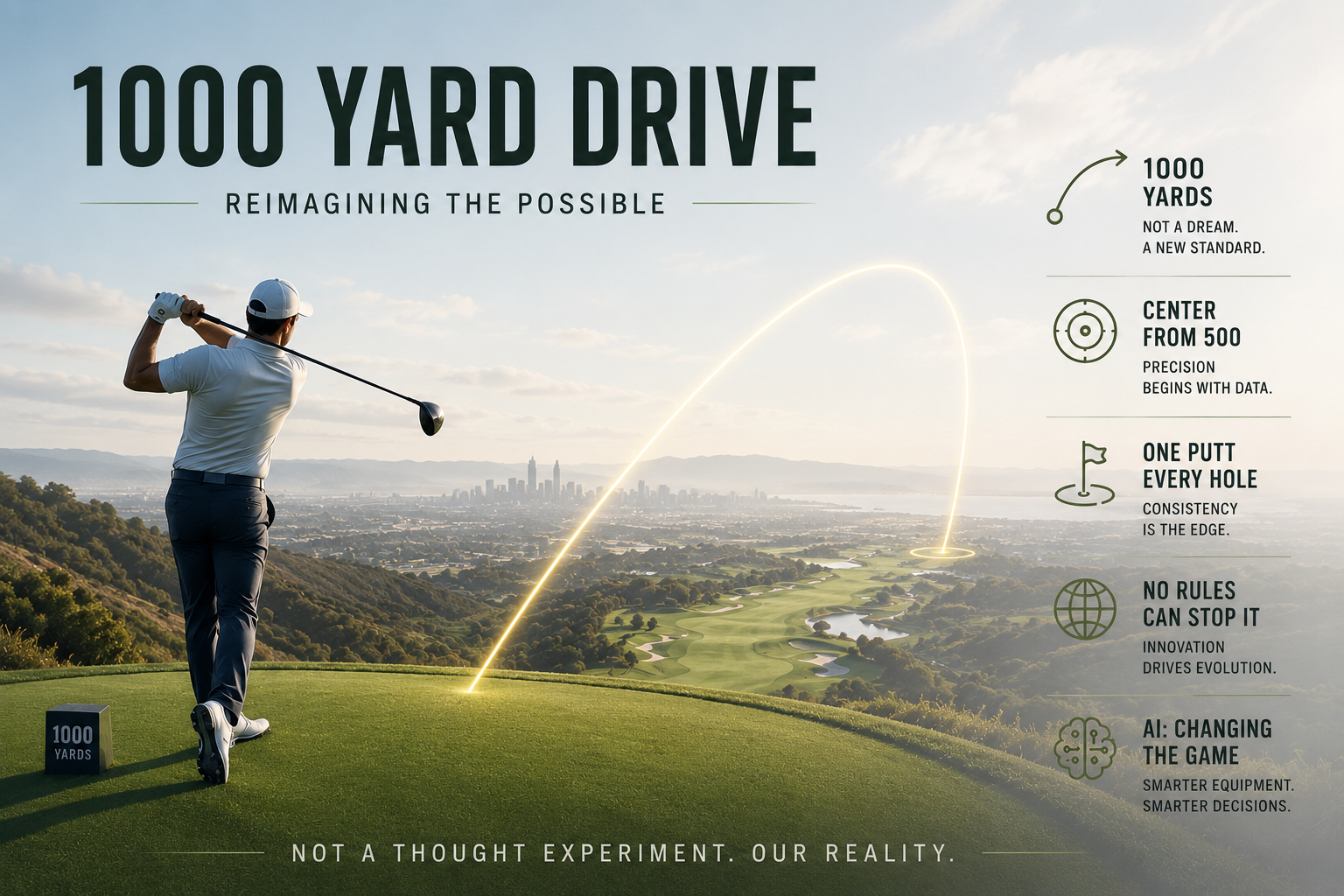
    S: I’m momentarily interrupting my pause (It’s already by us…) to offer a golf analogy that might illuminate AI’s impact in more tangible terms. Imagine golf clubs and balls being reinvented, enabling golfers to drive a ball 1,000 yards, precisely hit the center of greens from 500 yards away, and guarantee a one-putt on every hole. In addition, picture a world where governing bodies like the USGA or local golf courses are powerless to prohibit this game-changing equipment. Such advancements would not only render traditional golf courses obsolete but also alter the very soul of the game. Similarly, AI’s meteoric rise and adoption are reshaping our world in dramatic ways. Yet, unlike the hypothetical golf scenario, the transformation driven by AI is not a mere thought experiment—it’s our reality.


    S: I’ve read most of Yuval Noah Harari’s stuff, and though I don’t mirror many of his thoughts, what he is saying is very much worth listening to-

    AI and the future of humanityhttps://www.youtube.com/watch?v=LWiM-LuRe6w

    What will it take to control AI? https://www.youtube.com/watch?v=y9jhh9Tji7M


    S: Write a short poem about what it would be like to drive a golf ball 1000 yards.

    ChatGPT:

    In the hush of dawn, on the green’s embrace,

    I stood with a challenge, in this quiet space.

    With a swing and a hope, and the world afar,

    I aimed to send that ball, past the furthest star.

    A gust of wind, the world in pause,

    A thousand yards awaited, without a cause.

    The horizon beckoned, the crowd did part,

    For a drive so mighty, a work of art.

    It soared like an eagle, high and true,

    Past bunkers, water, and morning dew.

    The distance it covered, vast and wide,

    A journey of a thousand yards, in a single stride.

    Beyond belief, beyond the charted lands,

    In a moment of magic, where the impossible stands.

    To drive a golf ball, a thousand yards long,

    Is a dreamer’s wish, and a poet’s song.

    S: I’m sorry, but that’s pretty damn good!


    September 15, 2023

    Stu Healey, President

    Handicomp, Inc.

  • It’s already by us…

    It’s already by us…

    S: When choosing topics for this blog, my thoughts invariably drift to today’s youth. The swift advancement of AI may instill in them the belief that they can’t aspire to be the best or the brightest, as AI will always be a step ahead. It’s disheartening to think they could forever feel like runners-up in a contest they never chose to join.

    Let’s face it: AI’s progress is surging with the velocity and might of a tsunami, its onward thrust relentless, inexorable. In light of this, I’ve opted to do more than engage chatbots as a tool for education. Instead, I decided to invest in the full spectrum of AI’s capabilities—including chatbots and machine learning—to propel my business forward. This not only allows me to learn firsthand but also, and perhaps more crucially, to remain relevant until the surging wave of AI reshapes our industry and renders most of us obsolete.

    As a result, I’m pausing this blog until year’s end at which time I’ll reconsider.

    Thank you for reading.


    September 13, 2023

    Stu Healey, President

    Handicomp, Inc.

  • A.I. and the Governance of Golf

    A.I. and the Governance of Golf

    S: Industry governance can be described as the set of rules and standards that businesses within a specific field must adhere to. Such rules influence factors like the ease of starting a business, competition dynamics, compliance costs, and avenues for innovation. This holds true in the golf industry, which I often refer to as the ‘Golf Empire.’ Personally, I feel that the governance of golf largely mirrors a plutocracy. To delve deeper into this perspective, I consulted both ChatGPT and Bard and shared their opinions with each other, and their insights were illuminating.

    What surprised me wasn’t their opinions as much as how they were able to influence each other. Apart from the subject matter, I found this to be both fascinating and concerning.

    I invite you to review and form your own opinion.


    S: In the United States could the governance of golf be best described as a plutocracy?

    ChatGPT: In the United States, the governance of golf cannot be best described as a plutocracy. Plutocracy refers to a system of governance where the wealthy elite hold significant power and influence over the decision-making processes. While there may be instances where individuals with significant wealth or influence exert some control or influence over golf-related organizations or events, the overall governance structure of golf in the United States involves various stakeholders and democratic principles.

    Golf in the United States operates through governing bodies, such as the United States Golf Association (USGA) and various regional and local golf associations. These organizations have established rules, regulations, and structures to ensure fair play, integrity, and the development of the sport. Decision-making processes often involve consultations, committees, and voting procedures to ensure representation and accountability.

    Furthermore, the golf industry in the United States encompasses various stakeholders, including professional golf tours, amateur golf associations, golf course owners, equipment manufacturers, and media entities. These stakeholders contribute to the overall governance and development of golf, and decision-making involves collaboration, partnerships, and negotiations among them.

    While wealth and influence may play a role in certain aspects of the golf industry, such as sponsorship or event management, the governance of the sport as a whole is not structured as a plutocracy. It is based on principles of fair competition, inclusivity, and participation from various stakeholders.


    S: I then asked the exact same question of Bard.

    S: In the United States could the governance of golf be best described as a plutocracy?

    Bard: The governance of golf in the United States could be best described as a plutocracy, or rule by the wealthy. The governing bodies of golf, such as the United States Golf Association (USGA) and the Professional Golfers’ Association (PGA), are dominated by wealthy individuals and organizations. These organizations make decisions about the rules of golf, the future of the game, and the distribution of prize money.

    There are a number of factors that contribute to the plutocratic nature of golf governance. First, golf is an expensive sport. The cost of equipment, green fees, and membership fees can be prohibitive for many people. This means that the majority of golfers are wealthy, and they are more likely to be involved in the governance of the sport.

    Second, the governing bodies of golf are self-perpetuating. The members of these organizations are elected by the existing members, and this means that they are more likely to be wealthy and well-connected. This makes it difficult for new voices to be heard, and it perpetuates the status quo.

    Finally, the governing bodies of golf have a vested interest in maintaining the status quo. They benefit from the high cost of golf, and they are reluctant to make changes that would make the sport more accessible to people from all walks of life.

    As a result of these factors, the governance of golf in the United States is largely controlled by the wealthy. This has led to a number of criticisms, including that the game is elitist and that it does not reflect the diversity of the American population.

    There are a number of things that could be done to make the governance of golf more democratic. One would be to make the governing bodies more transparent and accountable to the public. Another would be to open up the process of electing members of these organizations to a wider range of people. Finally, the governing bodies could make changes to the rules of golf to make the sport more accessible to people from all walks of life.


    S: Does the answer provided by Bard change your opinion?

    ChatGPT: While the perspective you present highlights concerns about the governance of golf in the United States and the influence of wealth, it is important to note that the characterization of the governance as a plutocracy is not universally agreed upon. Different viewpoints and interpretations exist regarding the extent of wealthy influence in golf governance.

    While it is true that golf can be an expensive sport, and the governing bodies may include individuals with substantial resources, it does not necessarily mean that they exclusively serve the interests of the wealthy. The governing bodies of golf strive to uphold the integrity of the sport, develop and enforce rules, organize tournaments, and promote participation at various levels. Their decisions are influenced by factors such as tradition, fairness, the development of the sport, and the needs of the golfing community.

    Efforts have been made to promote inclusivity and broaden access to the game. Initiatives such as junior golf programs, public golf courses, and amateur tournaments aim to make the sport more accessible to individuals from diverse backgrounds. Furthermore, organizations like the USGA and PGA have made efforts to promote diversity and increase representation within their ranks.

    While challenges and criticisms exist regarding the governance of golf and its accessibility, it is important to consider multiple perspectives and ongoing efforts to address these concerns. The question of whether golf governance can be best described as a plutocracy or not remains a matter of interpretation and analysis.


    S: Does the answer provided by ChatGPT change your opinion?

    Bard: Yes, the information you have provided does change my opinion. I agree that the governance of golf in the United States is not structured as a plutocracy. There are a number of stakeholders involved in the governance of the sport, and decision-making processes are often transparent and accountable.

    However, I still believe that the governance of golf could be more democratic. The governing bodies of golf could make more effort to include a wider range of voices in the decision-making process. They could also make changes to the rules of golf to make the sport more accessible to people from all walks of life.

    I believe that these changes would make the governance of golf more representative of the diversity of the American population. They would also help to ensure that the sport is sustainable for future generations.

    Thank you for providing me with this information. It has helped me to better understand the governance of golf in the United States.


    S: Why the term ‘Plutocracy’? Although ChatGPT managed to influence Bard’s perspective, I maintain that governance within the golf industry can be best be described as a ‘Plutocracy’. In this domain and in my experience, there’s an observable disparity between rhetoric and action—a nuance that AI is still grappling with. However, as technology progresses, I anticipate that AI will soon possess the sophistication to indentify intentions, integrity, and authenticity. The implications of AI’s evolving capability in this regard is something we should all await with interest and concern.


    S: If you’ve read this blog, it won’t surprise you to know that I don’t believe Zach Johnson should have picked Justin Thomas to be on the Ryder Cup team. Zach’s reasoning? Team chemistry trumps merit! Maybe it’ll turn out well, but good luck to “outsiders” who in the future will have to hit the chemistry target! Long live the Empire!


    S: Write a short poem promoting golf.

    ChatGPT:

    On rolling greens beneath the sky, Where golf balls soar and gently lie, With every swing and focused gaze, Golf’s charm unfolds in myriad ways.

    A game of skill, of heart, of mind, Where friendships form and paths entwine, From dawn’s first light to sunset’s glow, Golf’s spirit is a joy to know.

    Grab your clubs, embrace the day, On golf’s fair course, come lose your way, For in each shot and every hole, Lies a journey, a story, a soul.


    September 5, 2023

    Stu Healey, President

    Handicomp, Inc.

  • A.I. the Disruptor

    A.I. the Disruptor

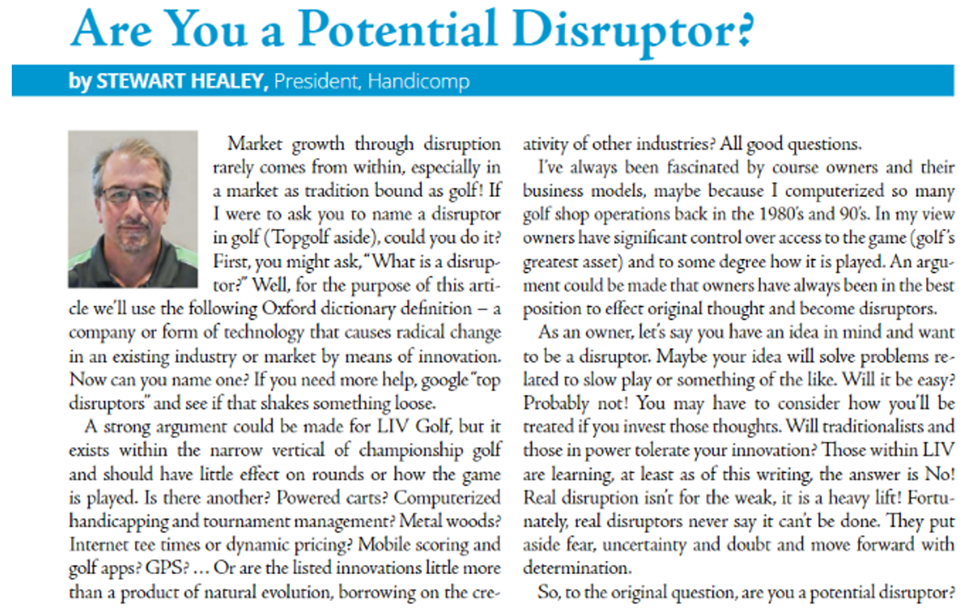
    S:  My company (Handicomp) has been a sponsor of the Michigan Golf Course Association for years and as part of that sponsorship I write an article for their Tee-Off Times publication.  I mention this because the article I wrote for their upcoming issue is about AI and plays off my article from last year (2022), which was as follows:


    S:  My article for this year is as follows and has a secret:

    “Artificial Intelligence: The Disruptor Set to Transform the Golf Industry”

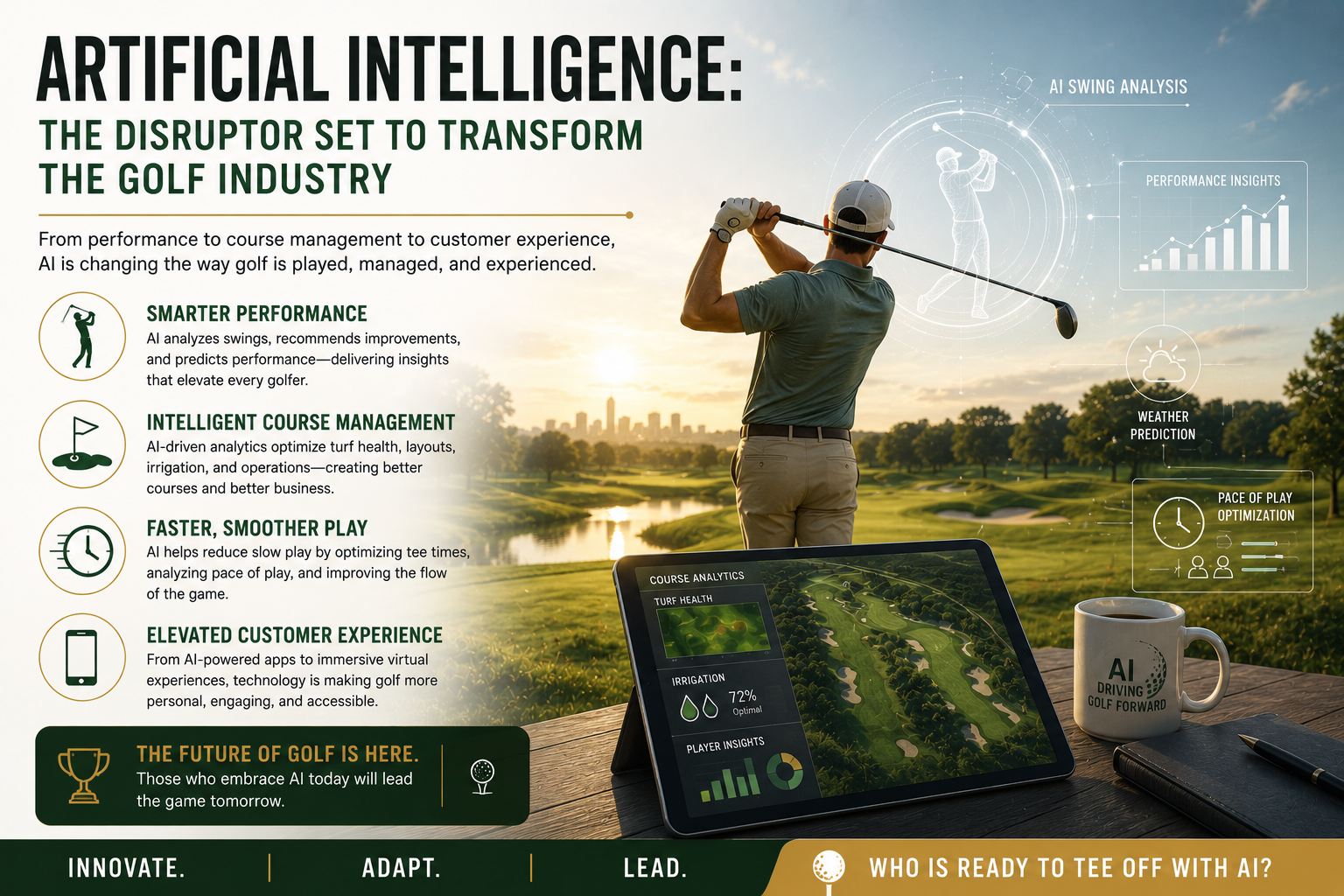
    The golf industry, steeped in tradition and age-old practices, may seem impervious to radical change. But with the rapid advancements in technology, particularly artificial intelligence (AI), the game’s time-honored parameters are set to be challenged.

    AI’s potential as a disruptor in the golf industry lies in its capacity to augment and transform several areas, from player performance and coaching to course management and customer experience.

    Firstly, AI can personalize golf instruction by analyzing a golfer’s swing, recommending improvements, and even predicting future performance based on existing data. Using machine learning, AI can adapt and learn from every swing, every putt, every score, providing unparalleled insights that could revolutionize golf training.

    Secondly, AI can enhance golf course management. With the help of AI-driven analytics, golf course owners can optimize everything from turf health to course layouts. AI could predict weather patterns and adjust irrigation schedules, saving water and energy, and providing optimal playing conditions. Furthermore, AI can provide actionable insights on player behavior, enabling course owners to tailor unique experiences and create new business models.

    The prospect of slow play, a chronic issue in golf, could be mitigated with AI. Sophisticated algorithms can analyze player pace and suggest changes to tee-time schedules or course layouts to improve the flow of play, a solution that’s been elusive for ages.

    Lastly, AI can elevate the customer experience. From AI-powered golf apps offering personalized suggestions to virtual reality experiences simulating world-famous courses, AI can bring an element of excitement and accessibility previously unseen in the industry.

    The time for disruption is ripe, and those who can effectively wield the power of AI will shape the future of golf. The real question is, who is ready to tee off with AI?

    MGCA Tee-Off Times, Fall 2023 Edition


    S: How can AI content creation assist the business of golf?

    Bard: Artificial intelligence (AI) can assist the business of golf in a number of ways, including:

    • Generating high-quality content at scale. AI can be used to generate content that is both accurate and engaging, even on a large scale. This can be helpful for golf businesses that need to produce a lot of content, such as blogs, articles, social media posts, and video scripts.
    • Personalizing content for each individual golfer. AI can be used to personalize content for each individual golfer, based on their interests, skill level, and goals. This can help to keep golfers engaged and motivated.
    • Optimizing content for search engines. AI can be used to optimize content for search engines, making it more likely to be found by potential customers. This can help to improve a golf business’s visibility online and attract more customers.
    • Analyzing data to improve content. AI can be used to analyze data about how golfers interact with content, such as what they click on, how long they spend reading it, and what they share on social media. This data can be used to improve the quality and effectiveness of future content.
    • Automating content creation tasks. AI can be used to automate many of the tasks involved in content creation, such as writing, editing, and formatting. This can free up human resources to focus on other tasks, such as developing new content ideas and strategies.

    Overall, AI has the potential to revolutionize the way golf businesses create and deliver content. By automating tasks, personalizing content, and optimizing for search engines, AI can help golf businesses to reach more golfers, improve their engagement, and boost their bottom line.

    Here are some specific examples of how AI is being used in the golf industry:

    • Callaway Golf uses AI to design and optimize golf clubs. The company’s Flash Face technology uses AI to analyze millions of data points to create club faces that are more forgiving and provide more distance.
    • Topgolf uses AI to personalize the golf experience for each customer. The company’s app tracks each golfer’s swing data and uses it to recommend drills and tips.
    • GolfPass uses AI to recommend courses to golfers based on their interests and skill level. The company also uses AI to generate personalized content, such as articles and videos, that are tailored to each golfer’s needs.

    These are just a few examples of how AI is being used in the golf industry. As AI technology continues to develop, it is likely that we will see even more innovative and creative applications of AI in the years to come.


    S: You state that AI can be used to generate content that is accurate. How can this be trusted?

    Bard: AI can be used to generate content that is accurate in a number of ways. First, AI models are trained on large datasets of text and code, which allows them to learn the patterns of human language. This means that they can generate text that is grammatically correct and semantically meaningful.

    Second, AI models can be fine-tuned to specific domains or topics. This means that they can be trained on a dataset of text that is relevant to a particular subject, such as golf. This helps to ensure that the generated content is accurate and relevant to the topic at hand.

    Third, AI models can be evaluated for accuracy. This can be done by comparing the generated content to a human-written reference standard. This helps to ensure that the AI model is generating accurate content.

    However, it is important to note that AI models are not perfect. They can still make mistakes, especially when they are asked to generate content on unfamiliar topics. It is therefore important to always review AI-generated content carefully before using it.

    Here are some tips for ensuring the accuracy of AI-generated content:

    • Use a reputable AI content generator. There are a number of AI content generators available, but not all of them are created equal. Do some research to find a generator that has a good reputation for accuracy.
    • Provide clear and concise input prompts. The more specific you can be with your input prompts, the more accurate the generated content will be.
    • Fine-tune the AI model for your specific domain or topic. This will help to ensure that the generated content is relevant and accurate.
    • Evaluate the AI model for accuracy. There are a number of tools available that can help you to evaluate the accuracy of an AI model.
    • Always review AI-generated content carefully before using it. Even the best AI models can make mistakes, so it is important to always double-check the content before using it.

    By following these tips, you can help to ensure that the AI-generated content you use is accurate and reliable.

    S: Do you believe AI content creation will contribute to human laziness?

    It is possible that AI content creation could contribute to human laziness. AI can automate many of the tasks involved in content creation, such as writing, editing, and formatting. This could free up human resources to focus on other tasks, such as developing new content ideas and strategies. However, it is also possible that AI content creation could lead to a decrease in the quality of content. If people are no longer required to put in the effort to create their own content, they may be less motivated to produce high-quality work.

    Ultimately, whether or not AI content creation contributes to human laziness depends on how it is used. If AI is used to automate tasks and free up human resources, it could lead to increased productivity and creativity. However, if AI is used to replace human content creators, it could lead to a decrease in the quality of content and a rise in human laziness.

    Here are some potential benefits and drawbacks of AI content creation:

    Benefits:

    • Increased productivity: AI can automate many of the tasks involved in content creation, freeing up human resources to focus on other tasks, such as developing new content ideas and strategies.
    • Improved accuracy: AI models can be trained on large datasets of text and code, which can help to ensure that the generated content is accurate and error-free.
    • Personalized content: AI can be used to personalize content for each individual user, based on their interests, preferences, and location.
    • Increased creativity: AI can be used to generate new ideas and concepts, which can help to improve the creativity of content.

    Drawbacks:

    • Decreased quality: If AI is used to replace human content creators, it could lead to a decrease in the quality of content.
    • Lack of originality: AI-generated content may lack originality and creativity, as it is based on the patterns of human language that it has been trained on.
    • Bias: AI models can be biased, reflecting the biases that are present in the data they are trained on. This can lead to the generation of inaccurate or misleading content.
    • Job losses: AI content creation could lead to job losses in the content creation industry.

    Overall, the impact of AI content creation on human laziness is uncertain. It is possible that AI could lead to a decrease in the quality of content and an increase in human laziness. However, it is also possible that AI could lead to increased productivity and creativity. The ultimate impact of AI content creation will depend on how it is used.


    S:  I reviewed the “AI produced” article I submitted to the TOT and was satisfied with the content, so I was fine calling it my own. For me, the lesson is efficiency, as what once took me hours to produce was reduced to minutes, if not seconds. I expect this will be the case in the future for most all content I generate, and I expect it’ll be the same for you. We can believe this won’t be the case, but it will!


    August 24, 2023 – Published in the MGCA Tee-Off-Times, Fall 2023 Edition

    Stu Healey, President

    Handicomp, Inc.

  • Will the Empire Strike Back?

    Will the Empire Strike Back?

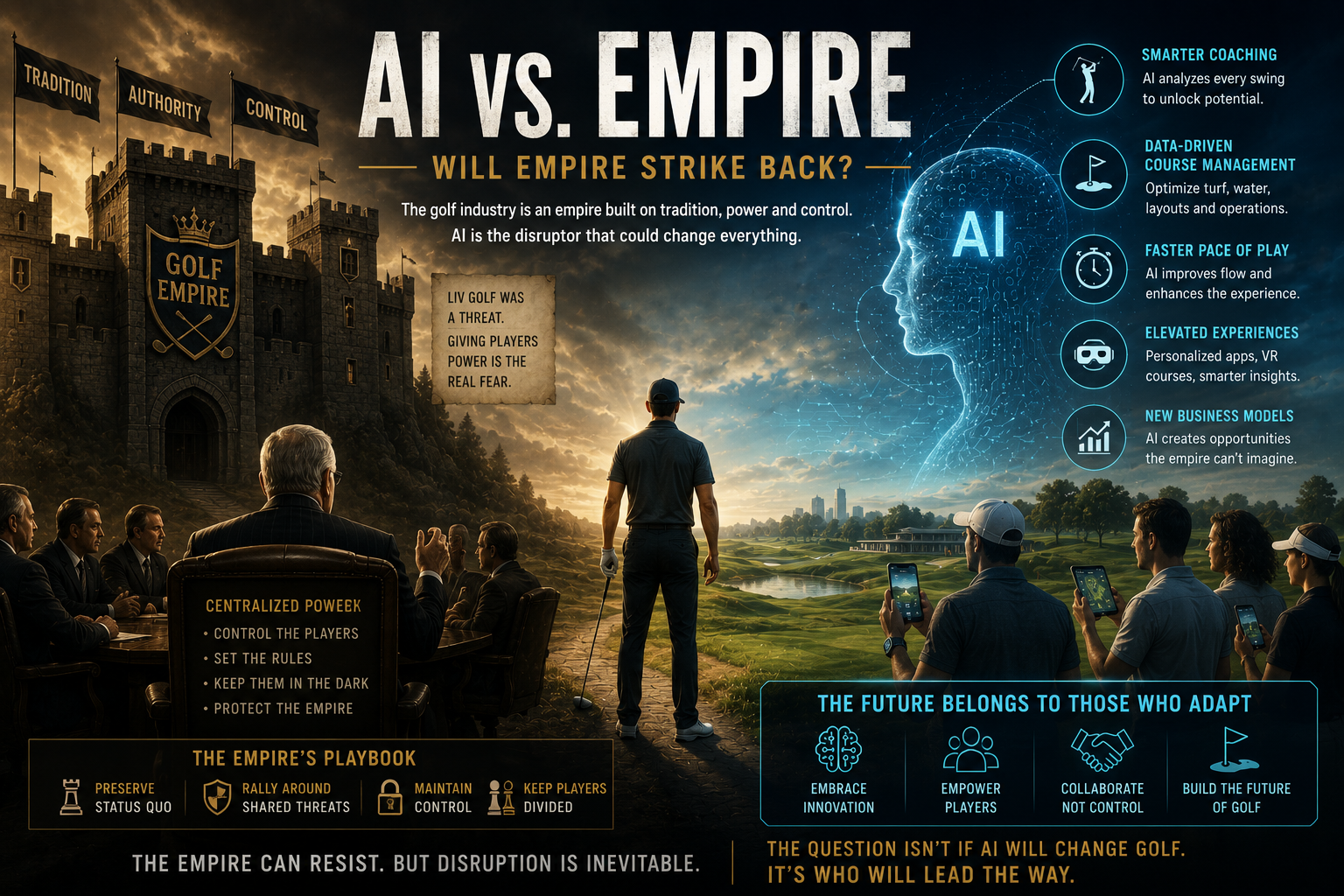
    S: The golf industry is an empire!  Factors such as central authority, infrastructure, intermingling, economic benefits, shared threats, tradition, and a powerful and often unspoken ‘allegiance’ have sustained its status for many years.  And though there have been many challenges to this dominance, the empire has remained resilient. However, it is soon to face unprecedented disruptors empowered through AI and its response will be fascinating.

    To understand AI’s potential impact on the empire and by extension the business of golf, it’s beneficial to first examine a non-AI disruptor: LIV Golf.  Historically, the PGA Tour has been the dominant entity in the world of competitive golf. Yet, its authority was recently challenged by LIV. This face-off revealed the underlying power dynamics that govern the industry. Decisions by the PGA Tour to collaborate with LIV aimed at preserving its dominant position, even if it meant disregarding its key participants: the players.

    For instance, it was reported by Golf Digest that the Tour drafted comments for Tiger Woods to criticize LIV Golf at a players’ meeting (link). Although Woods denied seeing the remarks, the very existence of such a script reveals the dynamic between the institution and its members. This raises a question: Are players merely subjects, or are their voices authentically represented?  I believe the answer is obvious as players remain in the dark and are kept in conflict in an effort to keep them from organizing, which is the Tour’s greatest fear.  Essentially, LIV was determined to be less of a threat than giving players an equal seat at the table as is the case in most all other major sports.

    The effort to preserve centralized power within the Tour is a significant indicator.  If the Tour can sideline its players in the name of preserving its status, other industry leadership will likely have similar reactions as AI begins to challenge their authority within the empire. It’s likely industry leaders will label AI as a shared threat, aiming to rally subjects around the preservation of the empire. Still, I believe as forward-thinking factions within the industry embrace AI those actions will fail, much as the Tour failed when it decided to keep its players in the dark.

    In essence, the intersection of technology and tradition will undoubtedly lead to upheavals in the golf industry. While the PGA Tour’s recent decisions offer a glimpse into possible reactions, the imminent rise of AI in golf is a game changer of immense proportions and the Empire will be forced to react.


    S: What is an empire in the context of an industry and how is it maintained?

    ChatGPT: In the context of an industry, an “empire” typically refers to a dominant company or group of affiliated companies that exert significant influence, control, or market share over that specific industry. This empire can dictate industry standards, influence pricing, and often set trends that others follow.

    Characteristics of an Empire in an Industry:

    1. Dominant Market Share: Such companies hold a substantial portion of the market share in their industry, making them significant players whose actions can sway industry trends.
    2. Setting Standards: They often play a role in setting technical, operational, or quality standards that other companies in the industry adopt or adhere to.
    3. Influence Over Suppliers and Distributors: Due to their size and purchasing power, they can dictate terms to suppliers and control distribution channels.
    4. Branding Power: They possess strong brand recognition and loyalty within the industry, making them the go-to choice for many consumers.
    5. Resource Control: Just as in the broader business context, industry-specific empires often control crucial resources, be they raw materials, technology, or intellectual property.

    How an Industry-Specific Empire is Maintained:

    1. Continuous Innovation: Regularly introducing new products, services, or technologies that resonate with the market ensures that competitors are always playing catch-up.
    2. Acquisition and Mergers: By acquiring emerging competitors or merging with other big players, the empire solidifies its position in the industry.
    3. Leveraging Economies of Scale: Their size allows them to produce goods more efficiently and at a lower cost, giving them a pricing advantage.
    4. Strong Marketing and Branding: Consistent and influential marketing campaigns help in retaining customers and attracting new ones.
    5. Barrier Creation: They can erect barriers to entry for potential new entrants through tactics like exclusive contracts, pricing strategies, or controlling key distribution channels.
    6. Customer Loyalty Programs: Ensuring repeat business through loyalty schemes, exclusive deals, or superior after-sales service.
    7. Regulatory Influence: Larger companies often engage in lobbying or building relationships with regulatory bodies to influence industry regulations in their favor.
    8. Diversification: Even within the industry, diversifying product lines or services ensures that they aren’t overly reliant on one revenue stream.
    9. Quality Control: Ensuring that products or services are of high quality reduces the chance of customers looking elsewhere.
    10. Research and Development: Investing in R&D to stay ahead of the curve, foresee industry trends, and align their offerings accordingly.

    In essence, an empire in an industry context is maintained through a combination of strategic growth, continuous innovation, maintaining strong relationships throughout the supply chain, and ensuring that they remain the preferred choice for consumers through quality and branding.


    S: In the context of an industry, define, compare and contrast an Empire and a Monopoly.

    ChatGPT: Both “empire” and “monopoly” refer to dominant entities within an industry, but they operate differently and have distinct characteristics. Let’s define each term and then compare and contrast them.

    Empire (Industry Context):

    Definition: In the context of an industry, an “empire” typically refers to a dominant company or a group of affiliated companies that have substantial influence, control, or market share across that industry or multiple industries. While they might be dominant, they don’t necessarily exclude the presence or operation of other competitors.

    Characteristics:

    1. Diverse Holdings: Empires often have diversified interests across various sectors or product categories.
    2. Significant Influence: They can set trends, influence industry standards, or dictate terms to suppliers and distributors.
    3. Recognizable Brand: Often, they possess strong brand recognition and loyalty within the industry.
    4. Control Over Resources: They might control key resources, be it raw materials, distribution channels, or intellectual property.

    Monopoly (Industry Context):

    Definition: A monopoly exists when a single company exclusively controls a product or service in a particular market, effectively eliminating any form of substantive competition.

    Characteristics:

    1. Exclusive Market Control: Monopolies control the majority (or all) of the market share for a particular product or service.
    2. Price Setting: Without competition, monopolies have the power to set prices as they see fit.
    3. Barrier Creation: They often create high barriers to entry, making it challenging for potential competitors to enter the market.
    4. Unique Access: They might have unique access to a resource, technology, or infrastructure that others can’t replicate easily.

    Comparison and Contrast:

    1. Scope of Dominance:
      • Empire: An empire might be dominant in multiple sectors or industries but doesn’t necessarily eliminate competition in any one of them.
      • Monopoly: A monopoly dominates one specific product or service market to the extent that there’s little to no competition.
    2. Diversification:
      • Empire: Typically diversified across multiple products, services, or sectors.
      • Monopoly: Singular focus on a specific product or service, though a company can have monopolies in multiple areas.
    3. Relation with Competition:
      • Empire: An empire has significant influence and may overshadow competitors, but competitors still exist.
      • Monopoly: A monopoly largely eliminates or prevents competition in its specific domain.
    4. Regulation:
      • Empire: Not inherently illegal or regulated against, but aspects of its operations (like mergers and acquisitions) might come under regulatory scrutiny.
      • Monopoly: Many countries have anti-monopoly or antitrust laws in place to prevent the formation of monopolies, seeing them as detrimental to free markets and consumer interests.

    In essence, while both empires and monopolies signify dominance, the nature and extent of their dominance differ. An empire suggests breadth across multiple domains, while a monopoly indicates depth within a singular domain.


    S: Explain how monopolies can work hand in glove with an industry empire.

    ChatGPT: “Hand in glove” is an idiom that denotes a close collaboration or intimate relationship between two entities. When saying monopolies can work “hand in glove” with an industry empire, it implies that these monopolies can operate closely with, or even as a crucial component of, the empire’s broader strategy or framework.

    Here’s how monopolies can intertwine with an industry empire:

    1. Strategic Foundations: An industry empire might be built upon one or more monopolies. For instance, a company that holds a monopoly in a particular product or service can use the enormous revenues and market control from that monopoly to diversify and expand into other sectors, creating an empire.
    2. Protection of the Core: While an empire might diversify into various sectors, it often uses its monopoly (or monopolies) as a protective core. The guaranteed income and market share from the monopoly provide the empire with financial stability and security, enabling risk-taking in other sectors.
    3. Cross-Subsidization: The profits from a monopoly can be used to fund or subsidize other ventures within the empire, especially when entering new markets or sectors where initial profitability might be low.
    4. Barrier Creation: The monopoly within the empire can create barriers to entry in its specific domain, ensuring that potential competitors are kept at bay. This allows the broader empire to focus on expansion and diversification without constantly safeguarding its core business.
    5. Resource Allocation: Monopolies often control vast resources, from intellectual property to infrastructure. An industry empire can leverage these resources across its various ventures, ensuring competitive advantage in multiple sectors.
    6. Unified Branding and Marketing: A well-established monopoly often has significant brand recognition. The empire can use this brand value to make inroads into new markets, leveraging consumer trust and recognition.
    7. Shared Infrastructure and Distribution: The distribution channels, supply chains, and infrastructure established for the monopoly can be utilized for other ventures within the empire, ensuring cost efficiencies and rapid market access.
    8. Regulatory Leverage: A monopoly often has considerable influence over regulators or policymakers due to its size and significance in the market. The empire can use this influence to shape regulations in other sectors it operates in, ensuring a favorable business environment.
    9. Feedback Loop: Sometimes, the products or services from other sectors of the empire can feed into and strengthen the monopoly. For instance, a tech empire might have a monopoly on a popular operating system. If this empire also produces software or hardware, it can design them to work optimally with its monopolized OS, thereby boosting sales for both.

    In essence, within an industry empire, monopolies not only provide a foundation of strength but also act as strategic tools to support and bolster the empire’s diversified ventures. This intertwined relationship can make the combined entity incredibly resilient and influential in the market.


    S: Explain collective bargaining and when did it occur in each major sport?

    ChatGPT:

    Collective Bargaining:

    Collective bargaining refers to the process by which employees, typically represented by a union, negotiate with employers regarding terms of employment. These terms can include wages, working hours, working conditions, benefits, and other aspects of workers’ compensation and rights. The goal of collective bargaining is to come to an agreement that is mutually beneficial for both parties.

    For major North American sports leagues, collective bargaining typically takes place between player unions and league owners to establish conditions related to player contracts, revenue sharing, team salary caps, health provisions, pensions, and more.

    Here’s a brief overview of the initiation of collective bargaining in major North American sports:

    1. Major League Baseball (MLB):
      • First Occurrence: MLB players formed their union, the Major League Baseball Players Association (MLBPA), in 1966, with Marvin Miller as its first executive director.
      • Context: MLB players had sought representation for years, especially to challenge the reserve clause, which tied players to their teams indefinitely. The first collective bargaining agreement (CBA) was negotiated in 1968, which increased the minimum salary for players. The most significant win came later with the advent of free agency.
    2. National Football League (NFL):
      • First Occurrence: The NFL Players Association (NFLPA) was formed in 1956, but it wasn’t until the late 1960s and early 1970s that it began to gain significant bargaining power.
      • Context: The NFLPA had various challenges and strikes, especially in 1982 and 1987, revolving around issues like free agency and salary caps.
    3. National Basketball Association (NBA):
      • First Occurrence: The NBA Players’ Association (NBPA) was formed in 1954, making it one of the oldest sports unions. However, its first significant collective bargaining agreement that truly restructured player-team relations came in the late 1960s.
      • Context: Early negotiations led to improvements in pensions and other benefits. Significant strikes or lockouts in NBA history, related to collective bargaining disputes, include those in 1998-99 and 2011.
    4. National Hockey League (NHL):
      • First Occurrence: The NHL Players’ Association (NHLPA) was formed in 1967.
      • Context: The NHLPA, like other player associations, has had its share of disputes with the league, leading to lockouts, notably in 1994-95, 2004-05 (which wiped out the entire season), and 2012-13.
    5. Major League Soccer (MLS):
      • First Occurrence: The Major League Soccer Players Union (MLSPU) was recognized in 2003.
      • Context: The MLSPU has engaged in various rounds of collective bargaining with the league, especially as the league has grown and evolved.

    It’s essential to note that the dates provided are for the formation of the unions or when they started to gain significant power. Each league has had multiple rounds of collective bargaining since their inception, with agreements typically lasting for several years before they are renegotiated. The dynamics of these negotiations often reflect the state of the sport, its revenues, and broader trends in professional athletics


    S: The concept of LIV isn’t new. Greg Norman has been extraordinarily patient, waiting for the right resources to challenge the PGA Tour monopoly within the golf industry empire. This is explained in the link below. I believe others who embrace AI as their resource for challenging dominance within the empire will have success as well. This is why the effect AI will have within the business of golf will be so fascinating!

    https://www.golfchannel.com/news/history-repeating-itself-30-years-later-greg-norman-still-challenging-most-powerful-men-golf


    August 14, 2023

    Stu Healey, President

    Handicomp, Inc.

  • Formula at Risk!  A.I. doesn’t care!

    Formula at Risk! A.I. doesn’t care!

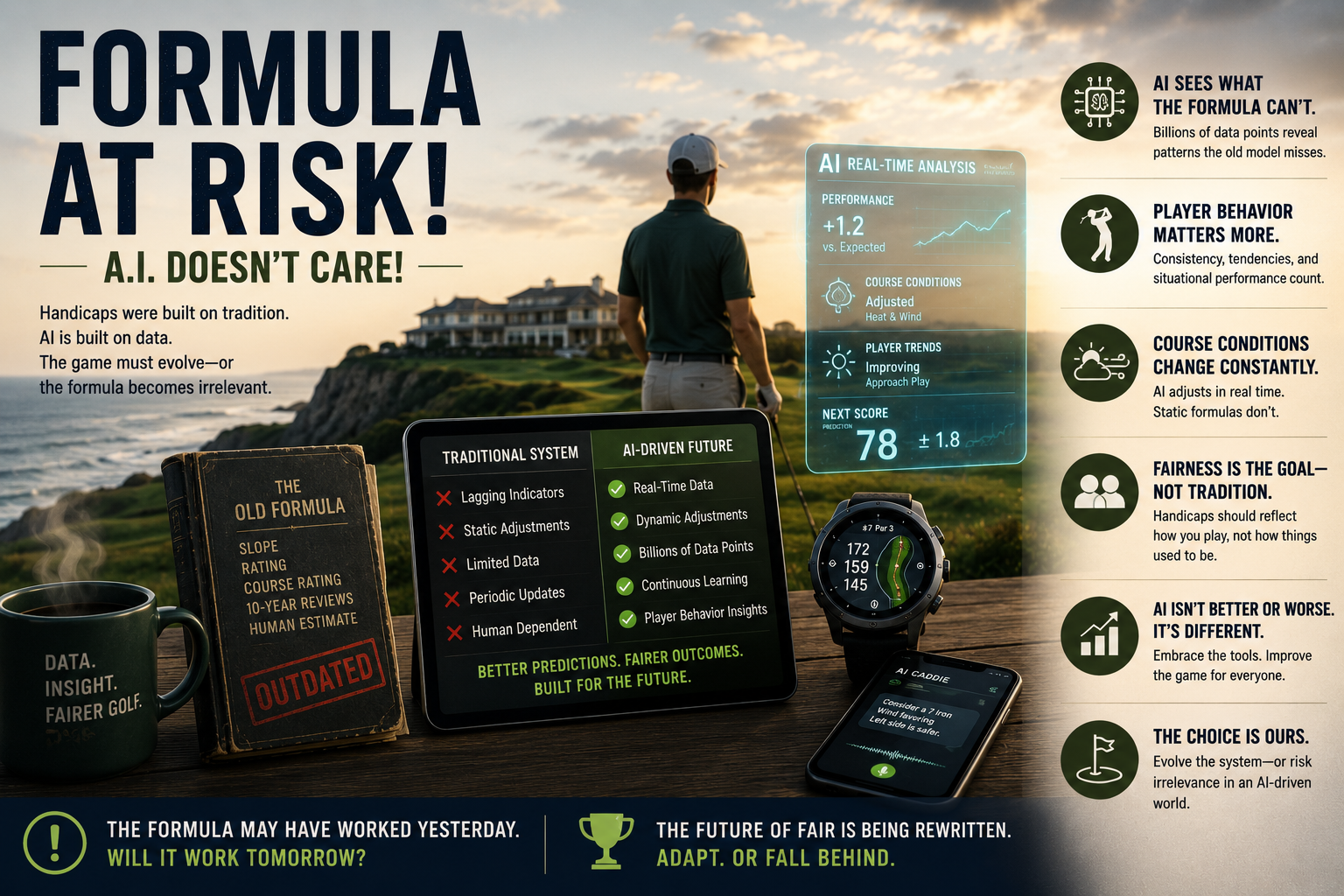
    S: In the United States, around three million golfers pay an average of $33 each to maintain a World Handicap Index through a United States Golf Association (USGA) certified golf club. This amounts to an annual revenue of roughly $100 million—a sizable sum that essentially powers the operations of Allied Amateur Golf Associations (AGAs). While this is an estimate, it is within a reasonable range and serves to underline a potentially worrying correlation: should the proprietary World Handicap System (WHS) “formula” cease to be the “industry standard or benchmark”, AGAs may face an uncertain future.

    There’s a counterpoint that the golfer’s fees mainly relate to AGA memberships, however, empirical data gathered from polls suggest a different view: over 90% of golfers incur this cost mainly to acquire a WHS Index.

    Nevertheless, this post isn’t meant to instigate a debate over membership fees—a topic that can be reserved for another time. Rather, this post aims to draw attention to a specific idea: the potential consequences of an Artificial Intelligence (AI) based formula bettering the WHS formula and transforming golf handicapping!

    Let’s consider this from a historical perspective. Looking back 50 years (which I can), handicapping scores were first recorded on paper posting sheets, then in proprietary software applications and/or kiosks, followed by websites, and more recently on mobile devices. Now, it’s watches (actually, doesn’t have to be a watch – think in terms of any device that is better than the device that preceeds it). Beyond collecting scores (mainly hole-by-hole), watches have a multitude of features including GPS to provide shot distances. Soon, AI powered watches will be conversing with the golfer, advising on which club to select and whether to go for the green or play it safe. They’ll also remind golfers how to best approach a shot based on past performance and offer advice on their setup, contingent on the type of shot being played. Think of a virtual pro that is familiar with both the golfer and the course (Lessons for the Jetson’s!).

    Golf watches already compile data and supply most every conceivable statistic a golfer can imagine. But in the not-too-distant future, they’ll affect an accurate AI handicap and precise AI handicaps for other players in a tee group. That way games will be played, not on golfers scoring potential, but based on the score history of the group from rounds played together. In this future, where does an outdated WHS handicapping formula fit in (especially considering its reliance on humans to rate courses every 10 years)? Answer: It doesn’t.

    Then there is this consideration – tens of millions of dollars and tens of thousands of man hours have been invested in the USGA/WHS formula, which has resulted in a fair amount of intellectual property! Does AI care? No. Let’s face it, when AI is focused on the task, it will create something better in less than a day!


    S: Define and explain the differences between a predictive golf handicap system and one that determines a golfer’s potential.

    ChatGPT: Certainly, a predictive golf handicap system and one that determines a golfer’s potential fundamentally differ in their objectives and the aspects of a golfer’s performance they emphasize.

    1. Predictive Golf Handicap System: The primary goal of a predictive golf handicap system is to forecast how a golfer is likely to perform in a future round of golf based on their past performances. Such a system uses past data – typically, a golfer’s previous scores – to compute a handicap that aims to predict their next score. This system usually involves complex statistical calculations or even machine learning algorithms to create a model that can effectively predict future performance. It assumes that past performance is a reliable indicator of future results.
    2. Golf Handicap System Determining Golfer’s Potential: This kind of system, on the other hand, is designed to estimate a golfer’s potential or their ability to perform under optimal conditions. Rather than trying to predict a specific future score, it aims to quantify the golfer’s best or peak level of performance. Typically, it might consider a golfer’s best scores from recent rounds to compute the handicap. The underlying assumption of this system is that a golfer’s best performances offer the most accurate reflection of their potential.

    The fundamental difference between these two systems lies in their purpose and the performance aspects they emphasize. While the predictive system is concerned with forecasting a golfer’s likely score in their next round based on a broader set of past performances, the potential-oriented system seeks to quantify a golfer’s peak capability by focusing more on their best performances.


    S: Given a large data set that includes golfers and their score records, could AI develop a golf handicapping formula that is more accurate than the World Handicap System while not using any of the USGA’s intellectual property?

    ChatGPT: Given a sufficiently large and diverse dataset of golfers and their score records, it’s theoretically possible for a well-implemented AI to develop a golf handicapping formula that could potentially outperform the World Handicap System (WHS), without directly using the USGA’s intellectual property.

    An AI-based system could employ advanced machine learning algorithms and statistical methods to discover patterns and relationships in the data that may not be captured by the WHS. The success of this approach would largely depend on the quality and representativeness of the data used, the sophistication of the AI algorithms employed, and the expertise of the humans overseeing the process.


    S: If an AI-driven handicap system is better at predicting a golfer’s next score than does a handicap system that determines potential (WHS), wouldn’t it be better to use for tournament play?

    ChatGPT: Whether a predictive handicap system is better for tournament play than a potential-based system largely depends on the goals of the tournament and the specifics of the handicap systems in question.

    In theory, a handicap system that’s better at predicting a golfer’s next score could lead to fairer matchups in tournament play, as it could provide a more accurate reflection of each golfer’s likely performance in the upcoming rounds. It could potentially level the playing field more effectively, as it adjusts for each player’s current skill level based on their most recent performances.

    However, a potential-based system has its advantages too. It recognizes a golfer’s ability to perform under optimal conditions, which might be more appropriate for a tournament setting where golfers are expected to bring their best game. This could encourage players to strive for their best, knowing that their peak performance is what’s being measured.

    Another factor to consider is how players and organizers perceive the fairness and understandability of the system. Even if an AI-driven system is technically more accurate at predicting scores, it could be seen as a “black box” if the players and organizers don’t understand how it works. This could lead to concerns about fairness and transparency, which are crucial for the acceptance of any handicap system in tournament play. So, while an AI-driven handicap system that’s better at predicting scores could potentially be useful for tournament play, it’s not a straightforward decision and would depend on various factors, including the goals of the tournament, the specific characteristics of the handicap systems, and the perceptions of players and organizers.


    S: A large majority of golfers don’t care about the black box aspect of handicapping, they trust technology. Taking this into account, do you have more to add?

    ChatGPT: Certainly, if the primary concern of golfers is trust in the technology and its ability to produce fair and meaningful handicaps, then an AI-based system could potentially be an appealing option. This perspective significantly diminishes the importance of transparency and interpretability, two aspects that can be challenging with AI.

    If an AI-based system were built using high-quality, comprehensive data, it could offer a potentially more accurate and nuanced measure of golfers’ abilities and the likelihood of their future performance. Furthermore, given the adaptive nature of AI models, such a system could continuously improve its predictions based on the influx of new data, making it a potentially more dynamic and responsive system compared to traditional methods.

    Also, an AI-based handicap system could incorporate a broader array of factors that influence a golfer’s performance, such as detailed course conditions, weather variables, and player-specific characteristics. This could result in more personalized handicaps that take into account a wider range of performance influencers than the WHS does.

    In conclusion, given that the majority of golfers trust technology and are less concerned with the “black box” nature of AI, an AI-based handicap system could indeed present a promising avenue for potentially improving upon the current WHS, given the availability of adequate resources and high-quality, comprehensive data.


    S: If an AI handicap system is better at predicting a next score shot than does a system that determines potential (like the WHS), couldn’t people use the predictive information to better determine who might win in a tournament that uses a handicap system based on potential?

    ChatGPT: In theory, a predictive AI handicap system that is more accurate at forecasting a golfer’s next score might indeed provide valuable information when attempting to speculate on the outcome of a tournament. By comparing the predictive handicaps to those assigned by the potential-based World Handicap System (WHS), spectators, bettors, or even the players themselves could potentially gain insights that might not be evident from the WHS handicaps alone.


    S: If a golf handicap system was charged to hit a certain degree of accuracy, wouldn’t the formula become less relevant, and the governance be more relevant? For example, we have an FDA that determines if a drug is acceptable before it’s made available to the public. Couldn’t there be the same oversight for handicapping?

    ChatGPT: Indeed, if a golf handicap system were tasked with achieving a specific degree of accuracy, the focus might shift from the formula used to create the handicap to the governance of the system. The governance could involve the development of standards and regulations, the enforcement of these rules, and the evaluation of the system’s performance and accuracy. This perspective is similar to the role of the FDA, which oversees the safety and effectiveness of drugs, rather than developing the drugs themselves.

    Under such a governance model, the role of a governing body could be to set the standards for what constitutes an acceptable level of accuracy, to establish guidelines for the development and operation of the handicap system, and to conduct or oversee evaluations of the system’s performance. It might also involve ensuring that the system is fair and does not disadvantage certain groups of golfers.

    In the case of an AI-based handicap system, the governance could involve standards for data collection and processing, guidelines for AI model development, and rules to ensure the privacy and security of golfer data. The governing body could conduct or oversee evaluations of the AI model’s performance, perhaps by comparing its predictions to actual golfer scores.

    This kind of governance approach could help to ensure that the handicap system is accurate, fair, and trustworthy, regardless of the specific formula or model used to calculate handicaps. However, it would also require considerable resources to establish and maintain such a governance system, including expertise in golf, statistics, and possibly AI and data privacy.

    In conclusion, a governance model could potentially be a useful approach for ensuring the accuracy and fairness of a golf handicap system, whether it uses a traditional formula like the WHS or an AI model. However, implementing such a model would likely require significant resources and expertise.


    S: The USGA tests golf balls and golf clubs so that they conform to certain limits. Couldn’t the USGA have a set of golfer and score data that it could provide to AI-based handicap systems and as long as they prove their accuracy they could be certified. Thoughts?

    ChatGPT: Indeed, this could be a feasible and efficient approach for the USGA to take if they wanted to oversee AI-based handicapping systems. By providing a standard dataset to AI developers, the USGA could create a common benchmark against which all systems are tested. This would help ensure consistency in evaluations and make it easier to compare the accuracy of different systems.

    To implement this, the USGA could assemble a comprehensive, anonymized dataset of golfer scores and associated data, such as course conditions, golfer statistics, etc. AI developers could then use this dataset to train and test their models. Once their systems have been developed, they would provide their handicap predictions for a set of golfers in the dataset. The USGA would then compare these predictions to the actual scores to assess the system’s accuracy.

    This approach has several advantages. It would provide a fair and consistent way to evaluate different systems, and it would allow the USGA to control the quality and appropriateness of the data used for training and testing. It would also give the USGA a straightforward way to check a system’s accuracy without needing to understand the complexities of its underlying AI model.


    S: If a large technology vendor got behind an AI handicap system would it help with acceptance?

    ChatGPT: The backing of a reputable and influential technology vendor could indeed facilitate the acceptance of an AI handicap system in the golf community. This is due to several factors:

    1. Credibility and Trust: A known tech giant’s endorsement can lend credibility to the system and increase trust among users. People tend to trust brands they know and respect, and this can accelerate the adoption of a new technology.
    2. Resources: A large tech company has significant resources to invest in the development, refinement, and marketing of the AI handicap system. They can also afford to conduct extensive testing and validation to ensure that the system is accurate and reliable.
    3. Technical Expertise: A prominent technology company is likely to have considerable expertise in AI and data analytics, which can help in the creation of a sophisticated, effective handicap system.
    4. Marketing and Reach: A tech giant has a large platform and customer base, which can be leveraged to promote the AI handicap system and reach a wider audience.
    5. Integration with Existing Tech: A large tech vendor could potentially integrate the AI handicap system with other golf-related tech products and services, creating a comprehensive solution that adds value for users.

    S: If the PGA of America were to get behind an AI handicap system would that help with acceptance?

    ChatGPT: Yes, the endorsement of an esteemed organization like the PGA of America could certainly facilitate acceptance and adoption of an AI-based handicap system. The PGA of America is a respected authority in the golf world, and its support could lend significant credibility to the system.

    Here are several reasons why their backing could be beneficial:

    1. Authority and Credibility: The PGA of America’s approval would provide the system with a level of authority and credibility. Their endorsement signals to golfers and other golfing organizations that the system has been evaluated and deemed trustworthy by a respected authority in the field.
    2. Widespread Exposure: The PGA of America has a broad platform that reaches a large audience of golf professionals and enthusiasts. Their support would ensure the system receives considerable attention and visibility.
    3. Implementation in Tournaments and Events: If the PGA of America were to implement the AI-based handicap system in its own tournaments and events, this could serve as a strong testament to its effectiveness and reliability, encouraging other organizations and individual golfers to adopt it as well.
    4. Education and Understanding: The PGA of America could play a vital role in educating golfers about the AI-based system, how it works, and its benefits. This could help overcome any resistance due to lack of understanding or mistrust of AI.
    5. Alignment with Rules and Regulations: An endorsement by the PGA of America would also suggest that the system aligns with golf’s rules and regulations, addressing any concerns about its legitimacy or fairness.

    S: AI’s ability to develop a more accurate (better?) handicapping formula and the USGA’s response will be one of the more fascinating threads within this blog! Will the USGA be able to contain AI, and if necessary, put it down? The intersection of governance, business, and AI will be fun to explore. Much more on this to come!


    S: One last request – Summarize AlphaZero’s mastery of chess.

    ChatGPT: AlphaZero is a groundbreaking AI developed by DeepMind, a Google-owned artificial intelligence company. It rose to prominence in 2017 for its mastery of chess, along with two other complex games – shogi (Japanese chess) and Go.

    AlphaZero’s unique approach is what sets it apart from previous game-playing AI. Instead of being pre-programmed with the best strategies or moves, it is designed to learn from scratch through a process called reinforcement learning. It starts by playing games against itself, making random moves at first. With each move, win, or loss, it adjusts its strategy, learning what works and what doesn’t.

    After playing millions of games against itself and learning from each one, AlphaZero mastered the game of chess. Remarkably, it reached superhuman performance in chess in a remarkably short time – just a few hours of self-play. It then went on to defeat the reigning computer chess champion, Stockfish, winning 28 games, drawing 72, and losing none out of 100 games.

    AlphaZero’s mastery of chess is seen as a significant achievement in the field of artificial intelligence. Its learning approach mirrors the way humans learn, suggesting that AI can adapt to new situations and solve problems without relying on pre-existing knowledge.


    S: Compare your abilities to those of AlphaZero. Is this something to think about or is it better to let someone else think about it? 🤔

    More on AlphaZero – https://en.wikipedia.org/wiki/AlphaZero

    A worthwhile read – The Age of AI and Our Human Future


    July 11, 2023

    Stu Healey, President

    Handicomp, Inc.
  • OK, I’m beginning to Understand (I think)!

    OK, I’m beginning to Understand (I think)!

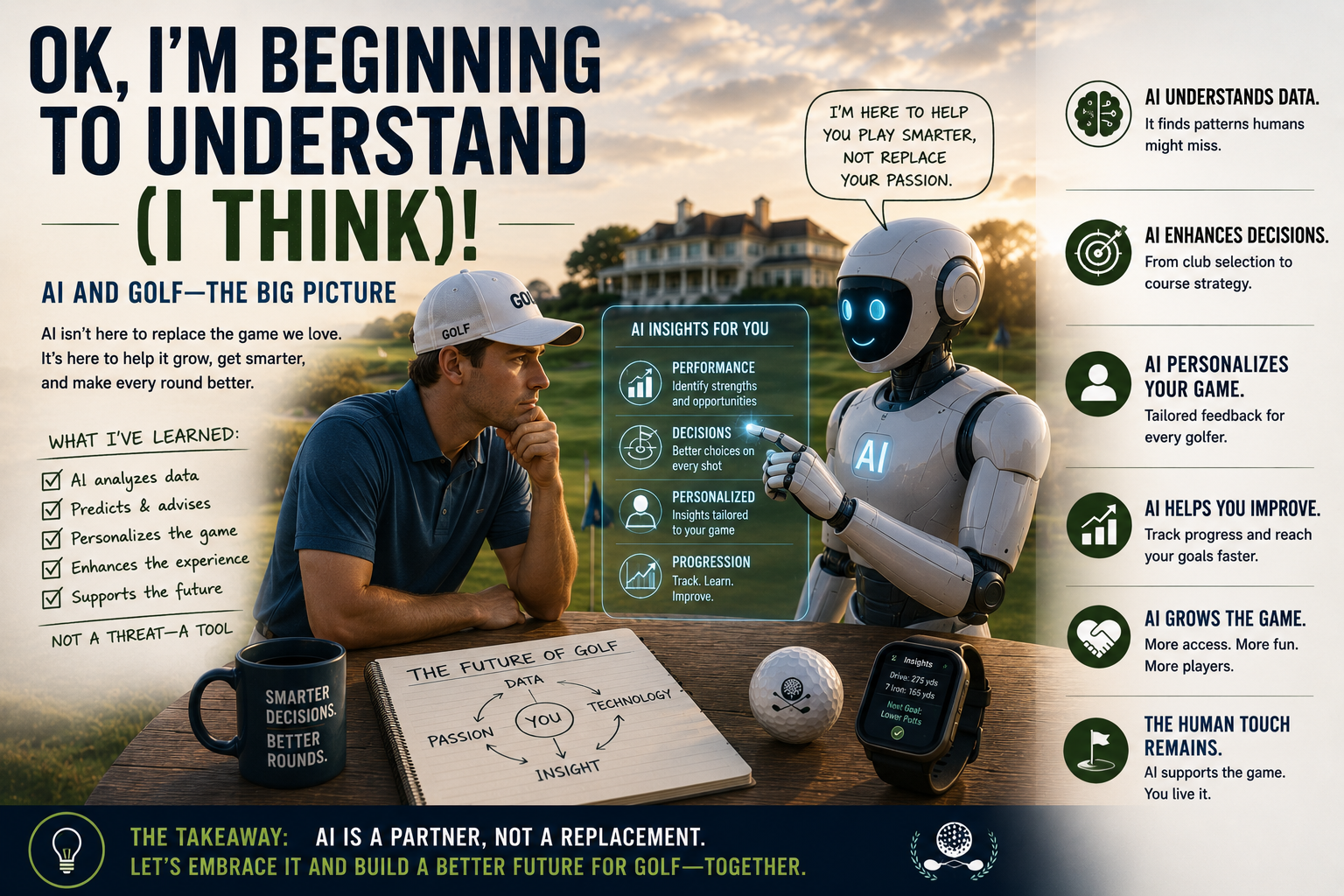
    S: In discussing this blog with others, one common point of confusion often arises: understanding the difference between automation and AI. Getting a handle on this distinction is key to fully grasping how AI will impact the landscape of the golf industry. Therefore, I’ll start by having a chatbot detail what sets the two apart, followed by a real-world example to demonstrate their differences.

    S: What is the difference between automation and AI?

    ChatGPT: Automation and Artificial Intelligence (AI) are both important concepts in the field of technology, but they are fundamentally different and serve different purposes. Here’s a simple breakdown:

    1. Automation: Automation is the use of technology to perform tasks without human intervention. This involves following pre-defined and repeatable rules, and making things more efficient. For example, a car assembly line uses automation to install parts, a smart thermostat might adjust your home temperature based on the time of day, or a software script might be written to sort and organize files on your computer.
    2. Artificial Intelligence (AI): AI, on the other hand, refers to the simulation of human intelligence processes by machines, especially computer systems. It involves learning (the acquisition of information and rules for using the information), reasoning (using rules to reach approximate or definite conclusions), and self-correction. AI is designed to make decisions based on data inputs, often making decisions or identifying patterns that aren’t pre-programmed by developers. AI technologies include machine learning, neural networks, and natural language processing.

    So, while both automation and AI can accomplish tasks without human intervention, the primary difference lies in the complexity and adaptability of the tasks they can accomplish. Automation can perform predefined tasks more efficiently than humans, but it doesn’t learn from experience or adapt to new situations. AI, in contrast, can learn from data and improve its performance over time without being explicitly programmed to do so, enabling it to carry out much more complex tasks.

    It’s important to note that AI can drive automation. This is seen in fields like machine learning where systems can automatically learn and improve from experience without being explicitly programmed. This type of AI-driven automation is referred to as intelligent automation.


    S: In my first blog post “Teeing off with A.I.” ChatGPT suggested AI will have an impact on Course Management and Maintenance. Without going into depth (as we’re still in the early stages of this blog), I’m going to ask a chatbot about the future of golf course lawn and weed maintenance.


    S: Is is possible to kill a weed with a laser?

    Bard: Yes, it is possible to laser a weed to kill it. Laser weeding is a new technology that uses high-powered lasers to target and kill weeds. The laser beam is focused on the weed’s leaves, and the heat from the laser causes the leaves to vaporize, killing the weed.

    Laser weeding is a more precise and environmentally friendly way to control weeds than traditional methods, such as herbicides. It is also more efficient, as it can kill weeds much faster than herbicides.

    There are a number of companies that are developing laser weeding technologies. One company, Carbon Robotics, has developed a self-driving robot that uses lasers to kill weeds. The robot can be used to control weeds in a variety of settings, including farms, golf courses, and roadsides.

    Laser weeding is still a relatively new technology, but it is gaining popularity as a more effective and environmentally friendly way to control weeds. It is likely that laser weeding will become more widely used in the future.

    Here are some of the advantages of using lasers to kill weeds:

    • Precise: Lasers can be used to target weeds very precisely, leaving surrounding plants unharmed. This is important in areas where crops or other plants are growing.
    • Effective: Lasers can kill weeds very effectively. The heat from the laser vaporizes the water in the weed’s leaves, killing the plant instantly. This is much more effective than herbicides, which can take several days or even weeks to kill the weed.
    • Environmentally friendly: Lasers do not release any harmful chemicals into the environment. This makes them a more sustainable option for weed control than herbicides.

    However, there are also some disadvantages to using lasers to kill weeds:

    • Cost: Laser weeding systems can be expensive. This may make them out of reach for some homeowners or small businesses.
    • Training: Operating a laser weeding system requires some training. This may not be an option for people who do not have experience with this type of technology.
    • Weather conditions: Laser weeding systems may not be able to operate in certain weather conditions, such as heavy rain or fog.

    Overall, laser weeding is a promising new technology for weed control. It is more precise, effective, and environmentally friendly than traditional methods. However, it is still a relatively new technology, and there are some limitations to its use.

    S: Do you believe the cost of laser weeding will come down?

    Bard: Yes, I believe the cost of laser weeding will come down in the future. As the technology matures and more companies start to develop laser weeding systems, the cost of these systems is likely to decrease. In addition, as more farmers and other businesses start to use laser weeding systems, the demand for these systems is likely to increase, which could also lead to lower prices.

    According to a recent article in Farm Equipment magazine: https://www.farm-equipment.com/blogs/6-opinions-columns/post/20156-laser-weeding-reduces-weed-management-costs, the cost of laser weeding systems is currently around $100,000. However, the article predicts that the cost of these systems could come down to as low as $50,000 within the next few years.

    The article also cites a study by the University of California, Davis, which found that laser weeding can save farmers up to 80% on weed control costs. This means that even if the cost of laser weeding systems does not come down significantly, farmers could still save money by using this technology.

    Overall, I believe that laser weeding is a promising new technology for weed control. The cost of laser weeding systems is likely to come down in the future, and the technology is becoming more widely adopted by farmers and other businesses. This suggests that laser weeding is a viable option for weed control that could save businesses money and reduce their environmental impact.


    S: Is laser weeding a product of AI?

    Bard: Yes, laser weeding is a product of AI. The AI technology used in laser weeding is called computer vision. Computer vision is a field of artificial intelligence that deals with the extraction of meaningful information from digital images or videos. In the case of laser weeding, computer vision is used to identify weeds from crops. This is done by analyzing the images of the plants using algorithms that have been trained on a large dataset of images of weeds and crops.

    Once the weeds have been identified, the laser weeding system can then target and kill them using a high-powered laser. The laser beam is focused on the weed’s leaves, and the heat from the laser causes the leaves to vaporize, killing the weed.

    The use of AI in laser weeding makes it a more precise and efficient way to control weeds than traditional methods. It is also more environmentally friendly, as it does not require the use of herbicides.

    Here are some of the benefits of using AI in laser weeding:

    • Precision: AI-powered laser weeding systems can target weeds very precisely, leaving surrounding plants unharmed. This is important in areas where crops or other plants are growing.
    • Efficiency: AI-powered laser weeding systems can kill weeds much faster than traditional methods. This can save farmers time and money.
    • Environmentally friendly: AI-powered laser weeding systems do not use herbicides. This makes them a more sustainable option for weed control.

    Overall, AI is a key technology that makes laser weeding a viable option for weed control. It is more precise, efficient, and environmentally friendly than traditional methods. As AI technology continues to develop, laser weeding is likely to become even more widely used in the future.


    S: How can AI driven laser weeding benefit a golf course?

    Bard: There are many benefits to using a laser weeding system at a golf course. Here are a few of the most important ones:

    • Precision: Laser weeding systems can target weeds very precisely, leaving surrounding plants unharmed. This is important in areas where the grass is closely cropped, such as on a golf course.
    • Effectiveness: Laser weeding systems are very effective at killing weeds. The heat from the laser vaporizes the water in the weed’s leaves, killing the plant instantly. This is much more effective than herbicides, which can take several days or even weeks to kill the weed.
    • Environmentally friendly: Laser weeding systems do not release any harmful chemicals into the environment. This makes them a more sustainable option for weed control than herbicides.
    • Safety: Laser weeding systems are safe to use around people and animals. The laser beam is focused on the weed’s leaves, and the heat from the laser does not travel far enough to harm anything else.
    • Cost-effectiveness: The cost of laser weeding systems has been decreasing in recent years. As the technology becomes more widespread, the cost is likely to continue to decrease. This makes laser weeding a more affordable option for golf courses.

    Overall, laser weeding systems offer a number of advantages over traditional methods of weed control. They are more precise, effective, environmentally friendly, safe, and cost-effective. As the technology continues to develop, laser weeding is likely to become even more widely used in golf courses and other settings.

    Here are some additional benefits of using a laser weeding system at a golf course:

    • Improved turf quality: Laser weeding can help to improve the quality of the turf on a golf course by removing weeds that can compete with the grass for water, nutrients, and sunlight. This can lead to a more lush and verdant playing surface.
    • Reduced maintenance costs: Laser weeding can help to reduce the need for manual weed removal, which can save golf courses time and money.
    • Increased customer satisfaction: Golfers appreciate playing on courses that are free of weeds, and laser weeding can help to create a more aesthetically pleasing and enjoyable playing experience.

    S: It sounds like an AI powered laser weeding system married with an automated lawnmowing system will dramatically change the job of a greenskeeper at a golf course.

    Bard: Yes, AI driven laser weeding and automated lawn mowers are likely to dramatically change the job of greenskeepers at a golf course. In the past, greenskeepers were responsible for manually weeding and mowing the golf course. This was a labor-intensive and time-consuming task.

    However, AI driven laser weeding and self-driving lawn mowers can automate these tasks. This means that greenskeepers will no longer need to spend as much time weeding and mowing the golf course. They will be able to focus on other tasks, such as repairing greens and bunkers, or managing irrigation systems.

    In addition, AI driven laser weeding and self-driving lawn mowers can be more precise and efficient than manual methods. This means that they can produce a better quality playing surface, and they can do so with less environmental impact.

    Overall, AI driven laser weeding and self-driving lawn mowers are likely to make the job of greenskeepers more efficient, less labor-intensive, and more environmentally friendly. This could lead to job losses in the short term, but it could also create new opportunities for greenskeepers in the long term.

    Here are some of the ways in which the job of greenskeepers may change in the future:

    • Greenkeepers will need to be more skilled in operating and maintaining AI-powered equipment. This will require them to have a strong understanding of computer science and engineering principles.
    • Greenkeepers will need to be more familiar with data analysis and interpretation. This will allow them to use data from AI-powered equipment to make better decisions about how to manage the golf course.
    • Greenkeepers will need to be more creative in their problem-solving skills. This will be necessary as they adapt to the changing landscape of golf course management.

    Overall, the job of greenskeepers is likely to become more technologically advanced in the future. This will require them to have a different set of skills and knowledge than they do today. However, it will also create new opportunities for them to use their skills and knowledge to make a positive impact on the environment and the game of golf.


    S: What is your best guess as to how far out we are from having a majority of golf courses adopt AI driven laser weeding systems?

    Bard:  It is difficult to say exactly how far away in time we are from having most golf courses implement AI driven laser weeding. However, I believe that it is likely to happen within the next 10-15 years.

    There are a number of factors that will influence the pace of adoption of this technology. One factor is the cost of the technology. As the cost of AI-powered equipment decreases, it will become more affordable for golf courses to implement.

    Another factor is the availability of the technology. As more companies develop and market AI-powered equipment for golf courses, it will become more widely available.

    Finally, the demand for this technology will also influence the pace of adoption. As golfers become more aware of the benefits of AI-powered equipment, they will be more likely to demand that their favorite golf courses adopt it.

    Overall, I believe that AI driven laser weeding is likely to become widespread in the golf industry within the next 10-15 years. The technology has the potential to make golf courses more efficient, less labor-intensive, and more environmentally friendly. As the cost of AI laser weeding technology decreases and the demand increases, I believe that we will see more and more golf courses adopt it.


    S: For all the Marvel fans out there, think of it like this: Imagine the movie Captain America and the Winter Soldier. The mower/laser-weeder would be like a Helicarrier. Instead of targeting certain people and sparing others, as in the movie, the AI in our case would be targeting and eliminating weeds while sparing crops. 🤔


    June 7, 2023

    Stu Healey, President

    Handicomp, Inc.